Wire rod for residential concrete work runs in the 5.5-16 mm diameter window, with HRB400 deformed rebar at US$370-470/ton FOB and Q235/SS400/A36 angle steel at US$450-600/ton FOB on the current Tangshan export book, minimum order 25 tons per mill [S1].
The selection sits between two material families: hot-rolled carbon wire rod for binding ties, mesh, and nails, and low-alloy deformed bar for primary reinforcement. Standard residential practice ties both to GB 1499.2 for rebar and GB/T 701 for plain wire rod, with mill minimum yields at 400 MPa for HRB400 and 235 MPa for Q235.
Grade map: HRB400 rebar versus Q235 wire rod versus low-alloy angle
For slab and beam reinforcement in detached housing, HRB400 deformed bar in 10-16 mm diameters carries the load, and the same 10-16 mm size range is the most quoted SKU on the Tangshan export channel at US$370-470/ton FOB [S1]. For stirrups, column ties, and mesh, plain Q235 wire rod in 5.5-8 mm is the standard choice, drawn down on site to the required gauge.
Q235 grade is widely used for stirrup ties and binding wire because of its low cost and adequate ductility, while HRB400 is reserved for primary flexural members where 400 MPa minimum yield is required. The price spread between the two grades reflects the alloy content and the extra quenching step in HRB400 production. For frame bracing, lintels, and embed plates, cable wire and low-alloy angle steel at US$450-600/ton FOB are the common call [S1].
Diameter window and minimum order economics
Residential rebar orders below 25 tons are rare from Tangshan mills, with every quoted SKU on the Dahao Trade channel carrying the same 25-ton minimum [S1]. Diameter banding matters more than the alloy name on small residential pours: 10-12 mm covers stirrups and slab distribution, 16 mm covers beam bottom bars, and 20 mm or larger usually steps to a different mill SKU outside the residential catalogue.
For a 200 m² two-storey house, the structural rebar order typically lands at 18-30 tons depending on foundation type and seismic zone, so the 25-ton MOQ from Tangshan either fits one house or a small subdivision of 2-3 units. Domestic Chinese rebar prices move in tighter bands than export FOB because shipping, port handling, and currency hedging add a fixed spread of roughly US$40-80/ton over the domestic ex-works price.
Selection criteria by residential application

For foundation and slab: HRB400 12-16 mm deformed bar at 150-200 mm spacing. For columns and beams: HRB400 16-25 mm as primary, HRB400 10 mm as stirrups at 100-200 mm spacing. For walls and partitions: 6-8 mm plain wire rod ties and 4 mm mesh. For embed plates and lintels: Q235 or SS400 angle steel in 50x50x5 to 75x75x8 mm sections. [S1]
The cost-driven decision usually lands on HRB400 for primary members and Q235 for everything else, with the alloy content of HRB400 roughly 0.25% carbon plus manganese and silicon versus 0.20% carbon for Q235. This 0.05% carbon delta drives the 20-30% price premium of HRB400 over plain Q235 wire rod on the same mill book [S1]. Engineers specifying on cost alone will over-spec Q235 in non-primary members and under-spec ductility in seismic zones, a common failure mode in self-built rural housing.
Who wire rod is for, and who it is not for
Wire rod in the 5.5-16 mm range is the right call for single-family residential, low-rise multi-family, and small commercial builds under 6 storeys. It is not the right call for high-rise shear walls, which require HRB500 or higher grade, nor for bridge decks or marine structures where epoxy-coated or stainless-clad bar is mandatory. [S1]
For buyers outside China, the FOB Tangshan price of US$370-470/ton for rebar and US$450-600/ton for angle steel must be uplifted by US$60-120/ton for ocean freight to Southeast Asia, the Middle East, or Africa, and US$120-180/ton to North America or Europe [S1]. This puts delivered residential rebar at roughly US$430-590/ton in nearby markets and US$490-650/ton in distant markets, before tariffs and port duties.
Failure modes and inspection gates
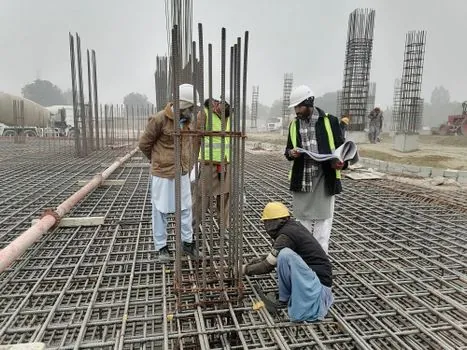
Three common failure modes show up on residential jobs: undersized diameter (rebar labelled 12 mm but measured at 10.5 mm), poor rib geometry on HRB400 that drops bond strength at the concrete interface, and weld defects when low-grade Q235 is substituted for HRB400 at column splice points. On-site caliper checks at 5-10% sample rate, plus mill test certificates for yield, ultimate, and elongation, are the standard mitigation.
Storage and handling on residential sites also drive failure: wire rod stored in standing water develops red rust that reduces section by 0.1-0.3 mm over a 3-month exposure window. Mill scale on hot-rolled rod is normal and does not require sandblasting, but pitting corrosion from chloride exposure does. Site engineers should reject coils with visible pitting beyond 0.2 mm depth regardless of mill cert.
Sourcing channels and verification
Direct mill purchase from Tangshan, Hebei, requires a 25-ton minimum and a mill booking 30-45 days ahead, with payment terms typically 30% T/T deposit and 70% against B/L copy. Trading houses can supply smaller lots at 8-15% premium over FOB but carry the same mill cert. Verification of mill cert, heat number, and third-party SGS or BV inspection is standard on export orders above 100 tons [S1].
For buyers comparing mill offers, the reliable signal is the mill test certificate traceable to the heat number, the actual measured rib height on HRB400 samples (typically 0.7-1.0 mm for 12 mm bar), and the bend test result at 180 degrees over a 3d mandrel. A mill quoting below US$370/ton FOB for HRB400 12 mm is a red flag, as the steel content alone does not support the price [S1].
Comparison: HRB400 rebar vs Q235 wire rod vs low-alloy angle
On four decision criteria, the three materials line up as follows. Cost: Q235 lowest, HRB400 mid, angle steel highest. Yield strength: HRB400 at 400 MPa minimum, Q235 at 235 MPa minimum, angle at 250-275 MPa depending on grade. Typical use: HRB400 for primary reinforcement, Q235 for ties and mesh, angle for embed and frame. Ductility: Q235 highest elongation at 26% min, HRB400 at 16% min, angle at 23% min. FOB Tangshan price bands sit at US$370-470/ton for HRB400, lower for Q235 wire rod, and US$450-600/ton for angle [S1].
Engineers selecting on a single criterion usually get burned: lowest cost drives Q235 substitution in primary members and brittle failure under seismic load, while highest strength drives HRB500 over-spec and unnecessary cost in slab distribution. The right residential mix is HRB400 for beams, columns, and slabs, Q235 for ties, and angle for embed plates and lintels. Buyers in adjacent heavy-construction segments can also reference truck crane selection for road construction: 1-160 t size map for the lifting side of the same project, or air impact wrench spec map for bridge construction bolting for the bolting side of the structural steel package.
Trackable signals for the next 90 days: Tangshan mill order book depth, FOB price moves outside the US$370-470/ton rebar band, and any domestic China steel export rebate changes that would shift the export FOB floor. Another trackable node is the GB 1499.2 periodic revision cycle, which historically moves HRB400 minimum yield requirements in 50 MPa steps every 5-7 years.
Component reference pages worth checking: draw wire sensor.
