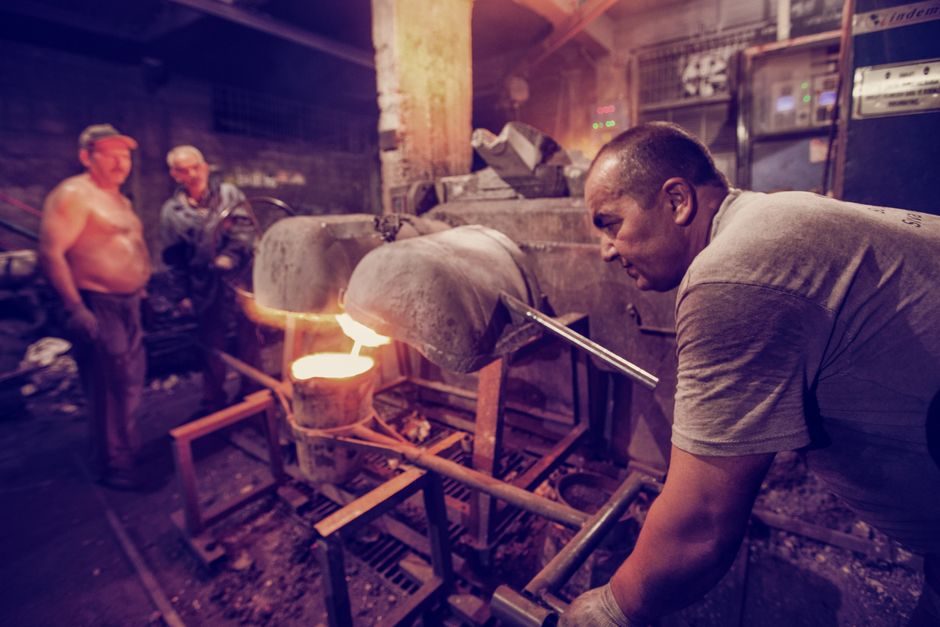
A cold chamber die casting machine is the standard configuration when the melt attacks iron-based components: molten aluminum, magnesium and copper alloys are ladled into the shot sleeve from an external furnace rather than drawn through an integrated gooseneck, which keeps the iron/steel shot cylinder, plunger tip and gooseneck out of continuous contact with the liquid metal [S2][S6].
Yizumi's HII-S series covers the 1000-5000 ton clamping range with a re-engineered toggle system, optimized hydraulic drive, modular HPM technology input, and an HMI integrated in the operation panel for process data display [S1]. Bengbu Long Hua supplies a parallel line from 120 T to 1300 T, with peak-season lead time of one month and off-season delivery within 15 working days, indicating that small-tonnage cold chamber units remain a stocked catalog item rather than a build-to-order project in China [S3].
Alloy Fit and Process Boundaries
Cold chamber architecture is the only viable option for alloys whose melt chemistry erodes a hot-chamber gooseneck: aluminum, magnesium, copper and brass alloys are the four commonly die-cast alloy families because their density, melting point, strength, corrosion resistance and liquid flow characteristics govern the cast [S6].
Aluminum and copper melt temperatures sit well above the safe continuous-immersion limit of a hot-chamber gooseneck, so the cold-chamber design — where the shot cylinder is filled externally per cycle — defines the upper bound of die casting machine capability for structural and high-temperature alloys [S2][S6]. Within that envelope, the aluminum die casting machine class is the volume leader in cold-chamber production globally.
Where the Cold Chamber Wins
Higher specific injection pressure and faster plunger acceleration are the headline advantages: Yizumi cites significantly increased casting precision, reduced pressure build-up time, top-line acceleration, and international-level process repeatability from the HII-S hydraulic and toggle design [S1]. Cycle time is shortened by the optimized hydraulic drive, which the manufacturer links to lower energy consumption per shot [S1].
Modular machine design with HPM technology input increases machine stability, and individually tested machine modules held in inventory allow fast delivery of complete machines to customers [S1]. For a 200-500 T shop looking for a smaller-format cold chamber, Lanson publishes a 200 T to 500 T small-die-casting range as a stocked, non-custom product. At the upper end, structural castings — automotive knuckles, subframes, gearbox housings, EV battery trays — lean on the cold-chamber machine class precisely because shot weight, intensification pressure and locking tonnage exceed what any hot-chamber design can deliver.
Where the Cold Chamber Costs You
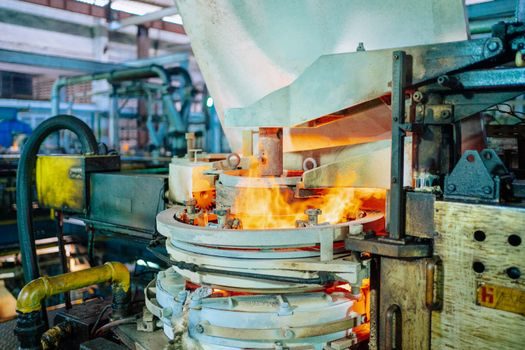
The architecture is mechanically honest about its trade-offs. A separate furnace and ladle per cell means floor space, holding-bath temperature control, and an extra handling step between melt and shot sleeve; the shot sleeve advantages and disadvantages reference frames this ladling interface as the dominant wear and downtime node. Operators also lose the sub-second cycle advantage of a hot-chamber machine, because each cold-chamber cycle includes the ladle transfer and shot-cylinder refilling step that a gooseneck-fed machine skips. [S1]
Higher clamp tonnage drives up machine cost, foundation requirements, and energy per shot; the shot sleeve TCO reference notes that downtime, lube consumption, cooling water and sleeve life are the four variables that drive 5-year spend on a cold-chamber cell. Magnesium die casting machine cells add the additional overhead of cover-gas atmosphere handling, which is a hard prerequisite for melt protection but does not change the cold-chamber injection path itself.
Selection Criteria: Cold vs Hot vs Vacuum
Three cold-chamber variants are typically evaluated head-to-head: standard cold chamber, hot chamber, and vacuum-assisted. The decision usually comes down to alloy, part geometry, and inclusion tolerance. [S2]
Standard cold chamber handles the broadest alloy range — aluminum, magnesium, copper, brass — at the cost of higher entrapped-air risk in thin-wall castings; vacuum die casting machine cells evacuate the shot sleeve before intensification specifically to suppress porosity in safety-critical structural parts. Hot-chamber machines win on cycle time and energy per shot for zinc and low-melt alloys, but are ruled out once melt temperature exceeds the gooseneck-material limit. Gravity die casting machine cells sit outside this comparison as a lower-pressure, non-injection alternative for larger simpler geometries.
Lanson's catalog breaks the cold-chamber line into aluminum, magnesium and copper machines, indicating that vendors already segment the cold-chamber product line by alloy, not by tonnage alone [S4]. Small-tonnage shops (200-500 T) buy a different machine than a structural-part foundry running 1000-5000 T, but the underlying cold-chamber process is the same [S1].
Real Production Footprint
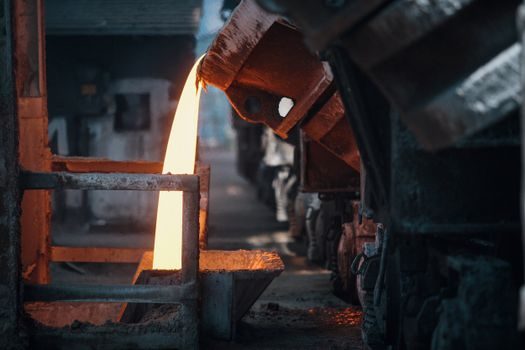
SYX Die Casting runs 8 cold chamber die casting machines for custom aluminum alloy parts under ISO 9001 and IATF 16949 certification, illustrating that a mid-size Tier-2 or Tier-3 supplier typically standardizes on cold-chamber cells rather than mixing architectures. [S3]
Bengbu Long Hua lists FOB and CIF as standard Incoterms, with LC, T/T and D/P as accepted payment terms and an average response time of ≤1.24 h on Made-in-China.com — a sourcing-baseline datapoint for procurement teams benchmarking Chinese cold-chamber OEMs [S3]. Lanson positions its cold-chamber line as designed and manufactured according to international standards, blending the latest technology with operational experience, and publishes the same claim for plastic injection molding and die-casting machine categories [S4][S5].
Failure Modes and Operating Constraints
Plunger tip and shot sleeve wear dominate the maintenance schedule because each cycle introduces a fresh ladle of melt into the cold sleeve; thermal cycling is more severe than on a hot-chamber machine, where the sleeve is held at temperature continuously. Oil-hydraulic intensifier systems must hold specific injection pressure band per alloy — too low and the part short-shots or porosity rises; too high and flash, die deflection and accelerated tool wear follow. [S4]
Safety standards cited by HII-S designs are described as the "highest safety standards" with HMI-supported technology data display and integrated hydraulic safety logic, but the manufacturer does not publish a specific EN 415 or ANSI B11.19 clause map in the product literature [S1]. Buyers specifying European automotive structural parts should still validate CE conformity, EN 415 machine safety, and any press-safety directive applicable to the installation country rather than relying on the OEM's general claim.
Sourcing Signals Worth Tracking

Two trackable signals stand out for the next procurement cycle. First, Chinese OEMs continue to segment the cold-chamber line by alloy (aluminum, magnesium, copper machines sold as distinct catalogs) rather than collapsing them into a single platform, which means an aluminum shop and a copper shop will end up with two different machine SKUs even at the same tonnage class [S4]. Second, the small-tonnage 200-500 T cold-chamber product is published as a stocked, off-the-shelf item by at least one major Chinese OEM, with peak-season lead time of one month and off-season delivery within 15 working days [S3]. Buyers should treat that lead-time band as the baseline for 2026 sourcing decisions, and assume anything above 800 T will slip toward a custom build slot.