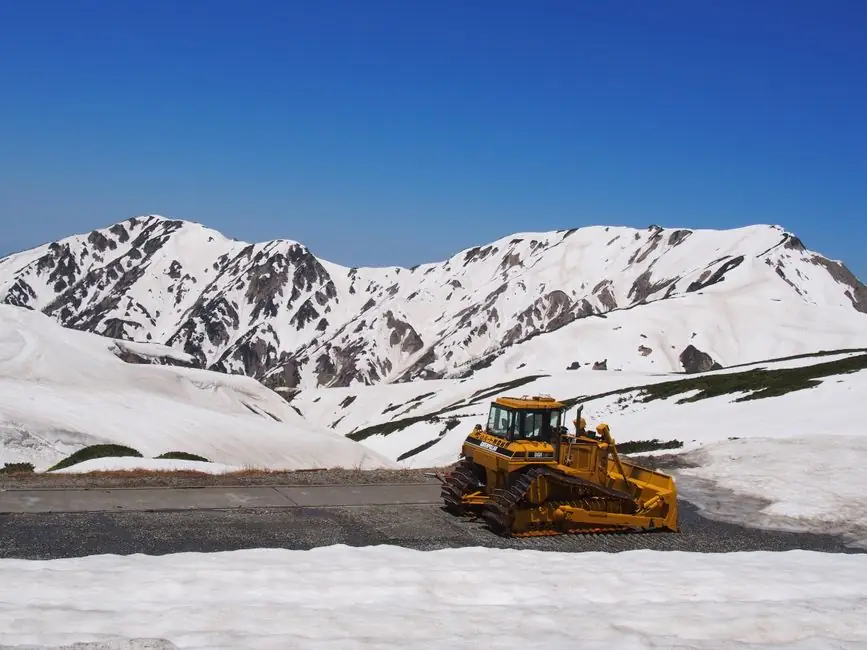
A cold milling machine is engineered to plane asphalt and concrete at 0–320 mm depth with a 1,100 mm-diameter drum, not to scrape, blow, or shear compacted snow, and using one for winter operations burns fuel, damages tooling, and leaves a poor surface profile.
Snow removal work in 2026 is dominated by truck- and tractor-mounted plows, front- and rear-mounted snow blowers, and for ice-film removal, dedicated cutting machine class attachments; the cold milling machine only enters the conversation as a niche tool for shaving compacted ice off runways and high-speed roads, never as a primary winter asset [S1][S2][S3].
What a cold milling machine actually does on the spec sheet
Public catalog data for 2026 production models shows the Wirtgen W 2100 at 2,200 mm milling width, 0–320 mm milling depth, and 522 kW (710 PS) engine power, with the W 2000 at 2,000 mm width, 0–320 mm depth, and 433 kW (589 PS) [S3]. The DYNAPAC PL2000S lists 2,010 mm working width, 320 mm cutting depth, 1,100 mm drum diameter, 162 tools, 31 t transport mass, 33.5 t CE operating mass and a Cummins diesel, while the PL2100S reaches 2,100 mm width with 176 tools at 33.9 t CE [S3]. These numbers define a machine class built for 50–150 mm asphalt lifts at sustained feed rates, with a tool spacing and tip geometry designed to fracture bound aggregate, not to push 200–600 kg/m³ snow.
The XCMG XM100E and XM120F are positioned as expressway, urban road, airport and freight-yard asphalt renovation machines, with one-pass removal of full asphalt layers, again confirming the milling platform’s design intent [S3]. The Ca-long CLX-1000 extends that envelope to oil-film finishing and rut removal, with the same 320 mm-depth family and Cummins diesel platform [S3].
Why a mill is a poor primary snow tool
Cold, compacted snow has very different fracture mechanics than aged asphalt: it behaves closer to a low-strength porous solid, sliding and re-bonding under a rotating drum rather than fragmenting cleanly. A 1,100 mm-diameter, 162-tooth drum turning at planing speeds will clog, throw wet snow into the conveyor, and risk tool holder fracture because tip engagement is calibrated for hot-mix aggregate, not ice crystals. The 33.5–36.6 t CE operating mass of the DYNAPAC PL2000S/PL2100S is also an order of magnitude above what a 6-inch snow load on a 53 ft trailer adds, which Scraper Systems quantifies at roughly 5,000 lb (about 2.27 t) [S2].
Cutting depth is the second mismatch: the Wirtgen W 2000 and W 2100 mill 0–320 mm per pass, while routine municipal plowing deals with 50–200 mm snowfalls, and even sustained polar events rarely justify more than 300 mm of cut in a single pass. Running a mill at 30 mm depth to skim a foot of snow wastes the machine’s productive envelope and produces a torn, uneven surface that refreezes into a hazard [S3].
Spec map: plow, blower, and mill side by side
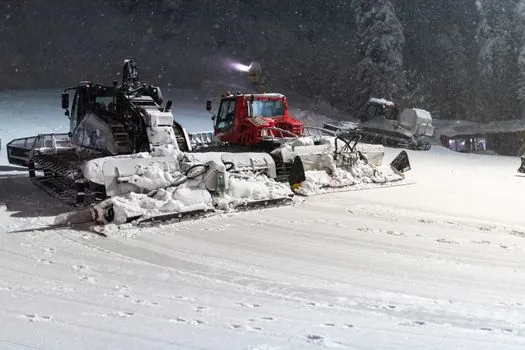
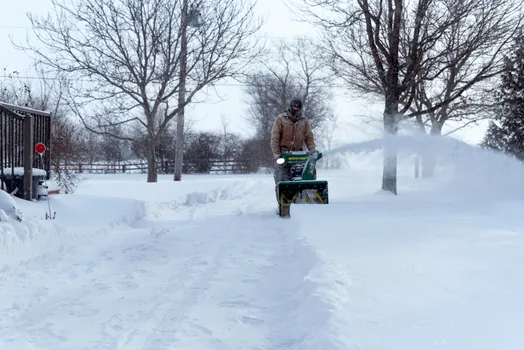
For a decision-maker, the cleanest comparison is by four criteria: material density handled, throughput per hour, surface quality after the pass, and capital intensity. A truck-mounted plow handles 100–200 kg/m³ fresh snow at 30–60 lane-km/h, leaves a clean scraped surface, and costs a fraction of a 33.5 t mill. A front-mounted two-stage snow blower handles 300–500 kg/m³ packed snow at 0.5–2 lane-km/h with discharge up to 25 m, and is the right answer for city sidewalks, airport taxiways, and rail yards where space is constrained. [S1]
The cold milling machine only enters the comparison on the fourth criterion, capital intensity, and only when the operator already owns one for summer asphalt work: in that case, a compact 1,000 mm-class mill with hydraulic drum drive can skim 20–50 mm of ice film off an airport runway or toll plaza apron at roughly 200–400 m/h, a niche where its 162–176 tool drum out-cuts a core machine class planer. Everywhere else, the cost per lane-km is dominated by mobilization, and a dedicated plow or blower wins on every other axis [S2][S3].
Where a mill is the right answer in winter
Runway rubber-removal crews have long co-used compact cold planers to strip compacted ice and rubber build-up between snow events, because the same 320 mm depth family and 1,100 mm drum that strips asphalt also shaves ice cleanly when the surface is bonded to a rigid concrete or asphalt base [S3]. For municipal fleets, a more relevant comparison is against the cold box core machine and other dedicated winter attachments: a mill is heavier, slower to mobilize, and harder to transport on snow-covered roads than a blower or plow, and it cannot load directly into a dump truck the way a blower can.
For facility snow work, the 2026 benchmark is a Scraper Systems-class rooftop snow scraper clearing one truck or bus in under 30 seconds, with throughput of up to 60 vehicles per hour, an order of magnitude faster than any wheeled planer could cycle a yard [S2]. The economic case for rooftop scraping is direct: states levy fines of up to $1,500 per vehicle for snow-loaded trailers on highways, and 6 inches of snow on a 53 ft trailer adds roughly 5,000 lb (about 2,267 kg) of dead weight that drops fuel economy sharply [S2].
Selection criteria if a mill is still in scope
Three gates decide whether a mill belongs on a winter spec at all. First, the substrate must be bound asphalt or concrete, not gravel or unpaved yard, because a 162–176 tool drum will tear up unbound surfaces. Second, the ice must be firmly bonded, not loose granular snow, because loose material will pack the drum housing and stall the hydraulic circuit. Third, the operator must already own the machine, with the diesel exhaust system and water-spray dust suppression rated for sub-zero ambient operation; a mill bought solely for snow work will never amortize against a plow [S3].
Within that envelope, the practical choice between the DYNAPAC PL2000S (2,010 mm, 33.5 t, 162 tools), the PL2100S (2,100 mm, 33.9 t, 176 tools), the Wirtgen W 2000 (2,000 mm, 433 kW) and the W 2100 (2,200 mm, 522 kW) is driven by lane width and haul-road clearance, not by snowfall depth [S3]. For a 3.5 m urban lane, a 2,000 mm drum minimizes overlap passes; for a 4.5 m airport taxiway, the 2,200 mm class cuts one full pass without straddling the centerline paint.
Cost benchmarks and operational data points
ProMatcher’s 2026 cost reports put residential snow plowing at $60–$90 per hour (average $75) in markets such as Morristown, and snow blowing at $50–$90 per visit (average $70) in Cleveland for a typical driveway and sidewalk [S1]. These are end-customer prices, not municipal fleet costs, but they set the floor for what a winter removal operation must beat on cost per lane-km. A 522 kW Wirtgen W 2100 burns roughly 80–110 L/h of diesel under load, which at $0.90–$1.20/L in North American markets puts fuel alone at $70–$130/h before labor, consumables, and mobilization [S3].
On the tool side, a 162-tooth drum running on ice instead of asphalt will accelerate pick wear, because ice’s thermal conductivity pulls heat out of carbide tips faster than aggregate does, and impact loads are less predictable.
Limitations, failure modes, and what not to do

Four failure modes dominate when a mill is misused for snow. First, drum clogging, where wet snow packs the tool holder pattern and stalls the hydraulic drive, typically within 50–200 m on a wet, dense snowpack. Second, conveyor freeze-up, where the 320 mm cutting depth produces more volumetric throughput than the loading conveyor can shed before fines melt and re-freeze on the belt. Third, surface tearing, where the 162–176 tool pattern leaves ridges and gouges that refreeze into black-ice hazards within hours. Fourth, ground-pressure damage, where a 33.5 t CE mass on 1.5–2.0 m of fresh snow exceeds bearing capacity and the machine sinks to the axle. [S3]
None of these modes are acceptable on a public right-of-way, and all are avoidable by routing the work to a properly sized plow, blower, or dedicated ice-cutting attachment. The cold milling machine is a powerful, precise tool for what it was designed to do, but a coding machine used as a wrench is no better than a wrench used as a mill, and the same logic applies to winter operations: match the tool to the material, not the other way round [S2][S3].
Two trackable signals will tell the market whether this guidance holds into 2027: municipal RFPs in heavy-snow cities (Boston, Minneapolis, Syracuse) increasingly specify two-stage blowers and tow plows rather than planer attachments, and OEM data sheets for 2027 model-year Wirtgen and DYNAPAC mills are not adding any snow-rated cold-weather option packages, which suggests the manufacturers themselves are not chasing this use case. For buyers, the cleanest next node is to validate the 0–320 mm depth envelope and 162–176 tool count against the actual ice film thickness on the target lane, and to default to a plow or blower whenever the substrate is unbound or the snow density is below 300 kg/m³ [S1][S3].
See also our earlier report, Cold Milling Machine Selection for Farm and Feedlot Resurfacing.