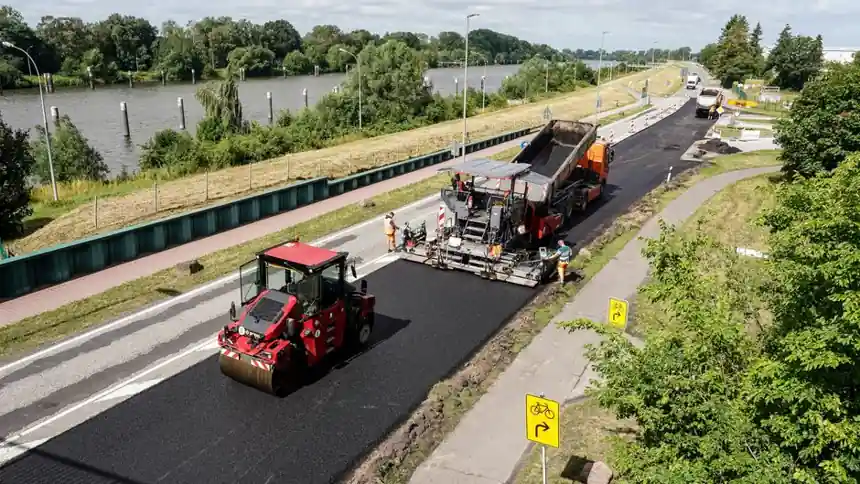
A compact cold milling machine in the 0.5-2.0 m drum-width class, paired with a dust extraction unit and a discharge conveyor sized to the cut width, is the default specification for night-shift urban asphalt rehabilitation contracts.
The same cold milling machine family also covers micro-milling drums (8-12 mm tooth spacing) for thin-lift surface texturing and full-depth removal drums (15-18 mm spacing) for pavement recycling, which is why procurement teams usually evaluate cutter-drum geometry before horsepower.
Working width, drum diameter, and the 100-500 hp class
Working widths in urban fleets cluster into three practical bands: 0.35-0.5 m for trenching and patch work around manholes, 1.0-1.2 m for lane-width removal on arterial roads, and 1.5-2.0 m for full carriageway passes on highways and runway rehabilitation [S2][S5].
Drum diameter typically scales 600-1500 mm with working width, and threefold tooth rotation around the drum gives linear tooth spacing of 8 mm (micro), 12-15 mm (standard fine), or 15-18 mm (standard coarse) for material between 30-300 mm cut depth. A 1.0 m drum at 15 mm spacing carries roughly 80-100 carbide picks, and pick consumption is a real line item at 0.3-0.5 picks per square meter on asphalt concrete.
For compact half-lane planers in the 100-300 hp band, total operating weight sits in the 13-22 t window with a front-loading conveyor rated around 150-300 t/h discharge, which has to be matched to the milling output in tonnes per hour or the machine will stall in front of the waiting truck [S2].
Cutter types, picks, and abrasive wear budget
Standard fine-milling picks (round-shank, 20-22 mm shank) are specified for hot-mix asphalt, while micro-picks (smaller shank, higher tip count) are specified for thin-lift texturing where a 0.8-1.2 mm peak-to-valley surface profile is required before an ultra-thin overlay.
Standard picks use a tungsten carbide tip brazed to a steel body, and the holder block threads or welds to the helical flighting of the drum. Pick wear is dominated by the abrasive aggregate, not the bitumen matrix, which is why reclaimed asphalt pavement (RAP) with high silica content can push pick consumption above 0.5 picks/m^2 even on a machine that would normally run 0.2 picks/m^2 on fresh dense-graded asphalt.
Drum rotation speed is usually 100-180 rpm with a 0-30 m/min travel speed range, and engine load goes up roughly linearly with travel speed at a given cut depth, so the operator's productivity lever is cut depth, not drum rpm. Halving cut depth roughly halves fuel burn per square meter in published Wirtgen-style application data, and that is the variable the foreman actually controls.
Engine, emissions, and Tier 4 / Stage V compliance

Modern urban planers in the 100-500 hp class are specified with diesel engines meeting US EPA Tier 4 Final or EU Stage V emissions, which means a diesel particulate filter (DPF), diesel oxidation catalyst (DOC), and selective catalytic reduction (SCR) with AdBlue/DEF dosing on the larger 300-500 hp units. [S1]
DPF regeneration cycles matter for night-shift urban work: passive regeneration requires sustained exhaust temperature above roughly 250-350 degrees C, and many city contracts idle the machine during truck change-outs, which forces periodic active (parked) regeneration. Procurement teams writing municipal specifications should require regeneration-clearance under the operator's cab and around any combustible dust or asphalt fines.
For indoor or tunnel work, electrically driven milling prototypes have appeared in the 100-150 kW class with a trailing cable or battery pack, but they are not yet mainstream procurement items and most urban tenders still default to diesel Stage V with a water-spray dust suppression system.
Dust suppression, water, and conveyor matching
Water-spray dust suppression is a contract requirement on most European city tenders, with typical spray bar flow rates of 20-60 L/min fed from an on-board 800-1500 L water tank, and the operator is supposed to keep the dust plume below the visible threshold at the cutter housing. [S2]
The discharge conveyor is specified as a folding or slewing design with a belt width of 500-800 mm and a discharge height around 3.5-4.5 m to clear a standard dump truck sidewall. Belt speed is roughly 1.0-1.6 m/s and the throughput must exceed milling throughput, otherwise the milled material backs up at the drum housing and re-milling efficiency drops.
A cold milling machine doing 200 t/h of milled material but feeding a 150 t/h conveyor is a common mismatch, and it is one of the first things a senior operator checks when a new machine arrives on site: the conveyor is the bottleneck, not the drum.
Grade control, automation, and 3D milling
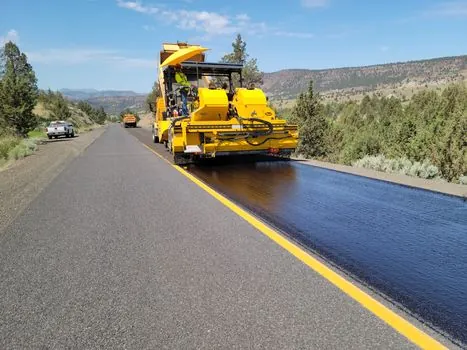
Two-dimensional grade control is now standard on most compact planers, with sonic or mechanical sensors referencing the existing pavement or a string line, and a hydraulic cylinder on each track keeping the cut depth within plus or minus 5 mm of the target.
Three-dimensional milling, using GNSS (typically GPS plus GLONASS or BeiDou, with RTK corrections giving 10-20 mm absolute vertical accuracy) or a total-station referenced to a design surface model, is specified where the milled surface is the final riding surface before a thin overlay, such as on airport runways or motorway surface-dressing preparatory contracts.
Onboard weighing and telematics log tonnes milled, square meters covered, fuel burn, and pick consumption, and most OEM telematics APIs (Wirtgen, Caterpillar, BOMAG, Dynapac) now push this data to the contractor's fleet management system at the end of every shift, which means a procurement team can write a contract clause for a target m^2 per liter fuel figure and check it from the office the next morning.
Selection criteria summary for urban tenders
For typical urban asphalt rehabilitation, the decision matrix reduces to six numbers: working width (0.5, 1.0, or 2.0 m class), operating weight (must stay under the bridge posting or road classification limit, often 13-22 t), engine emissions tier (Tier 4 Final / Stage V), water tank capacity (above 1000 L for a full shift), conveyor discharge height (clears the truck fleet), and grade control level (2D standard, 3D for thin-overlay prep). [S1]
Three options line up against these criteria: a 0.5 m / 100-150 hp compact planer for patch work, a 1.0-1.2 m / 200-300 hp mid-size planer for lane-width removal, and a 1.5-2.0 m / 400-500 hp large planer for full carriageway or runway work, with the 1.0-1.2 m class dominating European municipal procurement because it fits one truck lane and can work between parked cars in night shifts.
Track-versus-wheel configuration is a separate choice: tracked machines give lower ground pressure (typically 30-50 kPa for the 13-22 t class) and better stability on milled surfaces, while wheeled machines offer higher road speeds between sites (up to 10-15 km/h) for contractors that move between small urban patches daily.
Contractor economics and total cost of ownership

Total cost of ownership is dominated by pick consumption (around 5-10 percent of operating cost), diesel fuel (30-40 percent), and machine depreciation plus financing (35-45 percent), and labor is a smaller share than on most other site equipment because one operator and one groundsperson run a typical compact planer. [S3]
Hourly productivity in the field runs 80-300 m^2/h depending on cut depth, asphalt hardness, and machine class, and a 1.0 m planer at 50 mm average cut depth typically delivers 150-200 m^2/h on dense-graded asphalt, which is the figure most contractors use to back-calculate a tender price per square meter.
For context on matching support equipment, contractors pairing planers with compact loaders can reference the Skid Steer Loader Selection for Agriculture spec map, which covers rated operating capacity and hydraulic flow for the loader class that usually feeds the milling train.
For procurement teams writing fresh urban-rehabilitation specifications, the next trackable signals are: local low-emission zone rules tightening access for non-Stage V machines, and the gradual arrival of 3D-milled surface specifications as standard for thin-lift asphalt overlays, both of which will pull specifications toward higher-tier 3D-ready machines in the 1.0-2.0 m class.
Detailed specification references: cold chamber machine, and cold box core machine.