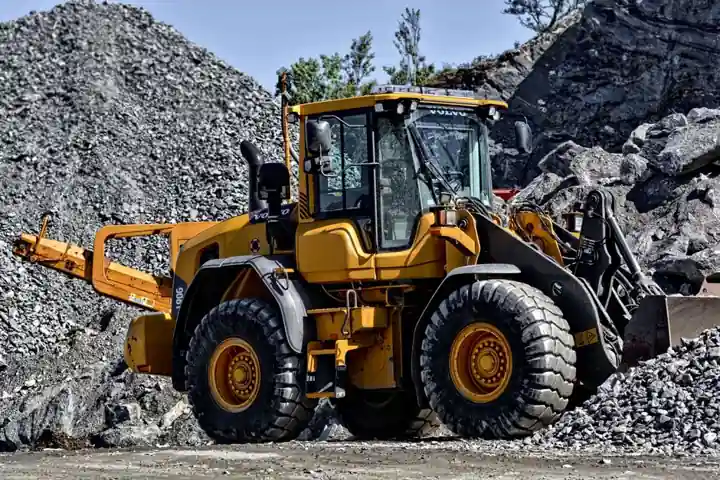
Selecting a skid steer loader for farm work is a duty-cycle decision, not a brand decision: the operator must match Rated Operating Capacity (ROC) to the densest routine load, hydraulic flow to the most demanding attachment, and frame type (wheeled or compact-track) to the wettest or softest ground on the property [S1][S4].
Across the surveyed specification range, agricultural duties cluster in the 700–1,100 kg ROC band with 60–80 L/min standard hydraulic flow, while high-flow options of 95–110 L/min (and 120–150+ L/min on heavy frames) become mandatory when the same machine has to drive a bale processor, feed mixer, or silage defacer [S1]. Engine power in the agricultural sweet spot lands at 60–90 HP, with operating weight typically 2,800–4,200 kg [S1].
Step 1: Match ROC to the Densest Material You Will Lift
Rated Operating Capacity is the single most important number on a farm skid steer spec sheet, defined at 50% of tipping load and acting as the hard ceiling for safe, stable lift [S1]. The dominant global ROC segment of 1,251–2,000 lbs (570–910 kg) covers the majority of construction, landscaping, and agricultural material handling, so a machine rated inside that window handles typical manure, silage, and round-bale work without strain [S1].
Material density is the variable most often underestimated on the farm: wet concrete weighs about 2,300 kg/m³, compacted clay about 1,750 kg/m³, dry sand about 1,520 kg/m³, and topsoil 950–1,200 kg/m³, which means a 0.4 m³ bucket of wet concrete carries nearly 1,000 kg and immediately stresses a light-duty frame [S1]. A working rule used by procurement engineers is to identify the heaviest routine load, then choose a machine with at least 20% ROC headroom above it, so dynamic loading during travel or dump does not push the lift into the tip-over envelope [S1].
Step 2: Wheeled vs. Compact-Track Frame for Ground Conditions
Wheeled skid steers account for approximately 56–58% of the global market and remain the right call on finished or paved yards, in barn aisles with concrete floors, and around grain-handling infrastructure where track abrasion on sealed surfaces is unacceptable [S1]. They are faster on hard surfaces and noticeably cheaper to maintain than a tracked equivalent, with tire replacement the main service line.
Compact track loaders distribute machine weight over a much larger footprint, dropping ground pressure to a fraction of a wheeled machine's value, which is exactly what is needed on soft, muddy, or uneven terrain, including winter paddock work, silage clamp faces, and freshly tilled headlands [S1]. For mixed farms that work both concrete and dirt, the decision usually comes down to which surface the machine spends more hours on, because operating cost per hour is governed by undercarriage wear, not sticker price. For a side-by-side spec map covering highway and shoulder grading duties, see the road-construction selection guide.
Step 3: Hydraulic Flow and High-Flow Options
Standard hydraulic flow of 45–60 L/min covers buckets, light forks, and basic post-hole augers on light-duty frames, while mid-range machines deliver 60–80 L/min and heavy-duty frames push 80–120 L/min, which is the threshold at which the same machine can run brush cutters, rotary tillers, and small trenchers without bogging [S1]. High-flow options open up the more demanding agricultural attachments: 95–110 L/min on mid-range units, and 120–150+ L/min on heavy-duty units, the latter needed for feed mixers, large bale processors, and high-capacity snow blowers used in dairy operations [S1].
Many mid-range and heavy-duty models also include hydraulic coolers as standard, which is a genuine requirement for continuous loader work in warm climates or for prolonged attachment duty cycles, because standard-flow circuits without active cooling derate quickly under sustained load [S4].
Step 4: Lift Path Geometry and Bucket Capacity
Lift path geometry matters as much as ROC on a farm: vertical-lift machines reach higher hinge-pin heights for loading mixer wagons and high-sided dump trailers, while radial-lift machines deliver higher breakout force at ground level for digging and prying in compacted manure or silage [S5]. Bucket capacity typically scales with frame size from roughly 0.4 m³ on light-duty units to 0.8 m³ and above on heavy-duty frames, and the right bucket should be sized to the ROC, not the other way around [S1].
For a general overview of the broader skid steer category, including ROC definitions and engine-power interpretation across all duties, the skid steer loader encyclopedia entry lays out the canonical spec structure used by most OEMs. New Holland's L-series shows how the lift-capacity curve scales within one OEM's lineup: the L316 delivers 1,600 lbs ROC at 60 HP, the L320 reaches 2,000 lbs ROC at 67 HP, and the L321 climbs to 2,100 lbs ROC at 70+ HP, with operating weights rising from 5,370 lbs to 6,970 lbs across the three models [S8].
Step 5: Who Should and Should Not Buy a Skid Steer

A skid steer is the right primary tool for a farm that needs a single compact machine to feed livestock, clear manure, move round bales, handle palletized feed, and clear snow, especially where the operator must pivot inside narrow barns and gateways where a standard tractor with its larger turning radius simply will not fit [S4]. It is also a good fit for mixed operations that already own a row-crop tractor, because the skid steer complements, rather than replaces, the tractor's higher field speeds and three-point-hitch implements.
A skid steer is the wrong primary tool for farms that need sustained tillage at depth, continuous row-crop fieldwork, or heavy PTO-driven implements, where a utility tractor or a compact wheel loader (see the wheel loader encyclopedia entry for the larger-frame comparison) is a more cost-effective match. The same logic applies to operations whose heaviest lifts exceed about 1,600 kg or whose reach requirements exceed a skid steer's hinge-pin height: a telehandler or a backhoe loader typically wins on lift height and roading speed.
Comparison of Common Agricultural Skid Steer Configurations
The table below lines up the three common ROC bands against the four decision criteria that drive agricultural selection: typical farm duty, engine power, standard hydraulic flow, and frame recommendation [S1].
Light-duty (<700 kg ROC, 40–60 HP, 45–60 L/min): best for smallholdings doing light manure handling, bucket work, and pallet feed, almost always specified on a wheeled frame. Mid-range (700–1,100 kg ROC, 60–90 HP, 60–80 L/min with optional 95–110 L/min high-flow): the agricultural sweet spot, suitable for round bales, silage, and most powered attachments, frame choice depends on ground. Heavy-duty (>1,100 kg ROC, 90–130+ HP, 80–120 L/min standard, 120–150+ L/min high-flow): required for large square bales, feed mixers, and continuous heavy-attachment duty, almost always on a tracked frame when the ground is soft [S1].
Spec libraries index the wider category across 370 models with net power from 15 to 191 HP, operating load rating from 370 to 4,130 lbs, and operational weight from 1,750 to 18,528 lbs, a spread that confirms how broadly the skid steer format has been adapted from sub-compact electric units to heavy construction frames [S3].
Selection Criteria and Sourcing Standards
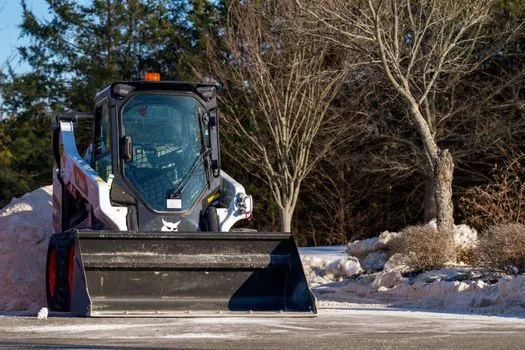
Manufacturer specification databases should be used as the primary reference, not dealer brochures, because brochure ROC figures are sometimes quoted at 50% tipping load and sometimes at 35%, and the difference is the difference between a safe lift and a tip-over [S1][S2]. Independent spec aggregators such as Construction Equipment Guide and RitchieSpecs normalize ROC, operating weight, and net power to a common format and let the buyer filter by these values directly, which is the most reliable cross-OEM comparison method [S2][S3].
For duty-cycle planning, the operator should also weigh the attachment ecosystem: a machine with 80+ L/min standard flow plus a high-flow option opens up the full agricultural attachment catalogue, while a fixed low-flow machine is restricted to buckets, forks, and small augers only [S1][S4]. Two trackable signals for the rest of 2026 are whether mid-range ROC frames (700–1,100 kg) continue to absorb share from light-duty units as bale weights trend upward, and whether high-flow hydraulic packages migrate downward into the 60–90 HP class as standard rather than optional equipment [S1][S8].