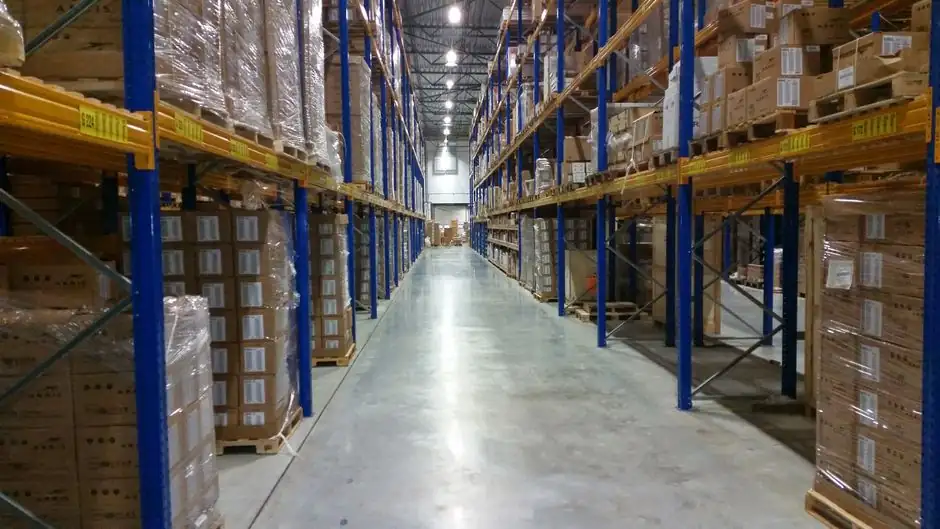
SBS modified bitumen membranes with a polyester (PY) carrier, 3-5 mm thickness, and a cold-flex rating of –20°C to –25°C are the spec baseline for cold storage warehouse roofs and freezer-grade envelopes, with torch-applied 4 mm SBS over a bituminous primer being the dominant 2026 build-up [S1][S3].
For refrigerated and frozen-goods warehouses where the membrane is sandwiched between the structural deck and an insulation/vapour-barrier composite, two failure modes dominate the spec: cold-flex cracking of the bitumen layer at low service temperatures, and vapour-drive blistering at the deck interface, both of which steer the selection toward SBS over APP and toward thicker 4-5 mm sheets rather than economy 3 mm [S3][S4].
SBS vs APP: cold-flex, heat resistance, and what each gives a freezer roof
APP (atactic polypropylene) modified bitumen membranes are routinely published with a low-temperature flexibility of –7°C and heat resistance of 110°C, with maximum peak tension of 500 N/50mm and peak elongation of 25% on PY-G reinforcement [S7]. SBS (styrene-butadiene-styrene) modified bitumen membranes on PY-G reinforcement are published at low-temperature flexibility of –20°C to –25°C, heat resistance of 90-105°C, maximum peak tension of 500 N/50mm (PY-G) and 800-900 N/50mm on PYG composite carriers, and peak elongation of 30-40% [S1].
For a cold storage roof, the cold-flex number is the load-bearing spec: APP's –7°C flexibility means the bitumen matrix begins to lose elastic recovery in any freezer zone where interstitial condensation can drive the membrane below 0°C, while SBS rated to –20°C to –25°C is engineered to stay elastic through those service temperatures [S3][S4]. APP's edge is heat resistance (110°C vs 90-105°C for SBS), which matters on dark exposed roofs in hot climates but is largely irrelevant inside an insulated cold-room envelope where the membrane sees a near-constant cool temperature [S1][S7].
Thickness, carrier, and the 3 mm / 4 mm / 5 mm decision
Published thickness options for SBS modified bitumen membrane are 3 mm, 4 mm, and 5 mm, with corresponding soluble content (a proxy for total bitumen mass per unit area) of 2100 g/m², 2900 g/m², and 3500 g/m² respectively under the GB 18242-2008 execution standard [S1]. Soluble content matters on cold storage jobs because thicker sheets carry more bitumen, which translates directly to a thicker waterproofing layer over the service life as the surface oxidises.
For cold storage warehouses, the field consensus from manufacturer technical bulletins is 4 mm minimum for horizontal roofs, with 3 mm allowed only on vertical parapet and detail work, and 5 mm used at high-traffic areas or where the membrane doubles as a protection layer over a primary waterproofing sheet [S1][S2]. The 3 mm thickness is explicitly characterised as providing "balanced structure between flexibility and lightweight performance" with sufficient resistance to punctures and tears for non-trafficked roofs, and the manufacturer recommends 4 mm or more for heavy soil or foundation conditions [S3].
Reinforcement: why polyester (PY) is the default for cold storage
Two reinforcement carriers dominate the published product data: polyester mat (PY / PY-G) and composite polyester-glass (PYG). On the GB 18242-2008 test grid, PY-G gives 500 N/50mm maximum peak tension at 30% elongation, while PYG boosts tension to 800-900 N/50mm but is published without a separate elongation figure in the standard's table [S1]. A 200 g/m² polyester core, coated on both sides with modified bitumen and surfaced with a thin polyethylene foil, is the typical construction for a heavy-duty protection membrane used over primary waterproofing in car parks, basements, tunnels, and reservoirs [S2].
For cold storage roofs, polyester carrier is preferred over fibreglass or composite PYG because cold-room structures experience thermal cycling between the freezer setpoint and ambient during defrost cycles, and polyester's higher elongation at break absorbs that movement without cracking the bitumen skin [S1][S3]. A 4.8 kg/m², 4 mm-thick SBS protection membrane on 200 g/m² polyester is published with "stability at high temperatures, flexibility at low temperatures" as a paired feature, and is sold in 1x10 m rolls sized for single-layer installation [S2].
Cold storage-specific products and the –20°C / –25°C / –30°C grading
Manufacturer datasheets publish three cold-flex grades: –20°C for standard cold-climate grades, –25°C for deep-winter SBS, and –30°C for arctic or high-altitude SBS, with low-temperature flexibility called out as a selectable parameter on the product listing rather than a fixed property [S1][S8]. The –20°C SBS modified bituminous membrane, supplied at 3 mm thickness on polyester felt, is the grade most commonly stocked for cold-climate commercial roofing, with manufacturer guidance giving a service life of 12-15 years under proper installation and protection [S3].
A purpose-built "cold storage polymer bitumen membrane" is listed as a distinct catalog product (rather than a generic SBS sheet), reflecting that cold storage buyers specifically filter on this application [S5]. Cold storage-specific builds typically run as a system: bituminous primer on the structural deck, torch-applied 4 mm SBS base sheet with 10 cm minimum laps, followed by an insulation layer and a separate vapour barrier on the warm side, since the membrane alone does not stop vapour drive from the warm interior [S3][S4]. For procurement, expect a 25-day lead time on dedicated cold-storage SKUs and minimum order quantities negotiated in square metres, with packaging at 25 rolls per pallet [S5].
Self-adhesive vs torch-applied: trade-offs on a freezer deck

Self-adhesive modified bituminous membrane is published as a polymer-modified asphalt sheet with a viscosifier additive and a silicone anti-sticking underside release film, eliminating the torch on site [S9]. Torch-applied SBS remains the spec default for cold storage roofs because the heat-welded lap is mechanically stronger, the lap survives the same thermal cycling as the field of the sheet, and the installer can re-soften seams during detail work around penetrations and upstands [S3][S4].
Self-adhesive is preferred where open-flame work is restricted, e.g. adjacent to existing insulation, over a wooden deck, or inside an operational food-grade facility where ignition risk is controlled. For a new-build cold storage warehouse roof on a concrete or metal deck, the published manufacturer guidance is to use the heat-fusion (torch) method in all seasons, with surface preparation to "clean, dry, and smooth" before primer application, and 10 cm minimum overlap at joints [S1][S3]. Cold-store storage and handling rules for the rolls themselves also differ: keep rolls upright, do not stack more than two tiers, and store at 4-45°C, away from direct sun and rain, with a 12-month shelf life from production date if reinspected [S1][S4].
Limitations and failure modes specific to cold storage
SBS modified bitumen membrane is published as suitable for "waterproofing projects in low-temperature cold areas and buildings with frequent structural deformation", but the datasheets explicitly warn against laying the sheet on snow-, water-, or frost-covered substrate, and require hand-rolled air evacuation during application to avoid blistering under traffic [S4]. On a cold storage roof, the dominant failure modes are (1) cold-flex cracking of the bitumen if the membrane is not SBS-rated for the local minimum service temperature, (2) blistering from vapour drive when a proper vapour barrier is not installed on the warm side, and (3) seam failure at the upstand-to-field transition where differential movement is highest [S3][S4].
Membrane alone is not a complete cold storage envelope. The published application field list includes roof, basement, tunnel, roof garden, road, bridge, parking lot, and swimming pool waterproofing, but for cold storage it functions as the lower waterproofing layer under an insulation composite, and the specifier must separately handle thermal insulation, vapour control, and air-sealing [S4]. For broader facility-spec context that touches the same thermal envelope logic, see the cold-climate concrete batching plant spec map, which applies a similar low-temperature service rating discipline to plant equipment skids.
Selection map: who SBS modified bitumen is for, and who should pick something else
SBS modified bitumen membrane is the right spec for: new-build cold storage warehouses with interior setpoints from chilled (0-5°C) down to frozen (-25°C), retrofit roofs over concrete decks, and freezer envelopes where the membrane must stay elastic across the full thermal cycle. APP is acceptable only for the warm-side weather protection layer on a non-freezer warehouse where the membrane never sees sub-zero service temperature [S1][S3][S7].
For freezer rooms colder than –25°C, specify SBS at –30°C cold-flex rating rather than the standard –20°C grade, and confirm the supplier publishes that rating rather than just inheriting the generic data sheet value [S8]. For non-freezer industrial cold-climate warehouses, the standard 4 mm SBS at –20°C with polyester carrier remains the cost-defaulted, code-compliant 2026 choice, and the specifier should pair it with a torch-applied base sheet, 10 cm laps, bituminous primer, and a separate vapour barrier on the warm side of the insulation layer. For the underlying waterproofing technology, see the modified bitumen membrane encyclopedia entry and the waterproof membrane category page; for on-site handling, the storage and handling guide covers the upright, two-tier-maximum roll-stacking rule cited across the datasheets.
Track for 2026-2027: SBS cold-flex grades dropping further as polymer chemistry extends (–30°C becoming a stock SKU rather than a special order), and self-adhesive SBS gaining market share in operational cold-store retrofits where hot-work permits are difficult to obtain.