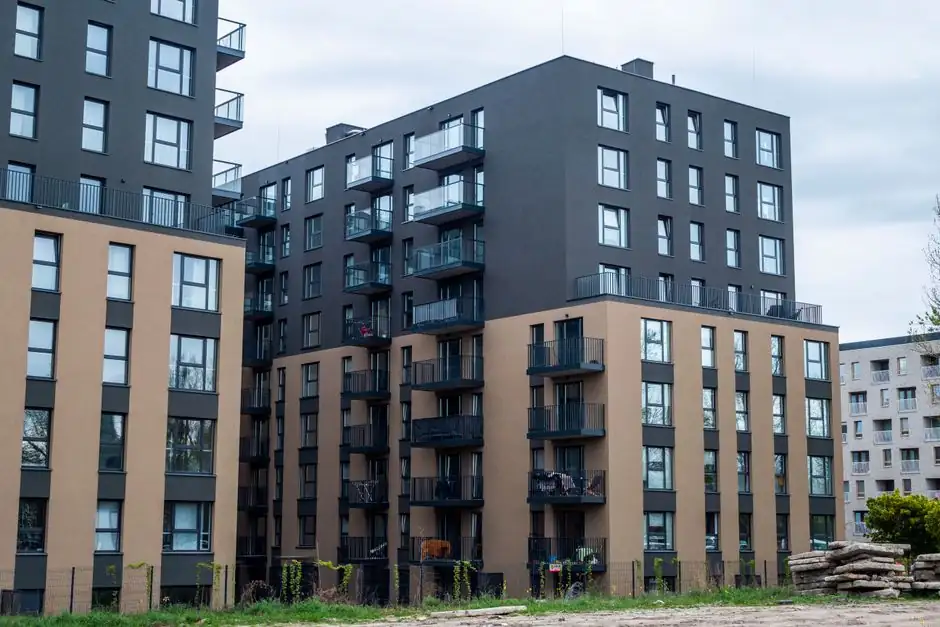
Residential flat-roof and low-slope waterproofing hinges on a two-polymer choice: SBS-modified bitumen delivers 30–40% higher elongation than APP, while APP-modified bitumen carries a higher softening point (≥130°C per ASTM D36) and stronger UV resistance for hot, sunny exposures [S3][S6]. Selecting between them is a climate-and-substrate decision, not a brand decision.
For detached homes, duplexes, low-rise apartments, and garage/balcony podium decks, the practical system is a torch-applied 3mm base sheet plus a 4mm mineral-cap sheet, both on a non-woven polyester carrier at roughly 180g/m², giving a 20–25 year protected service life when correctly detailed [S3]. This modified bitumen membrane format remains the default for residential bituminous waterproofing across hot-climate markets because of cost per m² and well-understood installer skill [S3].
Polymer Chemistry: What SBS and APP Actually Do to the Sheet
SBS (styrene-butadiene-styrene) is a thermoplastic elastomer that gives the bitumen matrix rubbery behaviour: the resulting sheet stretches further before tearing and recovers elastically, which matters on substrates that move with thermal cycling, seasonal deflection, or minor cracking [S5][S6]. APP (atactic polypropylene), sometimes co-blended with APAO/APO polyolefins, is a plastomer that stiffens the bitumen, raises its softening point, and gives a tougher, more UV-tolerant surface suitable for exposed roofs in hot climates [S4][S9].
The two chemistries are not drop-in interchangeable. SBS-modified sheets are commonly installed torch-on, cold-adhesive, or self-adhered; APP-modified sheets are predominantly torch-on or self-adhered, with cold-applied APP less common because the plastomer does not soften as readily under solvent contact [S5]. For a primer-and-torch residential job, both work; for a no-flame self-adhered retrofit over an existing sensitive substrate, SBS cold-applied grades are the safer default [S5][S7].
Climate, Slope and Substrate: Matching the Polymer to the Roof
APP is the right call where the roof sees sustained high surface temperatures and strong UV: south-facing terraces in hot-arid climates, dark-coloured exposed roofs, and any installation where the membrane is left uncovered rather than protected by pavers or ballast [S3][S4]. The plastomer's higher softening point (≥130°C per ASTM D36) means the sheet resists slump and tracking under direct sun, a failure mode that shows up as ripples and felt-block impressions on the cap surface [S3].
SBS is the right call where the roof moves: cold-winter freeze-thaw regions, timber decks with seasonal deflection, metal decks with thermal expansion, and any substrate with hairline cracking or anticipated movement at the deck joints [S5][S6]. Its higher elongation, often 30–40% above APP grades, lets the sheet absorb that movement without splitting at laps or upstands [S6]. A useful self-check: if the home is in a region with winter design temperatures below about -10°C, or the deck is timber/lightweight steel, default to SBS at the cap sheet and use APP only as a UV-stable surface if needed [S5].
Sheet Build-Up: Carrier, Thickness, and Two-Layer Systems
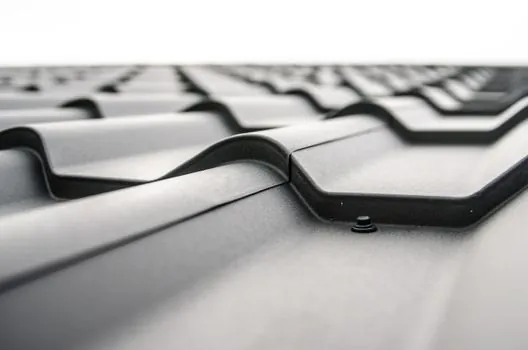
The carrier matters as much as the polymer. Non-woven polyester fleece at roughly 180g/m² is the residential-industry default because it balances tensile strength, tear resistance, and conformability around upstands, and it is the carrier called out in the typical UAE datasheet profile (≥600 N/50mm longitudinal tensile per EN 12311-1) [S3]. Fibreglass carriers are stiffer but lower tear; polyester is the more forgiving residential choice. APP datasheets commonly list polyester mat (PY) as the standard reinforcement with PE film, fine sand, or mineral slate as the surface isolation [S9].
For thickness, 3mm is the minimum residential grade, 4mm is the workhorse, and 5mm is heavy-duty. The two-layer build-up is the standard for a 20–25 year protected life: a 3mm smooth base sheet fully bonded to the primed deck, then a 4mm mineral cap sheet with laps offset at least 300mm from the base layer's laps, both torch-applied with side laps of 80mm minimum and end laps of 100mm minimum [S3]. The 3+4mm combination delivers redundancy: a puncture through the cap does not immediately leak because the base sheet sits underneath. Single-layer 4mm systems are accepted on cost-driven sheds and outbuildings, but for a primary residence the two-layer torch system is the spec to write.
Installation Gates That Decide Whether the Spec Holds
Four installation gates decide whether a 20–25 year residential service life is actually achieved. First, substrate prep: deck clean, dry, and structurally sound, cracks repaired, blow holes filled, slope to drainage verified at a minimum of 1:80 [S3]. Second, primer: bituminous primer at 0.15–0.25 L/m², left to dry tack-free (30–60 minutes in hot conditions) before the base sheet goes down [S3][S1]. Fourth, lap discipline and flood test: side laps ≥80mm, end laps ≥100mm, cap sheet laps offset ≥300mm from the base layer, then a 50mm ponding test for 24 hours or an electronic spark test before handover [S3].
For homeowners and contractors who want to avoid open-flame work, self-adhered polymer-modified bituminous membranes are a practical alternative on smaller residential footprints, but they demand flatter substrates (no fishmouths) and stricter primer selection; sample verification and packing checks are the buyer's main defence on import orders [S7]. If the residential job is a small porch or balcony and the homeowner is sensitive to torch fumes on a tight lot, a self-adhered SBS grade is the lower-risk route [S5][S7].
Comparison: APP vs SBS vs Self-Adhered on Residential Decision Criteria

For a residential specifier, the four decision criteria that actually drive the call are climate, substrate movement, installation method, and service-life target. On climate, APP wins in hot/sunny exposures (higher softening point, high UV tolerance) and SBS wins in cold or freeze-thaw climates (rubbery low-temperature flexibility) [S4][S5][S6]. On substrate movement, SBS's 30–40% higher elongation advantage makes it the default for timber decks, lightweight steel, and substrates with hairline cracking; APP is acceptable on stable concrete or plywood decks that do not move seasonally [S5][S6]. On installation method, both can be torch-on; SBS is the only one that reliably cold-applies, and self-adhered variants exist in both chemistries for no-flame retrofits [S5][S7]. On service-life target, both chemistries reach 20–25 years when protected (under pavers or ballast); exposed APP typically tracks 15–20 years before surface aggregate loss forces maintenance, and exposed SBS runs similarly but ages faster under UV without a cap or paint [S3].
On cost, both sit in the same band per m² for a given thickness; the residential decision is rarely about price and almost always about the climate-movement-installation triangle above. A reasonable rule: if the home is in a hot-sun belt and the deck is concrete, specify APP 4mm mineral cap over APP 3mm base; if the deck is timber or the climate swings, specify SBS 4mm mineral cap over SBS 3mm base; if the site forbids torch work, drop to self-adhered SBS and accept a tighter substrate-prep regime [S3][S5][S6][S7].
Standards, Documentation and Failure Modes to Watch
The European and Gulf residential bituminous systems typically reference EN 13707 (reinforced bitumen sheets for roof waterproofing), EN 13969 (below-grade tanking), BS 8217 (reinforced bitumen membranes for roofing), and ASTM D6222 (APP) / D6162-D6164 (SBS) on the North American side; water-tightness is commonly verified at 60 kPa for 24 hours with zero leakage per EN 1928 [S3]. Tensile strength is reported as ≥600 N/50mm longitudinal per EN 12311-1 on a 180g/m² polyester carrier in the typical datasheet profile [S3]. These are the numbers a contractor should be able to hand over with the rolls on site, not as marketing language but as a third-party test report on the actual production lot.
The three failure modes that end a residential modified-bitumen roof early are: laps that were not fully torch-welded and then never pond-tested, mineral cap that was bonded without offset to the base laps so a single puncture goes through both layers, and details (upstands, pipe boots, internal corners) that were field-fabricated without a reinforcement strip [S3][S1]. The fix for all three is procedural, not material: spec the lap dimensions, the offset, the 50mm/24h flood test, and the reinforcement strip, then hold the contractor to them. A 4mm APP cap on a stable concrete deck in a hot climate will still leak in year three if the parapet upstand was torched without the 150mm turn-up and reinforcement strip [S3].
For specifiers cross-referencing adjacent trades, the broader waterproof membrane family (PVC, TPO, EPDM, HDPE) is covered separately, and the construction tools and construction machinery and equipment categories cover the propane-torch, roller, and primer-spray kit side of the install. For renovation projects where modified bitumen is competing with liquid-applied coatings, a parallel Waterproofing Coating Selection for 2026 Renovation Projects: Spec Map walkthrough is worth pulling before locking the system. The two trackable signals to watch over the next 6–12 months are APP datasheet updates reflecting higher softening-point grades for hotter roof zones, and self-adhered SBS variants gaining ground on small-footprint residential retrofits where torch work is restricted [S4][S5][S7].