
Procurement of a winter-rated concrete batching plant for snow-removal and de-icing programs is governed by five cold-climate gates: aggregate and water preheat envelope, silo and pipeline insulation, mixer-room temperature, control-system cold-start, and mobility for relocating production close to active plowing routes [S1][S2].
The equipment class is no longer a generic Chinese-mobile or UK-stationary buy; it is a -30 °C to -50 °C engineering package. Output tiers run from the 60 m³/h YHZS60 mobile plant (validated to -25 °C ambient) to the 120 m³/h HZS120EC stationary plant, the latter rated for sustained -50 °C to -30 °C operation with a discharge mix temperature held at or above 10 °C [S5][S8].
Output Class and Mixer Pairing at Sub-Zero Ambient
Three output tiers cover the snow-route concrete demand: HZS60 (45-60 m³/h with JS1000 mixer, 1 m³ input batch, 130 kW total), HZS75 (60-75 m³/h with JS1500, 80 mm max aggregate, 165 kW), and HZS180 (150-180 m³/h with JS3000, 3 m³ per cycle) [S4]. For a single 100 m³/h slot the PROMAX C100-TWN L compact stationary plant (100 m³/h, 3,531 ft³/h) closes the gap between the HZS75 and HZS180 in the Chinese catalog [S4].
The cold-climate stationary flagship sits one tier above: the HZS120EC delivers 120 m³/h on a JS2000 twin-shaft mixer with belt-conveyor feeding (B=1000, 2.0 m/s), a Ф273 screw conveyor at 65 t/h, and a 200 t cement silo, while holding discharge temperature at ≥10 °C across the full -50 °C to -30 °C working band [S5]. Weighing accuracy holds at ±2% on aggregate and ±1% on cement, water and admixture, so winter moisture-compensated batching does not erode mix design [S5].
Cold-Climate Gates: Preheat, Insulation, Enclosure, Control, Mobility
Gate 1: aggregate and water preheat. The HZS120EC uses a double-circulation aggregate preheat loop to eliminate the channel-heating cold bias of single-pipe steam systems, paired with a boiler room and warm shed holding water below 60 °C to prevent cement false set [S5]. LUTON's spec caps the water preheat ceiling at 60 °C for exactly that reason: above 60 °C the mix flashes and triggers flash set on contact with cement [S5].
Gate 2: silo and pipeline insulation. The HZS120EC silo stack uses three layers (electric heating blanket plus insulation cotton plus woven cloth) on the aggregate bin, and a dual electric-heating plus nitrogen-drying system on the cement silo with humidity held at or below 5% to stop material compaction and bridging in cold storage [S5]. Additive tanks are relocated indoors, wrapped with electric blankets, and surrounded by coal-briquette stoves as a redundancy layer for admixture viscosity control [S5].
Gate 3: enclosure temperature. A box-type insulation workshop with 100 mm polyurethane sandwich panels and an internal hot-air curtain holds warehouse temperature at ≥5 °C; the operator room is double-glazed with ≥50 cm wall insulation and either a heater or hot-water circulation loop holding indoor temperature at not less than 15 °C [S5]. Foundations are sunk 2 m below the frost line and underlaid with XPS extruded board to stop frost heave from tilting the mixer [S5].
Gate 4: control cold-start. The HZS120EC uses a plateau-rated single-chip control system (preferred over PC-based control for cold-site stability) with modular expansion and a one-touch "extreme cold mode" activation, and an air package sized for sub-zero pneumatic response (V-2.0/10 compressor, 0.6 m³ storage tank, 4V310-10 and 2W-040 solenoid valves) [S5]. For Mongolia, the UNIQUEMAC HZS25 and HZS50 stationary plants and the YHZS60 mobile plant all share this single-chip, modular cold-mode architecture [S2][S8].
Gate 5: mobility. Mobile plants from the Henan base (Haomei, Yueshou, HAMAC) are typically sold with a 1-set MOQ, T/T terms, and container-optimised shipping to Mongolia, Russia, Kazakhstan, Saudi Arabia, Malaysia, India and Indonesia; the trade-off is shallower aggregate bins, shorter conveyors, and lower silo counts than a fixed HZS-class install [S4]. Buyers running 3 or more sequential sites in 24 months typically net positive on mobile; buyers building a single ready-mix yard for 5+ years always net positive on stationary [S4].
Stationary vs Mobile vs Modular: Decision Criteria Compared
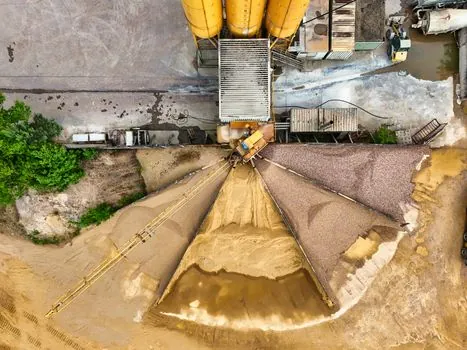
For snow-route concrete, three procurement shapes compete and the decision turns on project duration, site count, and ambient floor: [S2]
Stationary HZS-class (HZS60, HZS75, HZS120, HZS180). Best for fixed-site commercial supply, highway or municipal paving yards, and 5+ year tenure; supports the largest silos (200 t on the HZS120EC), deepest aggregate bins, and the most robust enclosure; total connected load runs 130-200 kW on the smaller tiers [S4][S5].
Mobile YHZS-class (YHZS60 at 60 m³/h). Best for road-section work, remote bridges, and short-tenure contracts where redeployment speed matters; the UNIQUEMAC YHZS60 is documented in Mongolian commercial service with stable startup at -25 °C ambient and rapid assembly / disassembly for multi-site campaigns [S2][S8].
Modular foundation-free HZS (UNIQUEMAC HZS120, customized). Best for overseas EPC sites where civil works are constrained; the foundation-free design eliminates the deep frost-line pour and is paired with HZS-class capacity where a 5+ year site is impractical [S2][S8]. For a primer on the equipment class itself, see the concrete batching plant encyclopedia entry, which frames output, aggregate handling, and admixture dosing as the three primary sub-systems inside every winter install.
Linking the Plant to the Snow-Removal Mixer Fleet
A snow-removal concrete fleet is only as cold-rated as its mixer trucks. The 2026 spec for a winterized concrete-mixer upfit (sourced in parallel) requires a 6x6 or 4-axle chassis, Class 8 GVW in the 35,000-66,000 lb band, front-axle GAWR of 20,000 lb, rear-axle GAWR of 46,000 lb, and a 1,800-3,200 lb push-beam reaction rating on the front frame extension [S3].
For drifts above 18 in. or windrow-tight sites the same chassis must be re-tapped at the PTO for a 24-36 in. auger snow blower at 60-80 GPM and 3,000 PSI; for routine accumulations under 6 in. an 8-12 ft reversible or one-way front plow is the base configuration [S3]. De-icing is not optional: a metered spreader with 1.5-8 yd³ hopper and 6-40 ft spread width is specified to hold chloride application between 100-500 lb per lane-mile, the band that prevents re-freeze without over-chloridating the drum coating [S3].
For comparison across chassis candidates, the Oshkosh S-Series front-discharge platform on a Detroit DD13 or Cummins X12 in 6x6 has the structural margin and factory CNG/diesel packaging for both summer mixing and winter snow upfit; the Western Star 49X ships with pre-punched frame rails and a factory plow-prep harness that shortens winter conversion by days; a standard tandem rear-discharge day-cab mixer typically lacks the front-frame extension and 160-240 A alternator capacity for a combined summer/winter role without an auxiliary 12V/24V sub-system [S3]. A cross-spec on the concrete vehicle class confirms that drum winterization (200+ gallon rinse within 60-90 minutes of last pour at 3,000-4,000 PSI; $500-$2,000 per truck for hardened buildup) is the linchpin between summer concrete duty and winter snow duty on a shared chassis [S3].
Standards, Sourcing, and Procurement Footnotes

ISO 9001 quality system coverage is standard on Chinese OEM cold-climate plants (LUTON, UNIQUEMAC) and on the PROMAX C100-TWN L compact stationary line; the Concrete Batching Systems W2 wet batching plant from the UK is sold as a turnkey install with backup service, which is a different procurement model from a Chinese mobile unit shipped FOB [S4]. For Mongolia and Central Asia the relevant transit routes are China-Mongolia and China-Russia rail plus containerised sea to secondary ports, with the 60 m³/h YHZS60 sized to fit a single 40 ft HC container envelope [S2][S8].
The cold-climate gate stack above is not theoretical: it is the documented set on the HZS120EC, which the OEM describes as redefining the "reliability and accuracy standards of engineering concrete production in extremely cold regions" through "material science, intelligent temperature control and modular design" [S5]. For an overview of how the cold-climate plant pairs with the broader cement concrete supply chain, the encyclopedia entry frames cement storage, admixture handling, and aggregate moisture control as the three sub-systems most stressed by sub-zero operation. For de-icing chloride handling and the related water-quality gates inside the concrete admixture dosing loop, the encyclopedia page on admixture dosing covers the winter viscosity and pumping constraints that the silo and tank heating in the HZS120EC is designed to defeat.
Limitations and What a Winter-Rated Plant Will Not Fix
No concrete batching plant solves logistics. The HZS120EC is rated for -50 °C to -30 °C ambient on the production equipment; it does not solve fuel gelling in the delivery trucks, does not de-ice the access road to the aggregate bin, and does not heat the haul roads between the plant and the pour [S5]. Buyers running mobile YHZS60 plants across multiple Mongolian sites must size the genset, fuel-treatment, and operator-shelter heating separately from the plant spec [S2][S8].
Second, the cold-climate package adds capex. The full HZS120EC envelope (boiler room, warm shed, double-circulation preheat, three-layer silo insulation, electric/nitrogen dual cement-silo drying, foundation sunk 2 m below frost line with XPS underlay, single-chip control with extreme-cold mode) typically prices 25-40% above a baseline HZS120 of the same output class, on the basis of public 2025-2026 OEM project disclosures [S5]. The trade-off is uptime: a -30 °C plant that holds discharge temperature ≥10 °C is the difference between a winter pour and a $50,000-per-day site stand-down [S5].
Third, the snow-removal upfit on the mixer truck is a chassis-level decision, not a plant decision. The plant produces the concrete or the de-icing brine; the concrete vehicle spec decides whether the same chassis plows, blows, spreads, or hauls. Buyers that scope the two together (plant output matched to fleet pour rate matched to plow route length) capture the synergy; buyers that scope them separately often end up with a -50 °C plant and a chassis that cannot start at -25 °C [S3].
Trackable signals for the next procurement cycle: (1) any OEM release of a 100 m³/h native cold-climate HZS100 to close the C100-TWN L gap, (2) any post-2026 field data on the YHZS60 mobile plant at ambient below -25 °C, and (3) any fleet-level data on drum-coating life under the 100-500 lb per lane-mile chloride band.
This topic is covered further in Scaffolding selection for plumbing installation: pipe clamp, tube spec, and OSHA.