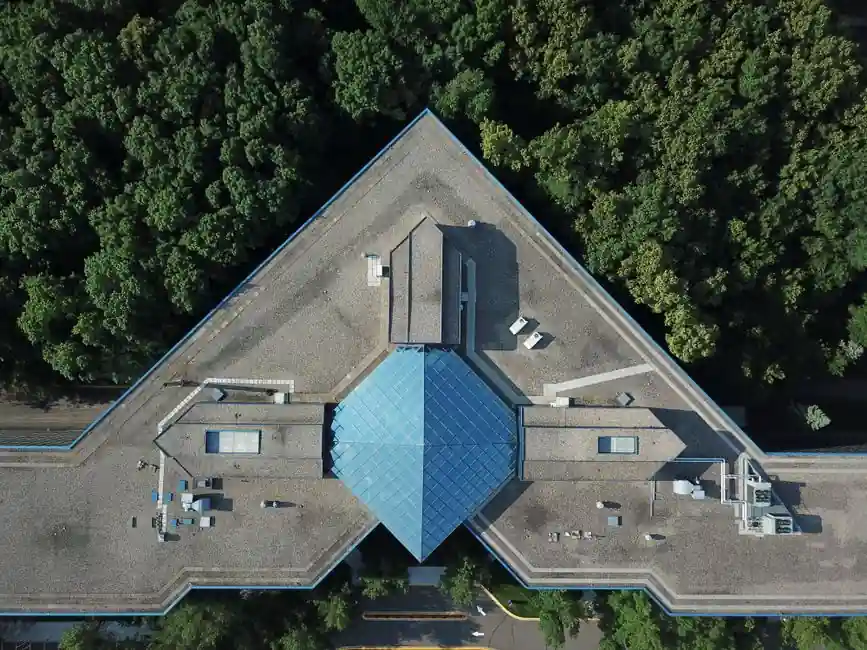
For commercial flat-roof selection in 2026, the working spec is a 3-4 mm APP or SBS modified bitumen membrane on a 180 g/m² polyester fleece, with lap widths of 80 mm perpendicular and 100 mm longitudinal, primer at 0.15-0.25 L/m², and a flood test at 50 mm water depth for 24 hours before handover [S2].
The same datasheet returns a Type A APP softening point of at least 130°C (ASTM D36), tensile strength of at least 600 N/50 mm longitudinal (EN 12311-1), and zero leakage at 60 kPa for 24 hours (EN 1928), with a 20-25 year service life on protected UAE flat-roof builds [S2]. modified bitumen membrane is still the dominant solution for commercial low-slope roofing in that market, and the spec envelope below applies broadly to commercial-roof projects in other warm climates as well.
Polymer Modifier Selection: APP vs SBS vs IPP
APP and IPP are plastomeric modifiers that raise the bitumen's softening point and stiffness without the same elastic recovery SBS delivers, making them the default choice for torch-applied membranes in warm-climate roofs, where a softening point of at least 130°C (ASTM D36) is the published minimum [S2][S3].
SBS, by contrast, is an elastomeric thermoplastic that gives the bitumen rubber-like elastic recovery, with a continuous elastic network forming once the polymer concentration exceeds roughly 6% by weight of the blend, raising viscosity, softening point, toughness, and complex modulus simultaneously [S3]. SBS membranes can stretch up to 800% of their original length without tearing, which is the published flexibility case for cold-climate and substrate-movement applications [S5]. For buildings where open-flame work is restricted, such as occupied healthcare facilities or combustible substrates, SBS self-adhered or cold-applied is the practical answer; APP is almost exclusively torch-applied [S5].
Base Mat, Thickness, and Surface Finish
Four carrier types are standard: polyester mat (highest elongation, suited to moving substrates), fiberglass mat (high tensile, low elongation), compound mat, and polyester-fiberglass mat (balanced properties), with the polyester fleece at 180 g/m² being a typical commercial-roof carrier weight [S2][S3]. Thickness in the 3-5 mm range is the commercial norm, with the 3+4 mm double-layer build-up being a common high-performance configuration in UAE specifications [S2].
Surface finish is a functional, not cosmetic, decision: PE film is the standard release face for torch application, aluminum foil adds solar reflectivity and a vapor barrier, mineral flakes (slate or colored granules) provide UV protection and walkability, and colored sand is used on lighter exposed systems [S3]. The combination of polyester mat plus 4 mm thickness plus mineral granule surface is the dominant exposed-roof specification, while fiberglass mat plus 3 mm plus PE film is the common buried or covered-system build [S3]. waterproof membrane selection follows the same logic on below-grade and plaza-deck assemblies, where the surface finish is rarely seen.
Substrate Preparation, Primer, and Lap Geometry
Concrete substrate must be clean, dry, and structurally sound, with cracks repaired, blow holes filled, and slope to drainage verified at a minimum of 1:80, before any primer or membrane is applied [S2]. Bituminous primer goes down at 0.15-0.25 L/m² and is allowed to dry to tack-free, which takes 30-60 minutes in UAE summer conditions, and all upstands (minimum 150 mm), penetrations, drains, and movement joints are then treated with a reinforcement strip membrane first [S2].
Perpendicular laps are specified at a minimum of 80 mm and longitudinal laps at a minimum of 100 mm, with the cap-sheet laps offset at least 300 mm from the base-layer laps to avoid four-ply stacks at the seam, and torch application is followed by immediate rolling of the laps to remove voids and bubbles [S2]. Acceptance is verified by either a 50 mm ponding flood test for 24 hours or an electronic spark test, with any defects remedied and the test result documented before handover [S2]. The HDPE-reinforced variant, finished with PE film on both faces and supplied at 3.0-4.0 mm thickness in 1 m × 10 m rolls, is one alternative carrier choice for non-exposed roofs, planting areas, and heavy water-vapor environments, executed under GB 18967-2009 [S1].
Failure Modes and Where Membranes Leak
Sheet-membrane leaks track to laps, terminations, and penetrations, with heat-welded seam failure, blistering from trapped moisture at the concrete substrate, and peel at upstands as the documented failure modes on commercial roofs [S6]. Standing-water ponding, repeated thermal cycling, and inadequate primer coverage accelerate all three.
Visual warning signs of end-of-life include extensive surface cracking, widespread blistering, and membrane separation where layers pull away from the deck, while performance warning signs include recurring leaks despite repeated repairs, persistent ponding water, and energy-cost drift from wet insulation below the membrane [S4]. The application method itself also drives risk: torch-applied systems require open-flame hot work permits, while self-adhered and cold-applied SBS systems trade a higher material cost for elimination of that hot-work risk on occupied buildings [S5].
Comparison: APP vs SBS for a Commercial Spec
On four decision criteria, the published data draws a clear line: APP wins on UV and heat stability with a minimum 130°C softening point, while SBS wins on cold-weather flexibility with elongation up to 800%; on installation, APP is almost exclusively torch-applied and SBS supports torch, cold-applied, or self-adhered; on climate fit, APP is the warm-climate default and SBS is the cold-climate and substrate-movement default; and on torch hot-work risk, APP requires an open-flame permit while SBS self-adhered removes it [S2][S3][S5].
For a developer building a multi-tenant commercial block in a hot climate, the cost-minimised spec is APP at 4 mm on 180 g/m² polyester, with mineral granule surface for the exposed cap sheet and PE film on the base sheet; for a hospital, school, or occupied healthcare facility, the spec shifts to SBS at 4 mm self-adhered on a polyester carrier, with a separate torch-applied or cold-applied cap sheet if fire-rated assemblies are required [S2][S5]. Specification writer should also reference waterproofing coating selection where liquid-applied PU or acrylic systems are competing for the same rooftop, because PU is more UV-stable without a protective topcoat while bare bitumen needs mineral granules or a reflective coat to keep surface temperature and oxidation down [S6].
Standards, Sourcing, and Lead-Time Envelope
The standards stack for a UAE-spec commercial build runs EN 13707 for reinforced bitumen sheets on roofs, EN 13969 for below-grade tanking and damp-proof courses, ASTM D6222 for APP, and BS 8217 for built-up and modified-bitumen roofing practice, with a 20-25 year expected service life on protected and 15-20 year on exposed systems [S2]. Production scale is global: a complete modified-bitumen membrane line integrates 21 device stations, runs at 0-50 m/min, and is quoted at 10 sets per month or 20 sets per year from major Chinese OEMs, with lead time of 30-40 days for a full line and per-line annual capacity of 1 to 20 million square meters [S3].
For a project team, the practical procurement check is to verify EN 13707 and EN 13969 marking on the data sheet, confirm 180 g/m² carrier weight and 3-4 mm thickness on the roll label, and require a sample for ASTM D36 softening point and EN 12311-1 tensile testing before shipment. Trackable signals to watch next: any 2026 updates to GB 18967-2009 for HDPE-reinforced grades, and any Saudi/UAE code amendment tightening minimum cap-sheet thickness on exposed roofs above the current 4 mm commercial norm.
Spec-level background on the components involved: pressure transmitter.