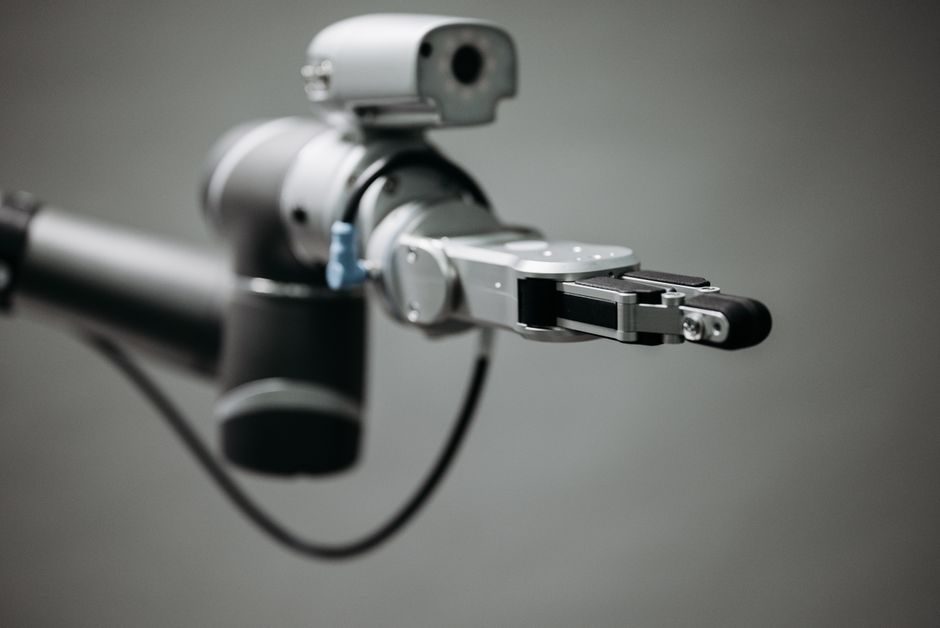
Universal Robots' UR20 pairs a 25 kg payload with a 1750 mm reach for heavier, farther tasks on the same Polyscope platform that anchors the rest of the e-Series [S3]. The global cobot market is tracked near $2.14 billion for 2025 with a compound annual growth rate of 31.6% through 2030 [S6], meaning 2026 buyers face a wider model lineup than at any prior point.
This guide maps the four payload tiers, the standards that govern the cell, the gripper and vacuum options that round out a working station, and the red flags that turn a cobot cell into a guarded robot. Use the comparison table to shortlist two or three candidates before vendor demos.
Definition, Scope, and the Collaborative Robot Standards Stack
A cobot is a robot designed for ISO/TS 15066 collaborative operation in a shared workspace, governed at the top level by ISO 10218-1 industrial robot safety and ISO 10218-2 cell integration; ISO/TS 15066 adds the biomechanical limits, the four collaborative operating modes (power-and-force limiting, speed-and-separation, hand-guiding, safety-rated monitored stop), and the guidance that lets a robot run without cages at defined speeds and contact thresholds. [S1]
For buyers, the practical scope is a 6-axis articulated arm (more rarely 7-axis) with collaborative-mode firmware, rated for a defined payload and reach, with category 3 PL d safety functions on each joint. Productive Robotics markets its OB7 as ISO 10218-1 compliant with joint-level collision sensing and a hand-stop that lets the operator halt and resume motion without re-energising the cell [S1]. Cobot's Proxie, announced 2024-11-20, was framed for real-world deployment in the same collaborative class [S5]. When a vendor says "collaborative," demand the certificate or declaration of conformity, not a brochure bullet.
Payload and Reach Tiers: The Four Buckets That Decide Everything
Payload drives end-effector, fixture mass, and part weight; reach drives cell footprint. The 2026 field sorts into four buckets the buyer can shortlist against [S3][S1]:
Tier 1 — ≤5 kg payload, ~500–850 mm reach: tabletop assembly, small-parts pick-and-place, light dispensing. Typical fit for electronics, lab automation, screw-driving. The smallest OB7 family member sits in this range and is positioned as "the perfect cobot for a wide range of lighter payload tasks and smaller work areas" [S1].
Tier 2 — 5–10 kg payload, ~850–1300 mm reach: the volume sweet spot for CNC tending, machine tending, packaging, and light welding. Universal Robots' 5 kg, 12.5 kg, and 16 kg e-Series models anchor this band; Productive Robotics' OB7 Stretch is positioned for lathe tending at slightly longer reach than the base OB7 [S1].
Tier 3 — 10–16 kg payload, ~1300–1700 mm reach: heavier machine tending, palletising small totes, longer-reach welding. The OB7-Max 12 (12 kg) and OB7-Max 16 sit here [S1]; the 16 kg-class market is where 2026 RFPs most often land.
Tier 4 — 16–25 kg payload, 1700 mm+ reach: palletising, large-format welding, automotive subassembly. The UR20 is the headline Tier 4 reference: 20–25 kg payload at 1750 mm reach, same Polyscope software stack as smaller e-Series units [S3]. Productive Robotics' OB7-Max 8 is the brand's "longest reach and largest operating sphere" variant within its own lineup, while Blaze welding cobots come in 1550 mm (61") and 2159 mm (85") reach variants including torch [S1]. Reach matters as much as payload — a 25 kg cobot at 1300 mm reach is a different cell from a 25 kg at 1750 mm.
Selection Criteria Beyond Payload: IP, Repeatability, DOF, and Safety

Payload is the headline number; everything else is what makes a cell survive. Lock these in before price talks [S1][S3][S9]:
1. Repeatability: cobots land in the ±0.03 mm to ±0.1 mm range; pick-and-place tolerates the loose end, dispensing and metrology do not. Confirm the spec sheet, not a brochure.
2. Degrees of freedom: standard is 6 axes; 7-axis arms exist for confined cells where the elbow must clear an obstacle.
3. IP rating: Tier 1–2 arms are typically IP54; food, washdown, and outdoor cells need IP65 or higher. Confirm against the actual datasheet — IP ratings differ by joint.
4. Safety I/O and functional safety: category 3 PL d minimum per ISO 13849-1 on every protective stop; dual-channel STO; configurable safe-speed and safe-zone inputs.
5. End-effector ecosystem: electric grippers, vacuum grippers, force/torque sensors, and quick-changers. SMC's collaborative robot vacuum unit is a representative example of the vacuum-side ecosystem that most Tier 2 and Tier 3 cells require for bin-picking and packaging [S9]. The same cell often couples to a linear guide for the seventh-axis stroke that extends a cobot's reach across a long machine.
6. Software stack: Polyscope (UR), plus custom no-code UIs from independents. Productive Robotics markets its OB7 line on the absence of traditional robot programming [S1]; Universal Robots leans on Polyscope and the UR+ ecosystem [S3]. The closer the software fits your operators' literacy, the lower the integration cost.
Who a Cobot is FOR, and Who Should Buy a Standard Industrial Robot Instead
Cobots are for high-mix, low-volume, short-cycle-changeover work where the cost of guarding, safety scanners, and a risk assessment per ISO/TS 15066 can be amortised across many part numbers. CNC tending for job shops, light welding for sub-contract fabricators, lab automation, and machine tending on lathe families are the canonical fits [S1][S2]. Cobot-as-a-service providers such as Cobot Team LLC explicitly market the workforce-uplift and upskilling angle rather than pure headcount replacement [S8].
Cobots are NOT for high-speed palletising of heavy totes (use a crossed-roller-guide palletiser or a guarded industrial articulated robot), high-throughput painting with flammable coatings (ATEX-classified arm required), cleanroom semiconductor front-end (vibration and outgassing rules out most cobots), or any application where the cycle time demands sustained collaborative-speed operation above the biomechanical thresholds of ISO/TS 15066. If the cell needs a fenced industrial robot to hit takt time, the cobot is the wrong tool.
Criteria-Based Comparison: Tier 2 and Tier 3 Cobot Options

Use this comparison to shortlist against decision criteria that determine cell cost, not headline sticker price:
UR20 (Tier 4 reference, Universal Robots): 20–25 kg payload, 1750 mm reach, Polyscope software, deep UR+ ecosystem, broad gripper and vision support. Premium price, lowest integration friction for teams already on UR [S3].
OB7 family (Productive Robotics, US-built): tiered from light to heavy across OB7, OB7 Stretch, OB7-Max 8, OB7-Max 12, OB7-Max 16; Blaze MIG/laser variants with Miller OptX laser heads up to 2 kW, Blaze Mobile for oversized parts. Marketed on no-programming simplicity, ISO 10218-1 safety compliance, joint-level collision sensing [S1]. Best fit for US machine shops and welding sub-contractors that value domestic support over software breadth.
Proxie (Cobot, launched 2024-11-20): the Amazon-veteran-founded entry, framed for real-world deployment and continuous-operation workloads rather than showcase demos [S5]. Evaluate when the application skews logistics and mobile manipulation.
UFACTORY alternatives ecosystem: aggregated xArm and other third-party arms, frequently listed at lower price points; evaluate against the same ISO 10218-1 / ISO/TS 15066 evidence chain rather than feature checklist alone [S6].
Across the four, decision weight should fall on (a) safety documentation and ISO/TS 15066 risk-assessment support, (b) reach-versus-cell-footprint match, (c) end-effector and vision ecosystem, (d) local service and spare-parts lead time. Price is a distractor until the cell design is fixed.
Cell Design Essentials: End Effectors, Vision, and the Cost Lines That Slip
The arm is roughly 50–60% of the cell bill. The remainder sits in the end-effector stack, the vision system, the fixturing, the conveyor or linear guide seventh axis, the safety scanner if the cell runs at non-collaborative speeds, and the integration labour. Vacuum grippers such as SMC's collaborative robot vacuum unit are typical line items on Tier 2 and Tier 3 packaging cells [S9]; the same cells often stack with AMR or AGV handoff for raw-part delivery.
Two cost lines that routinely surprise first-time buyers: the risk assessment and the safety scanner. A compliant risk assessment per ISO 12100 and ISO/TS 15066 is non-optional and frequently out-of-scope in OEM quotes; the optional laser safety scanner that lets an OB7 operate at higher speeds is an additional line item that can rival the price of a Tier 1 arm [S1]. Plan both into the budget before signing the PO.
Limitations, Failure Modes, and What to Verify On-Site

Three failure modes hit 2026 cobot deployments repeatedly. First, payload derating: the rated payload is for the wrist with the arm in a favourable pose; off-pose or with a heavy EO, the effective payload drops 20–30% with no warning beyond joint faults. Second, collaborative-mode cycle inflation: when a part requires the arm to exceed the ISO/TS 15066 biomechanical limits, the cell either slows to a guard-free takt that breaks the business case, or it gets a scanner and reverts to guarded operation — at which point a standard industrial arm may have been the better buy. Third, vendor lock on spare joints and dress packs: confirm joint-level repair pricing and lead time before purchase; the same rule applies as for any articulated robot cell. [S1]
When evaluating alternatives in adjacent categories, useful cross-references for budget planning include the PLC price and cost guide for the controller side and the SCARA selection spec-map when a SCARA outperforms a cobot on a high-speed horizontal pick-and-place.
Watch the trackable signals: 2026 announcements around Tier 4 (≥20 kg) reach extensions, ISO/TS 15066 revision chatter, and cobot-native vision packages that fold 2D/3D inspection into the same Polyscope or no-code UI. Two concrete next nodes — confirm the ISO 10218-1 declaration of conformity on the shortlisted SKU, and request the OEM's risk-assessment template before signing.