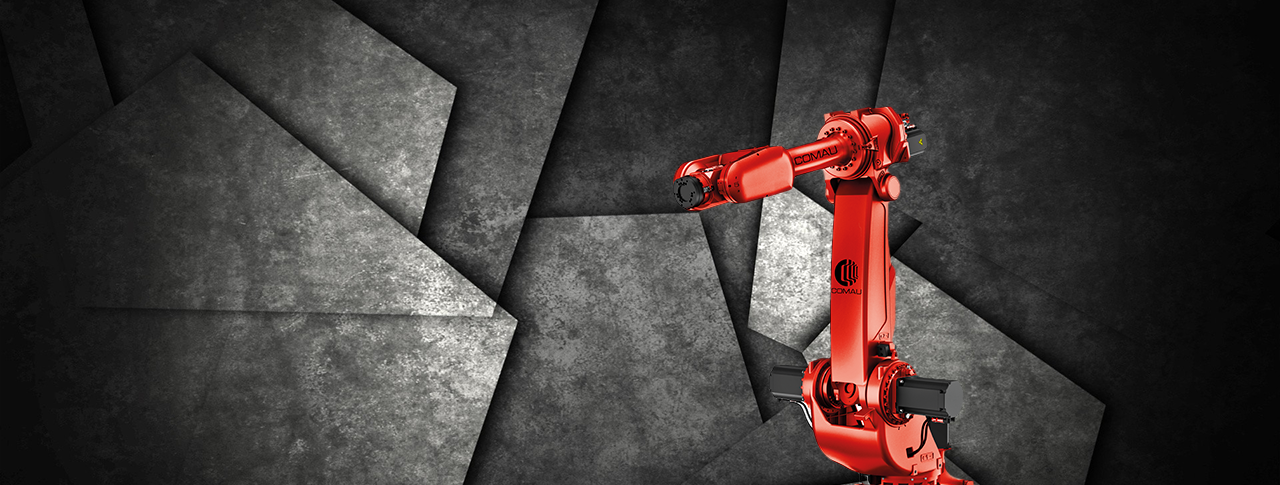
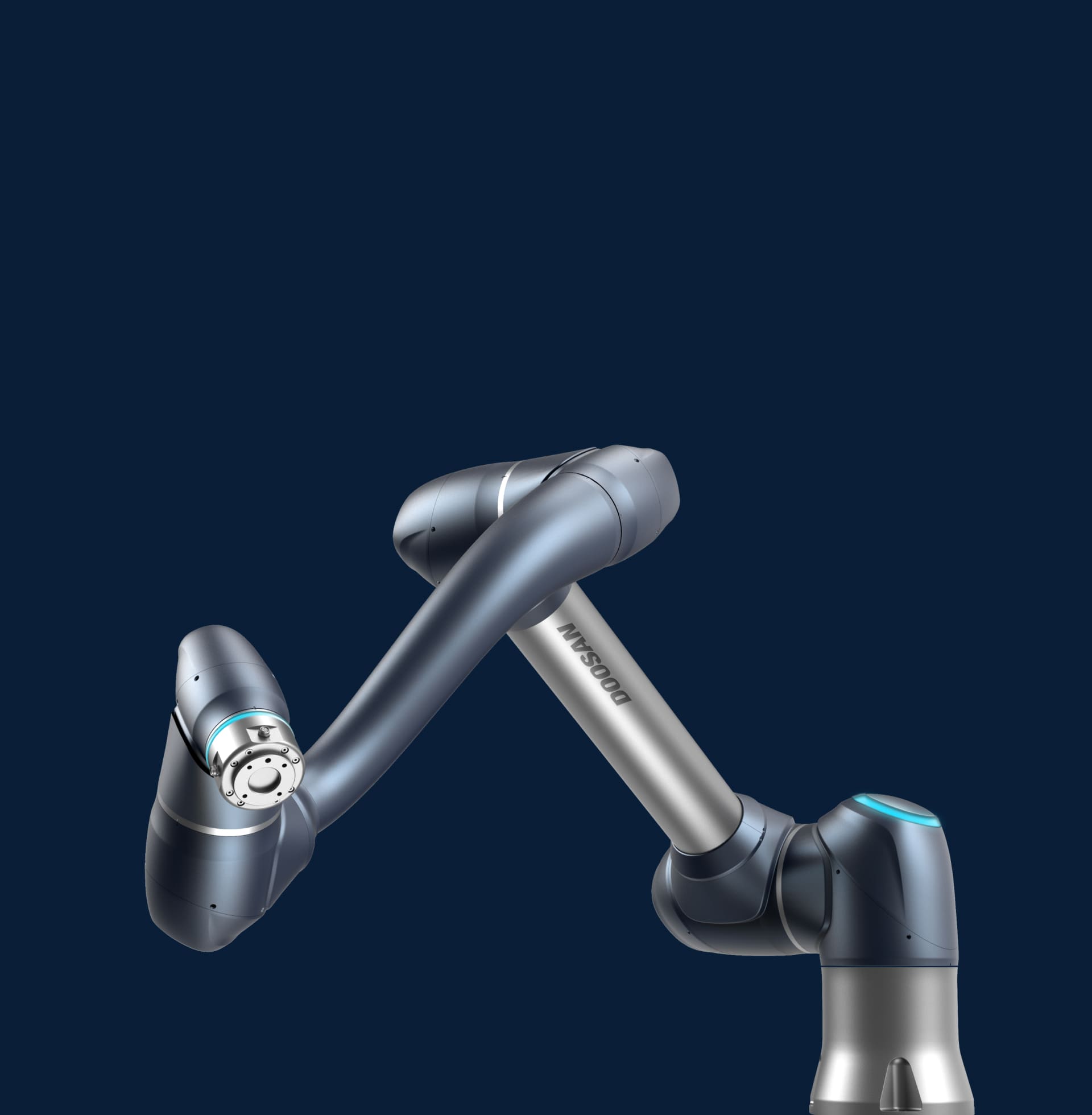
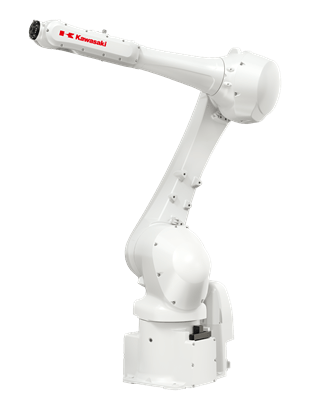
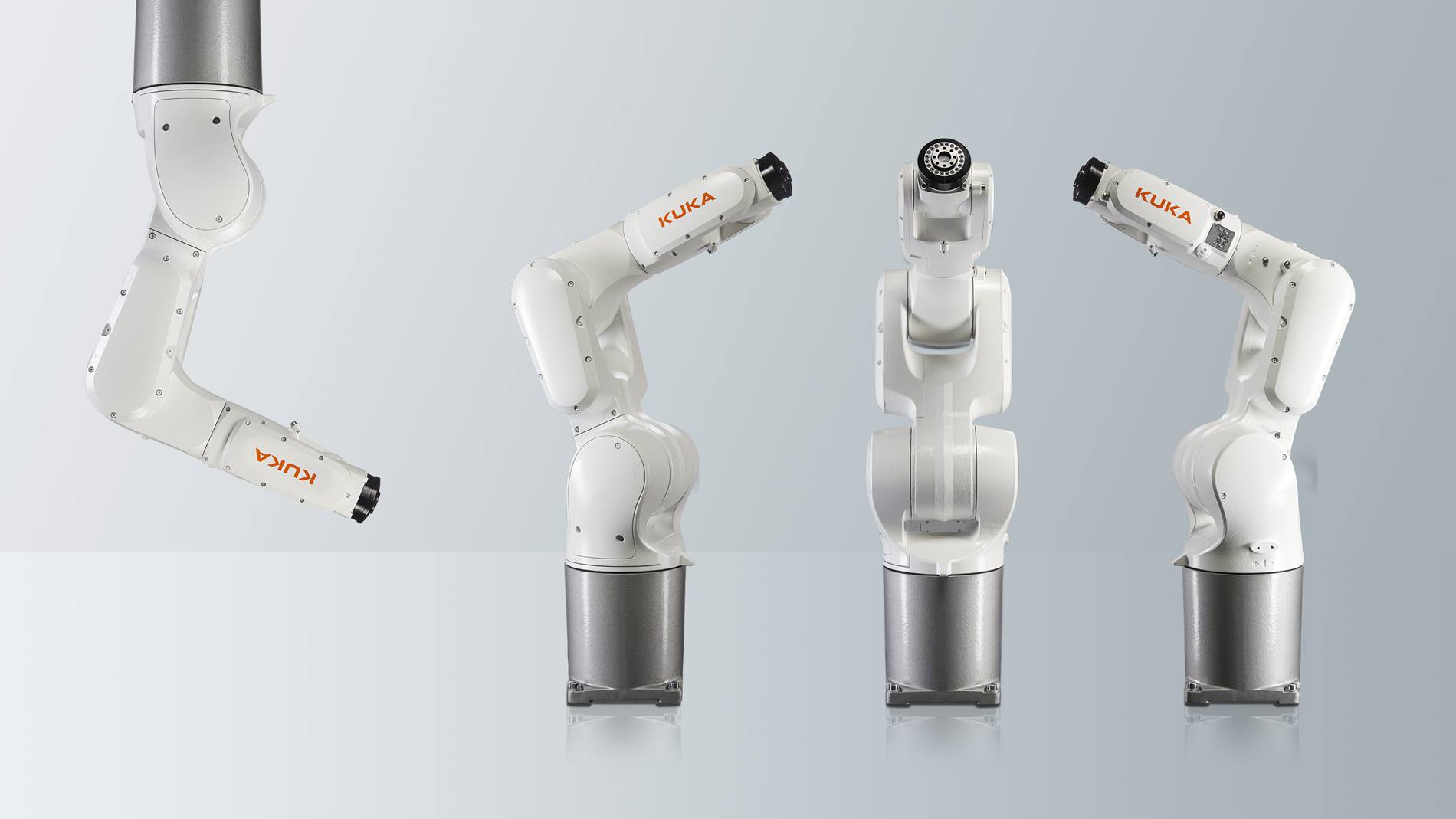
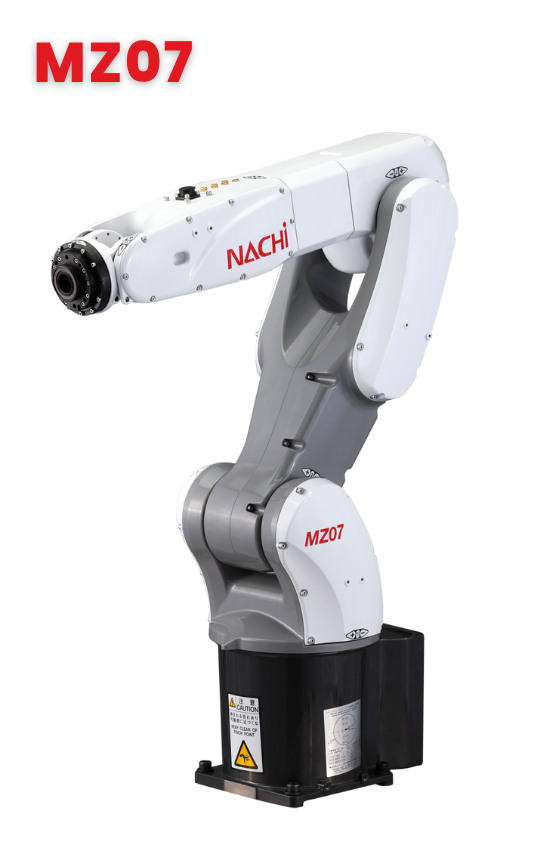
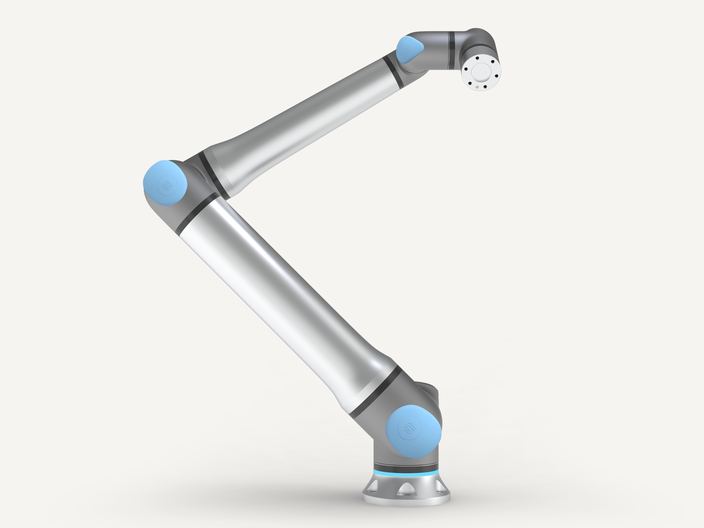
An articulated robot is an industrial manipulator built from a chain of rotary joints, the configuration that most closely resembles a human arm and the most widely installed robot type in the world. Under ISO 8373, an industrial robot is an automatically controlled, reprogrammable, multipurpose manipulator programmable in three or more axes; the articulated family uses three or more rotary joints in series, with the six-axis arm being the dominant form because it can position a tool at any point and any orientation inside its work envelope.
This guide is written for procurement and design engineers who must convert a process requirement into a specific model code. It decodes the parameters that actually drive selection, payload, reach, repeatability, drivetrain, protection class, and safety category, and grounds every figure in published standards and manufacturer datasheets rather than marketing copy.
Photo: Phasmatisnox, CC BY 3.0, via Wikimedia Commons
This guide is aimed at industrial purchasing engineers and design engineers. It covers 6 chapters from definition and scale, axis configurations, drivetrains and motion, payload reach and the work envelope, key spec-sheet parameters, to the selection decision sequence, with 7 selection FAQs and manufacturer comparisons. All parameters reference the public standards ISO 8373 (vocabulary), ISO 9283 (performance and repeatability test), and ISO 10218-1 and ISO 10218-2:2025 (robot and cell safety), with installed-base figures from the IFR World Robotics report.
Chapter 1 / 06
What is an Articulated Robot
An articulated robot is a serial-link manipulator whose degrees of freedom come entirely from rotary (revolute) joints connected end to end, the way a shoulder, elbow, and wrist connect the segments of a human arm. The first three joints (often labelled J1, J2, J3 or the base, shoulder, and elbow) position the wrist in space; the remaining joints orient the tool. The whole assembly is bolted to a base, carries a control cabinet and a teach pendant, and terminates at a mounting flange where a gripper, welding torch, dispense nozzle, or other end-effector is attached. Because the joints are all rotary, the reachable space is a complex shell rather than a simple box, which is both the strength and the planning challenge of this family.
The defining reference is ISO 8373, the robotics vocabulary standard revised in 2021. It defines an industrial robot as an automatically controlled, reprogrammable, multipurpose manipulator, programmable in three or more axes, which can be fixed in place or mounted on a platform for use in industrial automation. Two words carry weight. Reprogrammable means the motions can be changed without mechanical alteration, which separates a robot from a hard-tooled cam machine. Multipurpose means the same arm can weld today and palletize tomorrow with a tool change and a new program. The articulated arm satisfies these criteria while adding the dexterity of a wrist, which is why it dominates over Cartesian, SCARA, and delta layouts in general-purpose automation.
The industrial lineage runs from the Unimate, the first programmable industrial robot, installed on a General Motors die-casting line in 1961 to unload hot parts. Through the 1970s and 1980s hydraulic actuation gave way to electric servo drives, and the now-standard six-axis all-electric arm took shape. The four largest builders, FANUC of Japan, ABB of Switzerland and Sweden, KUKA of Germany, and Yaskawa Motoman of Japan, between them define most of the installed base, joined by Kawasaki, Mitsubishi, Stäubli, Comau, Nachi, and a fast-growing tier of Chinese makers including Estun, Inovance, and Siasun.
The scale is large and still growing. The IFR World Robotics report records the global operational stock of industrial robots passing four million units, with annual installations topping 500,000 for several consecutive years and roughly 540,000 new units installed in 2024. Electrical and electronics manufacturing is now the most robotized sector worldwide, ahead of automotive, and Asia accounts for the clear majority of new deployments. Articulated arms make up the bulk of that stock because they suit the widest range of tasks: spot and arc welding, machine tending, assembly, material handling, palletizing, painting, dispensing, deburring, and inspection.
Four engineering attributes determine whether an articulated robot fits a given job: payload (with its moment and inertia limits), reach and work envelope, repeatability, and the protection and safety class. Everything else in a datasheet, axis speeds, mass, controller options, communication buses, follows from how the buyer weighs those four against the process. A robot that is over-specified wastes capital and floor space; one that is under-specified stalls a production line. The chapters below decode each attribute in turn so the final model choice is defensible.
Chapter 2 / 06
Axis Configurations and Types
Articulated robots are first sorted by how many independently driven joints, or axes, they carry. Each axis adds a degree of freedom and a degree of cost and complexity. The number of axes determines whether the tool can reach an arbitrary orientation, how well the arm dodges obstacles, and how stiff and heavy-lifting the structure can be. The table below summarizes the four configurations a buyer will actually encounter, with their typical payload window and best-fit tasks.
Configuration
Degrees of Freedom
Typical Payload
Best-Fit Tasks
4-axis
4
5 to 1,500 kg
Palletizing, top-down material handling
5-axis
5
2 to 20 kg
Compact pick-and-place, light assembly
6-axis
6
3 to 2,300 kg
Welding, assembly, machine tending, general use
7-axis (redundant)
7
5 to 500 kg
Cluttered cells, reach-around, cobots
Six-axis is the reference configuration and the vast majority of the installed base. Three positioning joints place the wrist anywhere in the envelope, and three wrist joints provide roll, pitch, and yaw, so the controller can set both the location and the orientation of the tool independently. Six is the minimum count needed to reach an arbitrary pose in three-dimensional space, which is why almost every welding, assembly, and machine-tending arm is a six-axis. The tradeoff is that the open kinematic chain is less stiff and lower-payload than a comparable Cartesian gantry, and the wrist contains singular configurations the planner must avoid.
Four-axis arms drop the two pitch and roll wrist joints, keeping only base rotation, shoulder, elbow, and a single wrist rotation about the vertical. The tool stays pointed straight down. This is exactly what palletizing and top-down material handling need, and removing wrist joints buys back stiffness, payload, and speed while lowering cost. Dedicated palletizers reach into the hundreds and even above a thousand kilograms of payload by using this simplified, rigid layout. They cannot tilt a part, so they are the wrong choice for welding or orientation-critical assembly.
Seven-axis arms add one rotary joint beyond the six needed to reach any pose, making them kinematically redundant. Because six axes already suffice to set position and orientation, the seventh axis lets the robot hold a fixed tool pose with an infinite family of elbow positions. The arm can therefore reach around a fixture, thread into a crowded cell, or avoid a joint singularity without disturbing the tool. Many collaborative arms use seven axes for exactly this human-like dexterity. The cost is a more complex controller, an extra reducer and motor to maintain, and harder offline programming. A separately mounted external linear rail, sometimes counted as a seventh axis, serves a different purpose: extending travel along a long assembly line.
Outside the articulated family sit two relatives buyers often compare against. SCARA robots use two parallel revolute joints plus a vertical axis for fast planar pick-and-place and screwdriving; they are rigid in the vertical direction and quick in the horizontal plane but cannot tilt a tool freely. Delta (parallel) robots hang three or four arms from an overhead frame for very high-speed, light-payload picking in packaging lines. Both are non-articulated in the serial sense and are chosen when the task is essentially two-dimensional and speed-critical rather than dexterity-critical.
Chapter 3 / 06
Drivetrain, Motion, and Control
Inside every joint of a modern articulated arm sits the same building block: an AC servo motor driving the link through a high-ratio precision reducer, with an encoder closing the position loop back to the controller. Direct drive is rare because joint torque demands are high and the reducer multiplies motor torque while dividing speed, letting a compact motor move a heavy arm precisely. The two reducer families used in robotics differ in where they belong and why, and their condition dominates the arm's long-term accuracy. The table compares them.
Reducer Type
Typical Joint Location
Strengths
Payload Window
RV (cycloidal)
Base, shoulder, elbow
High torque, shock resistance, high rigidity
Above ~20 kg
Harmonic (strain-wave)
Wrist, small and cobot arms
Compact, light, low backlash, high ratio
Up to ~50 kg
RV cycloidal reducers use a cycloidal disc rolling against pins to deliver a high reduction ratio with great rigidity, shock tolerance, and torque capacity. They go in the heavily loaded base, shoulder, and elbow of any arm carrying more than roughly 20 kg, where the joints must hold large bending moments and absorb the inertia of a heavy load swinging at the end of a long link. RV reducers are larger and heavier than harmonic units of equal ratio, but their load-bearing capacity and fatigue strength make them the standard for the major positioning axes.
Harmonic, or strain-wave, reducers use a flexible toothed cup deformed by an elliptical wave generator to achieve a large single-stage ratio in a small, light package with effectively zero backlash. That compactness suits the wrist, where space and inertia are at a premium, and the whole arm of small and collaborative robots up to roughly 50 kg. The penalty is lower torque and stiffness than an RV unit of similar size, so harmonic drives are rarely used in the base of a heavy arm. Because both reducer types wear, and a worn reducer is the most common cause of an arm drifting out of its repeatability specification, the reducer brand, ratio, and rebuild availability deserve scrutiny at purchase time.
The servo motors are paired with high-resolution absolute encoders so the controller always knows joint angle at power-up without a homing move, and so it can run closed-loop position, velocity, and torque control. The controller solves inverse kinematics in real time to convert a commanded tool pose into the six or seven joint angles, blends motion through via-points, and enforces joint limits, speed limits, and singularity avoidance. Two programming modes coexist: online teaching with a pendant, where the operator jogs the arm to each point and the controller records joint angles (this needs only good repeatability), and offline programming, where a CAD or simulation tool generates paths in a world coordinate frame (this needs calibrated absolute accuracy, an option on most arms).
Motion performance is described by per-axis maximum speed in degrees per second, end-effector linear speed, and acceleration, which together with reach set the cycle time that ultimately drives throughput economics. Heavier arms move their large links more slowly; light assembly arms can reach tool-center speeds of several meters per second. The controller also handles the field-bus and digital and analog I/O that let the robot coordinate with the cell: common interfaces include PROFINET, EtherNet/IP, EtherCAT, and PROFIBUS, plus safety buses such as PROFIsafe and FSoE for connecting safety scanners and interlocks. For multi-robot lines, makers offer coordination features so several arms share a workpiece or a moving conveyor frame.
Chapter 4 / 06
Payload, Reach, and the Work Envelope
Payload and reach are the two headline numbers on every datasheet, and the most common selection mistakes come from reading them too simply. Rated payload is the mass the wrist flange can carry at full speed and acceleration without overrunning motor or reducer limits, and it must include the gripper, fixture, hoses, and cables, not just the part. A 10 kg part handled by a 3 kg gripper needs at least a 13 kg arm with margin. But mass alone is incomplete: two further limits bound what the wrist can really carry.
The first is allowable moment, expressed in newton-meters, which limits how far the load center of mass may sit from the flange face. A modest mass on a long offset fixture can exceed the moment limit while staying well under the mass rating, because the load torques the wrist reducers. The second is allowable moment of inertia, in kilogram-meters-squared, which limits how fast the wrist can accelerate a load of given size: a wide or long part forces the controller to slow wrist rotation to protect the gearing. Manufacturers therefore publish a payload-versus-offset diagram rather than a single figure, and a part must fit inside that diagram on all three counts to qualify. The table below maps the practical payload classes to the arm sizes and tasks they serve.
Payload Class
Typical Reach
Representative Series
Typical Tasks
Tabletop (3 to 10 kg)
500 to 900 mm
FANUC LR Mate 200iD, KUKA KR AGILUS
Assembly, machine tending, dispensing
Light (10 to 50 kg)
1,400 to 2,000 mm
FANUC M-20, Yaskawa GP25
Arc welding, handling, packaging
Medium (50 to 200 kg)
2,000 to 3,200 mm
ABB IRB 6700, KUKA KR QUANTEC
Spot welding, heavy handling
Heavy (200 to 800 kg)
2,500 to 4,200 mm
ABB IRB 8700, Yaskawa GP400
Body shop, casting, large parts
Ultra-heavy (800 to 2,300 kg)
3,200 to 4,700 mm
KUKA KR 1000 Titan, FANUC M-2000iA
Engine blocks, building materials
Reach is the maximum horizontal distance from the J1 base center to the wrist flange, but the number a buyer must plan against is the full three-dimensional work envelope, the hollow shell the tool can sweep. The envelope is not a sphere: it has a dead zone directly above and below the base where the arm cannot fold, limited overhead reach, and a region close to the base the arm cannot enter. As the arm extends toward full reach, available payload, stiffness, and speed all fall, so the working rule is to keep the most-used poses inside roughly 80 percent of maximum reach rather than at the limit.
Real datasheet anchors make the spread concrete. A FANUC LR Mate 200iD tabletop arm carries 7 kg over a 717 mm reach with plus-or-minus 0.01 mm repeatability and IP67 wrist protection, while its 7L variant extends the reach to 911 mm. An ABB IRB 6700 in its 150 kg, 3,200 mm variant serves automotive spot welding, and the same family scales to 235 kg at 2,650 mm. At the extreme, the FANUC M-2000iA/1700L lifts up to 1,700 kg at a 4.7 m reach, and the KUKA KR 1000 Titan handles 1,000 kg over a 3,200 mm reach. When no single model spans the needed reach and payload, a mounting riser, an inverted (ceiling) mount, or an external linear rail is often cheaper than jumping to a larger arm.
Chapter 5 / 06
Key Specification Parameters
Reading a robot datasheet is a core procurement skill, because two arms with the same payload and reach can differ sharply in accuracy, protection, and serviceability. Beyond the headline payload and reach already covered, the parameters below drive the decision and are explained one by one.
Repeatability is the single most-quoted precision figure, and under ISO 9283 it is the radius of the sphere that contains the scatter of the tool center point when the arm returns to the same commanded pose 30 times, measured at five positions inside the ISO test cube placed in the most-used part of the envelope. Industrial six-axis arms typically achieve plus-or-minus 0.02 to 0.1 mm; small assembly arms reach the tight end, large heavy arms the loose end. Repeatability is what taught (online) programs depend on, and it is the spec that degrades first as reducers wear.
Accuracy (pose accuracy in ISO 9283 terms) is a different and often misunderstood number: how close the tool lands to the absolute commanded coordinate, not how tightly it returns to a taught point. Because of link-length tolerances, gear backlash, and thermal and load deflection, raw accuracy is often roughly ten times worse than repeatability. Offline programming, CAD-driven paths, and metrology applications require an extra-cost absolute-accuracy calibration that maps and compensates each arm's individual geometry. If the application teaches every point by hand, accuracy can be ignored; if paths come from a computer, it cannot.
Number of axes sets reachable orientation and obstacle avoidance, as Chapter 2 detailed. Maximum speed is given per axis in degrees per second and as end-effector linear speed, and together with acceleration and reach it determines cycle time and therefore throughput. Mass of the arm matters for the foundation, for ceiling or wall mounting, and for any seventh-axis carriage that must move it. The table below collects the spec spread across the payload classes so a buyer can sanity-check a quote.
Protection class follows the IEC 60529 IP system: most arms ship at IP54 on the body and IP67 on the wrist, which suits dust and machining coolant. Welding needs anti-spatter wrist seals and sleeving; foundry, die-cast, and grinding need vendor heavy-duty packages such as ABB Foundry Plus 2 that seal and pressurize the whole arm; food, pharma, and washdown need full IP67 or IP69K stainless or coated arms rated for caustic cleaning; cleanroom assembly needs low-particle rated arms. Protection cannot usually be retrofitted, so it must be specified up front.
Mounting options (floor, inverted/ceiling, wall, tilted, or rail) change the achievable envelope and the rated payload, since gravity loads the joints differently. Controller and interfaces determine integration: field buses (PROFINET, EtherNet/IP, EtherCAT), safety buses (PROFIsafe, FSoE), digital and analog I/O counts, and the teach-pendant ecosystem. Finally, environmental ratings, ambient temperature range, humidity, and vibration resistance, must cover the installation site, especially for outdoor, cold-store, or high-vibration cells.
Chapter 6 / 06
Selection Decision Factors
To turn the preceding five chapters into a specific model code, work through the ordered sequence below. Most selection failures come not from one wrong answer but from deciding a later step before an earlier one is fixed, so resist the urge to pick a brand before the task is fully specified. These steps double as a fixed RFQ template.
Define the task and motion: Decide whether the job needs full tool orientation (6-axis), top-down handling only (4-axis), or reach-around dexterity (7-axis). List every pick, place, via-point, and required tool angle, because this constrains everything downstream.
Size the payload correctly: Sum part mass, gripper, fixture, hoses, and cables, add margin, then check the load against the maker's payload-versus-offset diagram for both allowable moment (Nm) and moment of inertia (kgm2), not mass alone.
Size reach and envelope: Map all poses with the tool attached and keep the most-used poses inside roughly 80 percent of maximum reach; verify the base dead zone, overhead limit, and joint limits with the maker's reach diagram or an offline simulation before purchase.
Set the precision class: Choose repeatability to suit the process tolerance (assembly and dispensing tight, palletizing loose), and decide whether offline or CAD-driven paths require the extra-cost absolute-accuracy calibration.
Choose mounting and protection: Pick floor, inverted, wall, or rail mounting (which changes envelope and rated payload), and specify the IP and special-duty package (welding, foundry, washdown, cleanroom) up front, since protection cannot be retrofitted.
Plan the safety system: Default high-speed arms must be guarded under ISO 10218-2:2025 with fencing, interlocks, light curtains, or scanners; a fenceless collaborative application needs a documented risk assessment validating power-and-force limiting or speed-and-separation monitoring per ISO 10218-2:2025.
Match controller and integration: Confirm the field bus and safety bus (PROFINET, EtherNet/IP, EtherCAT, PROFIsafe, FSoE), I/O counts, multi-robot coordination, and compatibility with the existing PLC and HMI ecosystem.
Total cost of ownership: Weigh purchase price against energy, programming, spare-reducer and spare-motor lead time, calibration intervals, and downtime cost. A cheaper arm whose reducers take months to source can cost far more over a ten-year line life than a dearer one with local stock.
One dimension buyers routinely underweight is serviceability and local support: spare-reducer and spare-motor availability, mean time to repair, the depth of the local integrator network, software and controller upgrade paths, and operator-training availability. An articulated robot is a ten-to-fifteen-year capital asset whose uptime depends more on parts logistics and technician access than on the headline datasheet. The big four, FANUC, ABB, KUKA, and Yaskawa Motoman, maintain broad service and spare-parts networks; regional and Chinese builders such as Estun and Inovance compete strongly on price and increasingly on local service. Match the arm to the payload and reach class first, then let service depth and integration fit, rather than sticker price, break the tie.
FAQ
How many axes does an articulated robot need, and when is 4 or 7 better than 6?
Six axes is the industry default because three wrist joints (roll, pitch, yaw) let the tool reach any position and any orientation inside the work envelope. Choose 4 axes for pure palletizing and top-down material handling: a 4-axis arm keeps the tool vertical, adds stiffness and payload, and costs less. Choose a 7-axis (kinematically redundant) arm when you must reach around fixtures or into cluttered cells, because the extra joint lets the robot hold the same tool pose with an infinite set of elbow positions, dodging obstacles and singularities. SCARA and delta robots are separate kinematic families optimized for planar pick-and-place, not general 6-DOF orientation.
What is the difference between payload, rated payload, and wrist moment of inertia?
Rated payload is the mass the wrist flange can carry at full speed and acceleration without exceeding motor or reducer limits, and it already includes the gripper, not just the part. Two parameters bound it. Allowable moment (Nm) limits how far the load center of mass may sit from the flange face: a 10 kg part on a long fixture can exceed the moment limit even though the mass is within payload. Allowable moment of inertia (kgm2) limits angular acceleration: a wide load forces the controller to slow wrist rotation. Always size against all three, because manufacturers publish payload-versus-offset diagrams, not a single number.
What does ISO 9283 repeatability actually mean, and how is it different from accuracy?
Pose repeatability under ISO 9283 is the radius of the sphere containing the scatter of the tool center point when the robot returns to the same commanded pose 30 times, tested at five positions inside the ISO test cube. Industrial 6-axis arms typically reach plus-or-minus 0.02 to 0.1 mm. Pose accuracy is different: it is how close the robot lands to the absolute commanded coordinate, and it is often 10 times worse than repeatability because of link tolerances and deflection. Taught (online) programming only needs good repeatability. Offline programming, CAD-driven paths, and metrology applications need calibrated absolute accuracy, an extra-cost option on most arms.
Harmonic drive or RV cycloidal reducer: which joints use which, and why does it matter?
Robot joints almost universally run servo motors through precision reducers rather than direct drive. RV (cycloidal) reducers go in the base, shoulder, and elbow of any arm above roughly 20 kg payload because they carry high torque, resist shock, and stay stiff. Harmonic (strain-wave) reducers go in the wrist and in small or collaborative arms up to roughly 50 kg because they are compact, light, low-backlash, and offer high single-stage ratio. It matters for buyers because reducer brand and condition dominate long-term repeatability and rebuild cost: a worn reducer is the most common cause of an arm drifting out of its repeatability spec.
How do I size reach and work envelope so the robot can actually do the job?
Reach is the maximum horizontal distance from the J1 (base) center to the wrist flange, but the usable space is the full 3D work envelope, which is hollow near the base and limited overhead. Size by mapping every pick, place, and via-point with the gripper and part attached, then keep the most-used poses inside roughly 80 percent of maximum reach so the arm is not fully extended (full extension reduces payload, stiffness, and speed). Check the dead zone directly above and below the base, joint limits, and whether a 7th external rail or a riser is cheaper than buying a longer-reach model. Verify with the maker's reach diagram or an offline simulation before purchase.
What IP rating and protection options do I need for welding, foundry, or washdown?
Standard industrial arms ship at IP54 on the body and IP67 on the wrist, which handles dust and machining coolant. For arc and spot welding choose anti-spatter wrist seals and protective sleeving. For foundry, die-cast, and high-particulate work choose vendor heavy-duty packages such as ABB Foundry Plus 2 or equivalent, which seal the whole arm and pressurize the wrist. For food, pharma, and washdown choose full IP67 or IP69K stainless or epoxy-coated arms rated for caustic CIP. Cleanroom assembly needs ISO Class rated low-particle arms. Specify the protection class on the purchase order, because retrofitting seals in the field is rarely possible.
Do articulated robots need a safety fence, or can they work next to people?
A standard high-speed industrial arm is not collaborative and must be guarded under ISO 10218-2:2025, typically with a fence plus interlocked gate, light curtains, or area scanners that stop motion on intrusion. A collaborative application (formerly covered by ISO/TS 15066, now folded into ISO 10218-2:2025) allows fenceless operation only after a documented risk assessment validates power-and-force-limiting, speed-and-separation monitoring, safety-rated monitored stop, or hand guiding. Note that a cobot-rated arm running at full speed with a sharp tool is still a hazard: the application, not the robot model, determines whether a fence is required.
Articulated Robot Manufacturers
Source-backed product routes. Open a company dossier for procurement scope and cited evidence.