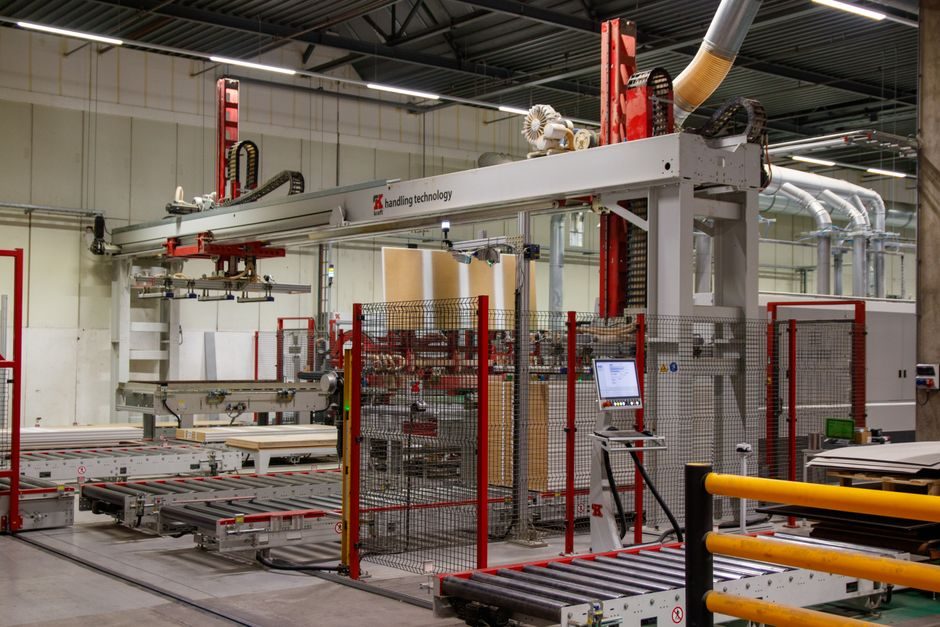
An articulated robot is selected by matching five numeric envelopes — payload, reach, repeatability, axes, and duty cycle — to the workpiece, the cell footprint, and the cycle-time budget before any brand is shortlisted.
In 2026 industrial buying, buyers first segment cells by payload class: light (<16 kg), medium (16-160 kg), and heavy (≥280 kg). ABB's large-robot family IRB 7710 and IRB 7720 sits in that heavy band, offering 16 variants with 280-620 kg payload [S2], while the IRB 5720 line covers the mid-to-high material-handling class [S1].
Payload, Reach, and Repeatability Envelope
Payload, reach and repeatability are the three numeric envelopes that gate every other decision on an articulated robot cell, and they must be set before any controller or brand discussion [S7].
The classical taxonomy still used in 2026 buyer guides splits the market into two payload bands: up to 16.00 kg and 16.01-160.00 kg [S7]. Above 160 kg, dedicated heavy-class arms such as the IRB 7710/7720 family (280-620 kg payload, 16 variants) become the realistic shortlist for press tending, foundry handling, and EV battery module placement [S2].
Reach is set by the cell layout, not by the catalogue maximum — oversizing reach by 20-30% buys collision clearance but costs inertia, energy, and price. Repeatability of ±0.02-0.05 mm is typical for material-handling articulated arms; tighter classes (≤±0.02 mm) belong in dispensing and small-parts assembly, which is why dispensing is listed as a distinct function in the segmentation [S7].
Function-Match: Handling, Welding, Dispensing, Assembly
Function match matters more than brand prestige: the same 50 kg articulated arm used for handling is rarely the right arm for arc welding, because welding cells demand a hollow wrist, a dress package, and a different repeatability class [S7].
Per the same segmentation, the four dominant functions on an articulated line are handling, welding, dispensing, and assembly, in that order of installed base [S7]. Handling absorbs the bulk of heavy-payload demand, which is why ABB's IRB 7710/7720 launch explicitly targets 280-620 kg material-handling cells and quotes up to 30% energy savings versus the previous large-robot generation [S2].
Welding cells still favour 6-axis arms with a through-the-wrist cable dress; dispensing (adhesive, sealant, paint) leans on arms with a clean hollow wrist and closed-loop path accuracy. For collaborative cells the same functional split is being absorbed by collaborative robot lines, which are not the same product class and should not be cross-quoted against heavy articulated arms.
Energy, Footprint, and Modular Design
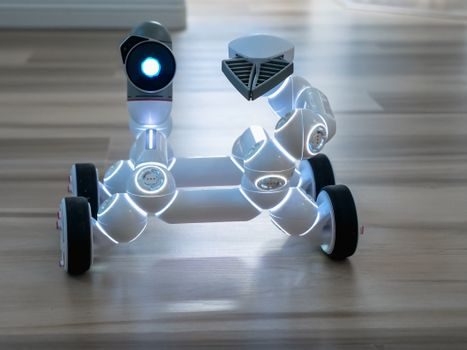
Modular mechanical design and energy use are now first-line selection criteria, not afterthoughts: ABB states the IRB 7710 and IRB 7720 cut energy consumption by up to 30% versus the prior large-robot generation [S2].
Two engineering consequences follow. First, lower energy use at the same payload means smaller cabinet feeds, lower cooling load on the switchroom, and a lower total cost of ownership over a 7-10 year depreciation window — relevant to anyone running three-shift cells. Second, modularity shortens the lead time for spare gearboxes and wrist modules, which historically has been the worst downtime driver on heavy articulated arms [S2].
For light-and-medium cells, buyers also compare articulated arms against SCARA robot configurations on planar pick-and-place. SCARAs win on cycle time per axis count when the path is a flat top-down transfer; articulated arms win the moment the trajectory needs a tilted approach or an out-of-plane reorientation.
Selection Criteria Checklist and Shortlist Logic
A defensible shortlist for an industrial buyer in 2026 sorts articulated-robot candidates against four numeric gates — payload, reach, repeatability, energy use — before any vendor name is written down.
Compare the realistic options on a 4-criterion matrix. ABB IRB 7710/7720 wins on heavy-payload handling with a 280-620 kg envelope and an up to 30% energy reduction over the prior generation [S2]. ABB IRB 5720 is the mid-to-high handling class with a strong material-handling orientation [S1]. For light (<16 kg) assembly or pick-and-place, buyers usually cross-shop SCARA robot and collaborative robot classes instead of a 6-axis articulated arm. For mobile manipulation and AGV-mounted cells, the AGV robot and AMR robot envelope replaces the fixed articulated arm altogether.
Who should NOT pick a heavy articulated arm: anyone with a sub-160 kg payload, a single-shift duty cycle, or a footprint that a SCARA can already cover. The capital cost and energy bill will not pay back. For process engineers wiring a new cell, the same shortlist logic is mirrored in adjacent spec maps, including SCADA software selection criteria for plant engineers and the drag chain cable selection criteria for packaging line retrofits when the robot is being installed on an existing line.
Integration, Programming, and Open Interfaces
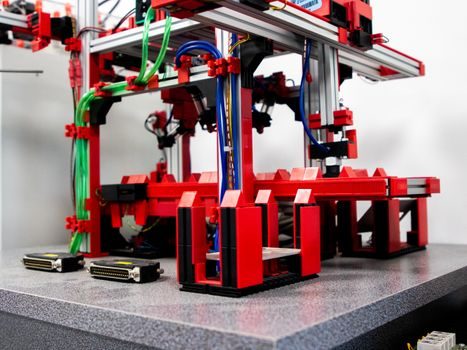
Open programming interfaces now sit on the selection sheet alongside payload and reach, because cell integrators in 2026 expect to control the arm from Python, ROS, or a PLC over Externally Guided Motion (EGM) or similar fieldbus, not from a vendor-locked pendant only [S6].
For example, the open-source library `rparak/ABB_EGM_Python` (commit history: 55 commits, last updated 2026-07-04) exposes ABB arm control through EGM, which is now a common ask in cell-integration RFQs [S6]. Buyers should confirm EGM, OPC UA, or PROFINET support is in the standard controller, not in a paid option.
For simulation, the same cell can be validated in RobotStudio or an OpenGL-based kinematic viewer such as the `iTrofa/Articulated_Robot_OpenGL` repository (7 commits, last updated 2026-06-28) [S8] — useful for first-pass reachability checks before a paid licence is procured.
Constraints, Failure Modes, and What Buyers Mis-Spec
The three most common mis-specs on articulated-robot projects in 2026 are payload over-rate, reach over-rate, and ignoring the duty cycle — all three are sold as "we'll derate it later" and all three create warranty disputes inside 18 months.
Payload over-rate is the dominant failure mode: the catalogue figure is the rated payload, not the dynamic payload with a gripper, a dressed cable, and a part at full extension. Reach over-rate is the second: a 3.1 m arm that fits the cell on paper can be unusable if the wrist can't reach the back row of the tray at the programmed pose. Duty cycle is the third: a robot rated for 3-shift continuous duty at one brand may only be rated for light-duty in another, and that rating is not interchangeable.
For peripheral selection on the same line, the same numeric-gate discipline applies in adjacent spec maps — see thrust bearing selection criteria for servo positioning axes for the rotary joints, and terminal block selection criteria for packaging line retrofits for the cabinet wiring around the robot controller.
Trackable signals for the next 90 days: ABB's IRB 7710/7720 energy-saving claim of up to 30% versus the prior generation is the benchmark to watch against competing heavy-payload launches in the same 280-620 kg band [S2]; the IRB 5720 line will set the reference for the mid-to-high material-handling class through 2026 [S1]; and open-source EGM tooling such as `ABB_EGM_Python` is a leading indicator of how quickly buyers can cut vendor lock-in on the integration layer [S6].