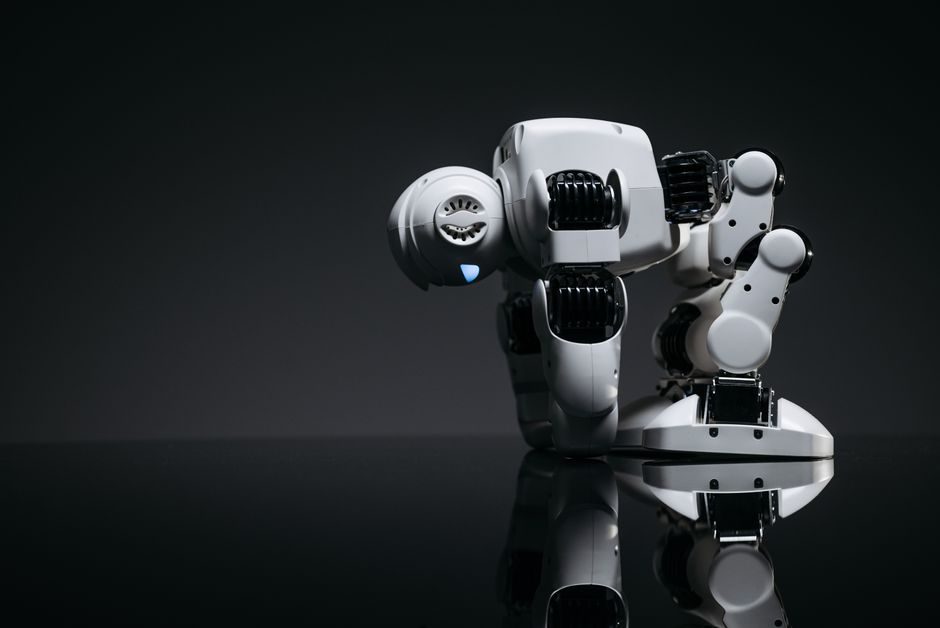
The cleanest split in 2026 is payload-and-reach versus human-proximity: a Universal Robots UR20 cobot delivers 25 kg payload and 1,750 mm reach in a 245 kg base footprint [S5], while a DENSO VS-series 6-axis articulated robot is floor- or ceiling-mounted behind safety fencing for high-speed handling and assembly [S3].
Vendors are now shipping both architectures from the same supplier — for example, ABB lists the YuMi collaborative arm alongside its general 6-axis articulated line [S1], and Yuanda Robotics markets a 6-axis arm that is configured as both articulated and collaborative depending on the cell layout [S2]. That overlap is exactly why spec-first selection, not category labels, has to drive the buy decision.
Definition and Operating Envelope
A 6-axis articulated robot is a floor-, wall- or ceiling-mounted arm with six rotary joints, normally fenced, with payload bands that climb past 800 kg on heavy-payload lines; the DENSO VS-series ships in IP54 / IP65 / IP67 variants and is targeted at electronics, pharmaceutical, medical and clean-room handling [S3]. Its working envelope, repeatability and axis speeds assume the operator stays outside the cell, and a typical articulated arm has a base footprint substantially larger than a cobot of the same reach.
A collaborative robot, by design, is built to share workspace with a human — Universal Robots describes the UR20 as a "heavy payload cobot" with the longest reach in that payload class and a small footprint that lets it lift heavy objects over longer distances inside the same cell as the operator [S5]. The collaborative concept was commercialised from a clean-sheet design in 2009 with the UR5, in contrast to earlier retrofits of industrial arms [S6].
Selection Criteria: Payload, Reach, Footprint, Cycle
Hard gate one is payload-and-reach: the UR20's 25 kg at 1,750 mm reach [S5] covers machine-tending of CNC and larger packaging heads, but parts heavier than 25 kg still drop back to a fenced articulated arm of the DENSO VS-series class or above [S3]. Yuanda's 6-axis arm lists palletizing, depalletizing, screw tightening, painting, laser-tracker measuring and loading/unloading among its function set [S2] — work that is either too heavy, too long-cycle, or too dirty for a cobot.
Hard gate two is footprint and ceiling height. DENSO explicitly lists floor- and ceiling-mount options for the VS-series [S3]; the Yuanda 6-axis adds wall-mount to that list [S2]. Cobots such as the UR20 are typically pedestal- or cart-mounted on a 245 kg base [S5], so cell re-layout is faster but ceiling or inverted articulated mounting is rarely an option. Cycle time is the third gate: articulated arms run at industrial servo speeds under power-and-force-limiting (PFL) disengagement, while cobots cap joint speeds so a contact event stays below the biomechanical thresholds defined in the robot safety standard ISO/TS 15066.
Safety Architecture and Human Proximity

An articulated robot is treated as a high-energy hazard: the cell is fenced, interlocks are wired into a safety controller, and access is governed by stop categories per ISO 10218-1. The VS-series datasheet does not claim collaborative operation — it lists IP ratings and clean-room applicability instead [S3], which is consistent with a fenced industrial cell.
A cobot adds PFL sensing on each joint, rounded geometry, and ISO/TS 15066 pain-threshold limits on quasi-static and transient contact. Universal Robots states outright that "the safety of the operator is always our number one priority" and that the UR20 was engineered around safety functions, not retrofitted with them [S5]. ABB's YuMi page groups the cobot into a separate product family from the general 6-axis line [S1], reflecting that the safety case — risk assessment, validated stopping distances, and cooperative-mode procedure — is fundamentally different from a fenced cell.
Side-by-Side Comparison
Three decision criteria line the two architectures up cleanly: payload, reach/footprint ratio, and human proximity. On raw lift, articulated 6-axis arms extend well past 25 kg and into hundreds of kilograms; on reach-to-footprint, the UR20's 1,750 mm reach from a 245 kg base [S5] gives a cobot the edge in dense cells; on human proximity, a cobot is designed to share the workspace without fencing, while a DENSO VS-series or Yuanda 6-axis cell is fenced by default [S2][S3]. The natural reading is that the cobot wins on mixed human-robot tasks up to ~25 kg, and the articulated arm wins on throughput, payload and dirty/dangerous process steps.
Real Use Cases on the Factory Floor
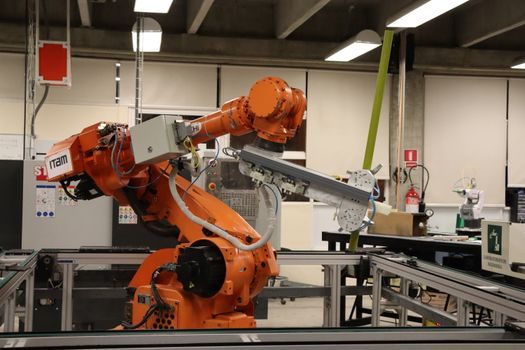
Machine tending, screw fastening, pick-and-place of mid-weight packaging, and lab automation in pharmaceuticals are the canonical cobot wins, because the UR20's 25 kg payload and 1,750 mm reach cover the part plus the gripper mass while the operator still loads trays beside the arm [S5]. The Yuanda 6-axis articulated line is positioned for palletizing, depalletizing, painting, surface treatment, screw tightening and laser-tracker-based measuring [S2] — operations that are either high-cycle, hazardous, or both, and therefore belong behind a fence. DENSO's VS-series is the typical fit for electronics, pharmaceutical, medical and clean-room handling where a sealed envelope (IP65 / IP67) and high-speed motion matter more than collaborative operation [S3].
Limits, Failure Modes and Sourcing Reality
Cobots hit three hard walls: payload ceiling (25 kg on the UR20 [S5] is the current high-mark for the Universal Robots heavy-payload line), cycle-time ceiling (PFL clamps joint speed to keep contact force below the ISO/TS 15066 limits), and reach ceiling (1,750 mm on the UR20 [S5]; longer reach pushes buyers back to articulated arms). Articulated arms hit the opposite walls: cell footprint grows with reach, fence and interlock cost is non-trivial, and any operator-in-the-loop task (re-gripping, inspection, teaching) needs a documented safe-reduced-speed procedure.
For a deeper read on articulated-arm pricing tiers, payload bands and where cobots still undercut them on cost, the articulated robot price & cost guide 2026 maps the SKU tiers by payload. For a clean comparison against the SCARA class on envelope, speed and sourcing, see the articulated robot vs SCARA spec map.
Standards, Sourcing and 2026 Buying Signals
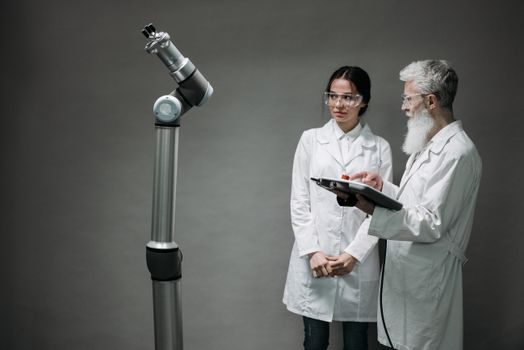
Two technical standards frame every collaborative-versus-articulated decision: ISO 10218-1 / ISO 10218-2 for industrial robot cells and the supporting technical specification ISO/TS 15066 for collaborative operation and PFL limits. A spec-first 2026 RFQ should call out payload at the wrist (kg), reach (mm), repeatability (mm), protection class (e.g. IP54 / IP65 / IP67 per IEC 60529 — DENSO lists those three explicitly on the VS-series [S3]), mounting options, and the documented safe-stopping distances. Universal Robots publishes the UR20 at 25 kg payload / 1,750 mm reach in its heavy-payload cobot line [S5]; DENSO publishes the VS-series as a 6-axis articulated unit with IP54 / IP65 / IP67 sealing [S3]; Yuanda publishes its 6-axis arm as configurable between articulated and collaborative mounting with palletizing and painting functions [S2].
Three signals to track into the second half of 2026: (1) cobot payload ceiling — does the 25 kg UR20 class get pushed higher by competing heavy-payload launches; (2) articulated-arm protective-class push — how quickly IP67 / clean-room-rated 6-axis arms such as the VS-series [S3] displace IP54 units in pharma and medical lines; and (3) collaborative-versus-articulated convergence on the vendor side, already visible in Yuanda offering both modes on one 6-axis platform [S2] and ABB selling YuMi alongside its articulated line [S1]. A buyer who locks the spec, the standard, and the cell layout before talking to vendors will see the procurement cycle drop by at least one round of quotation.