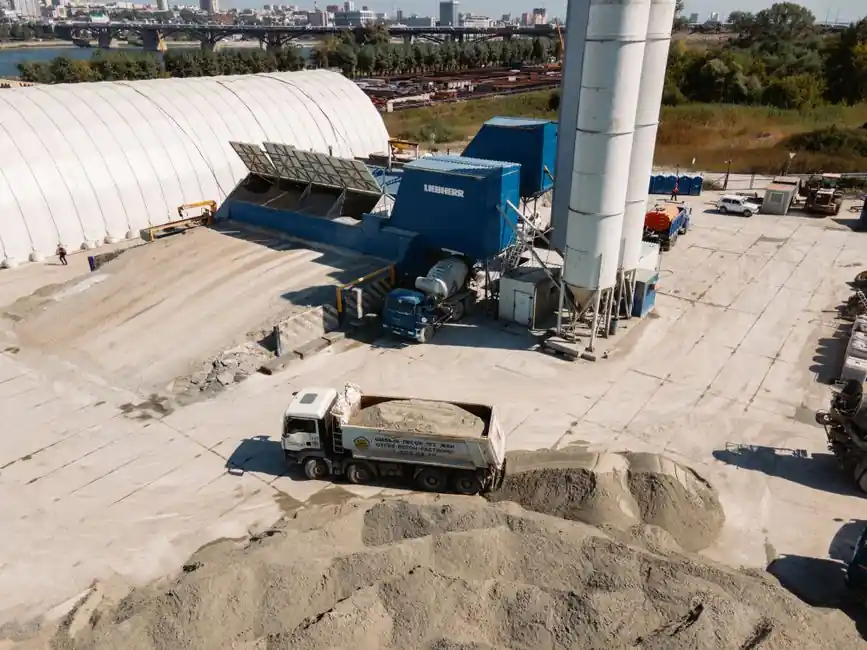
A concrete batching plant must meter water within the approved batch tolerance, because batch-water variation changes the effective water-cement ratio, workability, strength and mix consistency [S1][S3].
The critical scope covers water quantity, aggregate moisture correction, calibration records, equipment selection and verification of actual batch records rather than meter readings alone [S1][S4].
Water Metering Controls Effective Mix Ratio
A batch plant combines aggregates, cementitious materials, chemical admixtures and water in approved proportions, with computerized control performing most batching in central-mixed plants [S1]. Concrete consistency is affected directly by water content, while an indirect amp-meter or slump-meter reading indicates consistency through its relationship to the current required to rotate the mixer [S1].
Batch water cannot be judged accurately in isolation because aggregate water is part of the mix. Accurate moisture estimates for coarse and fine aggregate are required to adjust added water, and fine-aggregate moisture is commonly evaluated with probes located in the weigh bins [S1]. ASTM C94 permits aggregate quantities to vary by ±2% from the required mass, while water, cementitious materials and admixtures must also remain within their applicable batch tolerances [S3].
Mass Measurement Outweighs Flow Metering
Weight batching is more accurate than volume batching for solids because load cells measure each component against the recipe, and high-precision mass measurement remains the reference method for consistent concrete production [S3]. Water and liquid admixtures can be measured by mass or volume, but flow meters can be affected by leaks or air pockets that change the delivered quantity and disturb the water-cement ratio [S3].
The comparison is straightforward: mass measurement provides direct batch mass, supports recipe-based correction and fits computerized weighing systems; volumetric measurement can suit continuous-mix plants but requires reliable flow, pipe integrity and controlled fluid conditions. An electromagnetic flow-meter example has a stated capacity of up to 170 GPM for continuous concrete mixing, illustrating that flow metering is application-specific rather than a universal replacement for batch weighing [S6].
For a concrete batching plant, the practical selection rule is to prioritize verified mass measurement for batch production, use volumetric or flow measurement where continuous output and fluid integrity are well controlled, and retain an independent cross-check for effective water. Suppliers describe meters for measuring and controlling both water and chemical additives in concrete production, confirming that the same measurement discipline applies to both liquid groups [S2].
Calibration Frequency and Test Points

A documented calibration should verify every weighing and measuring element against the approved recipe and establish repeatability, traceability and mix consistency [S4]. The cited calibration guidance calls for checks every 3–6 months depending on use, with repeat calibration after major maintenance, load-cell replacement or before an audit [S4].
Calibration is not a zero-and-single-point exercise. The cited procedure calls for certified test weights where possible, water or aggregate for incremental verification on high-capacity systems, and test points at 5%, 20%, 40%, 60%, 80% and 100% of full capacity [S4]. The empty-system zero should remain stable for 2–3 minutes, and readings should be taken while both increasing and decreasing load to expose hysteresis [S4].
Traceability requires more than a green status light. Calibration certificates, raw measurement sheets, deviation graphs, calibration labels, recipes, batch data and calibration logs should be retained in the plant quality system, with SCADA or automation systems used for centralized digital records [S4].
Moisture and Aggregate Error Interact
Aggregate moisture errors and water-metering errors alter the same ratio, so separating their contributions is essential. Moisture probes in fine-aggregate bins support batch-water correction, while load-cell measurement controls the aggregate and cementitious fractions [S1][S3]. The plant control system must compare corrected batch water with the target water-cement ratio rather than assume that the commanded pump volume equals water entering the mixer.
Under-batched aggregate can increase cracking and shrinkage risk, reduce strength and make the mix harder to pump and finish; over-batched aggregate can increase segregation, reduce workability and strength, worsen surface appearance, and raise permeability [S3]. These are not isolated water-meter faults, but they show why a water total outside tolerance can magnify proportioning errors across the complete batch.
A practical audit should reconcile the recipe, moisture correction, meter total, admixture total, cementitious mass, aggregate mass and measured batch record. If water commands vary while corrected batch results remain stable, the automation may be compensating. If totals agree with the command but concrete consistency changes, inspect aggregate moisture, mixer behavior, admixture interaction and the indirect consistency indicator [S1].
Central, Truck and Continuous Mixing Need Different Checks

Central-mixed plants complete mixing at the stationary mixer before discharge, and about 20% of concrete plants in the United States use a central mixer according to the plant-operation reference [S1]. In this arrangement, accurate water proportioning supports higher production capability, better quality control and consistency, and reduced wear on truck mixer drums [S1].
Truck-mixed concrete transfers responsibility for part of the mixing process, so a plant water total must still be paired with controlled delivery and discharge records. Continuous-mix systems use flow-based water addition, where meter capacity, pipe condition and air entrainment become more important because the water stream is not confined to a discrete weighed batch [S6].
Central, truck and continuous mixing are therefore not interchangeable measurement cases. A concrete mixer truck completes or continues mixing after leaving the plant, but it cannot correct an inaccurate initial water total. Central plants need batch-focused calibration, truck-mixed operations need plant-to-truck record control, and continuous plants need verified flow delivery.
Select Metering and Control by Failure Mode
Batch plants may be manual, semi-automatic or fully automated, with load cells used to measure components according to required accuracy [S3]. Automation, data analytics and IoT integration have improved accuracy and efficiency in both ready-mix and conventional batching plants, but digital control does not remove the need to verify sensors, valves, moisture corrections and calibration records [S7].
For batch production, choose mass measurement, individual or cumulative weighing appropriate to the recipe, calibrated load cells, stable zero, multiple-span verification and retained batch records [S1][S4]. For continuous production, choose a flow meter sized for the operating range and water quality, then verify indicated flow against a controlled reference because the cited example reaches up to 170 GPM [S6].
Do not specify a meter from maximum flow alone. Require compatibility with the plant’s water and admixture services, validation method, readable engineering units, alarm or interlock behavior, and a traceable test interval. This selection framework fits a larger comparison of automatic and semi-automatic batching controls, where automation changes execution speed and record depth rather than replacing physical measurement verification.
Verify the Batch, Not Just the Instrument

Water-metering acceptance should require evidence that calibrated instruments, moisture corrections and recipe execution produce repeatable batches, with every result traceable to a date, test load, raw reading, deviation and authorized mix design [S4]. A meter displaying a stable value is not proof of correct delivery if a leaking valve, trapped air or an unverified moisture correction changes the quantity entering the mixer [S3].
Track repeatability across operators and shifts, because a repeatable recipe is a core calibration outcome [S4]. Review zero drift, hysteresis, test-point errors, moisture probe condition, water-system leaks and batch-record variance at defined intervals, then repeat the check after load-cell replacement, major maintenance or material-system changes [S1][S4].
The next trackable signal is not a new meter model but the quality of the plant records: percentage of batches within tolerance, zero drift, upward-versus-downward span error, and unresolved deviations by operator, shift and recipe [S4].