
A screw conveyor is usually the better fit for short, high-density cement transfers from a silo to the weighing system or mixer, while pneumatic conveying is stronger for long routes, sealed dust control, and flexible plant routing [S2][S3][S5].
The decision depends on transfer distance, material condition, required containment, operating control, and installed-cost tolerance, not on a universal preference for either technology [S3][S4].
Decision Basis for Cement Feed Systems
Cement feed equipment has two established mechanical roles: transferring cement from a cement silo to a concrete mixer, and moving material from a storage silo to the concrete batching machine [S1]. A cement screw conveyor performs the narrower transfer from storage equipment into the weighing system, which is the usual arrangement in concrete batching plants [S2].
Screw systems use direct mechanical displacement through a rotating helical flight, while pneumatic systems use pressure or vacuum to transport cement through a closed pipeline [S3][S5]. Pneumatic systems divide into dense-phase and lean-phase arrangements: dense phase uses a low-velocity, high-pressure air stream for concentrated movement, while lean phase uses high-velocity, low-pressure air for dilute transport [S4].
The concrete batching plant should select the system around the actual duty cycle, including bulk density, particle size, route geometry, dust exposure, moisture risk, and metering requirements. These variables determine whether the added pneumatic system complexity is justified [S3][S4].
Screw Conveyor Suitability for Dense Cement
A robust screw conveyor handles high bulk densities and short internal plant distances well, which matches the dense, continuous cement duty commonly found between a batching-plant silo and the weighing system [S2][S3]. The conveying tube, reducer, motor, screw spindle, tail bearing, intermediate suspension shaft, feed port, and discharge port form the principal screw-conveyor assembly [S1].
Screw flights push cement toward the discharge point while continuous rotation provides mechanical agitation and shear. That behavior can break short bridges and move moderately cohesive material, although highly cohesive products can still adhere to the flights and require special flight geometry, internal scrapers, or heated or insulated troughs [S3].
A screw conveyor can be installed horizontally, inclined, or as a combined arrangement, and batching-plant suppliers offer cylindrical, conical, square, and rectangular feed and discharge connections [S1]. Enclosed construction limits dust escape, while wear-resistant steel, hardened flights or liners, and sealing arrangements address the abrasive character of cement [S1][S3].
Pneumatic Transfer for Long, Sealed Routes
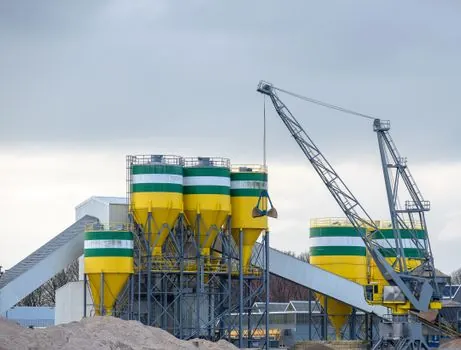
Pneumatic conveying is the stronger option when cement must cross long distances, negotiate multiple directional changes, or remain inside a fully closed pipeline [S5]. Positive-pressure systems feed silos, vacuum systems unload bulk tankers, and rotary valves regulate flow into downstream equipment such as bagging lines [S5].
The piping arrangement is central to pneumatic performance because transport depends on maintaining particle suspension through air velocity, pressure drop, bends, and the receiving hopper. Dense phase is appropriate for abrasive and fragile products, while lean phase fits non-abrasive, free-flowing material [S4]. This distinction makes system design material-specific rather than equipment-specific.
A pneumatic conveyor also reduces manual handling during tanker unloading and limits dust loss through sealed transfer [S5]. Its disadvantages are the additional dependence on air-moving equipment, dust-control components, rotary valves, and pipeline balancing. Moist or sticky powders can compact inside pneumatic lines, while excessive particle velocity through long runs and bends can increase cement degradation [S3].
Head-to-Head Selection Criteria
On short internal transfers with dry, free-flowing cement, a screw conveyor normally wins on mechanical simplicity, compact installation, and continuous movement at high bulk density [S2][S3]. On long, complex routes requiring sealed handling, pneumatic transfer wins on route flexibility and dust containment, provided the air system is engineered for the specific material and line geometry [S5].
For abrasive cement, both options need deliberate wear control. Screws can use wear-resistant steel, hardened flights, liners, replaceable wear parts, and sealing bearings, while pneumatic systems require material-appropriate dense-phase design and attention to bend geometry [S1][S3][S4]. For metering into a weighing system, screw feed offers a direct mechanical path, while pneumatic systems require controlled admission through devices such as rotary valves [S2][S5].
For operating load, the screw conveyor converts motor torque into continuous displacement and exposes drive, bearings, flights, and tube walls to wear. Pneumatic conveying moves the power burden into air generation and pressure management, but introduces dust-control, separation, and valve-maintenance obligations [S3][S5]. Neither option has an automatic cost advantage because capital cost must be weighed against distance, filter duty, replacement parts, and maintenance access.
Use Cases and Failure Modes
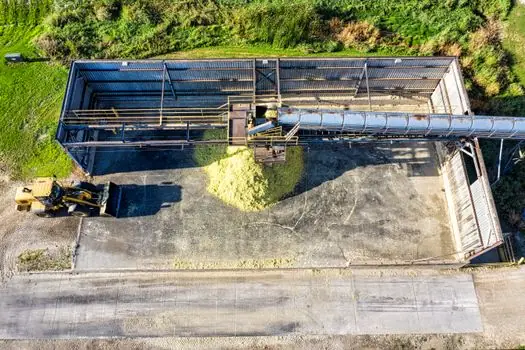
Screw conveying fits silo-to-weigh-hopper feeds, short runs to a mixer, and layouts where the transfer line is straight or only moderately inclined [S1][S2]. It also fits operators that prefer locally accessible mechanical components rather than a distributed air network. The cement weigh hopper remains the receiving point in the common screw-conveyor arrangement, so feed consistency and discharge control must be checked together [S2].
Pneumatic conveying fits silo feeding, inter-process transfers, bulk-tanker unloading, and routes that would require multiple screw sections or difficult changes in elevation [S5]. The line must still account for bends, receiver pressure, rotary-valve leakage, filter performance, and air availability. Dense-phase operation should be considered for abrasive cement, but the operating point must be verified for the actual material [S4].
Common failure modes differ by technology. A screw system can suffer flight wear, bearing failure, shaft seizure, caking, and dust leakage at connections. A pneumatic system can suffer line plugging, valve leakage, air leakage, filter blinding, unstable flow, and particle attrition at high velocity [S1][S3][S5]. Moisture control is critical for both routes because hygroscopic material can cake and compromise reliable flow [S3].
Sourcing, Maintenance, and Plant Integration
Specify the complete duty rather than naming only a conveyor type: define the cement bulk density, particle size, transfer rate, route length, elevation change, duty cycle, hopper pressure, and required outlet arrangement [S2][S3]. For screw equipment, request the flight diameter and length, reducer and motor rating, tube and flight material, bearing sealing, supported-span arrangement, feed and discharge geometry, and replacement-part plan [S1].
For pneumatic equipment, request the dense- or lean-phase basis, pipe diameter, air requirement, working pressure, bend layout, dust collection arrangement, rotary-valve specification, and commissioning method. A useful plant rule is to test the full powder route under the worst expected moisture and throughput condition, because nominal capacity alone does not demonstrate stable delivery [S3][S4].
Factory testing provides a useful procurement checkpoint, and screw conveyors described for batching plants undergo assembly and safety-performance checks before shipment [S1]. Maintenance planning should also cover access to bearings, flights, pipe spools, valves, filters, and air-service items. The batch plant review should then confirm that either system preserves weighing accuracy, mixer feed continuity, dust containment, and safe access to isolation points.
The next procurement checkpoint is a side-by-side route review: record transfer length, elevation, peak tonnes per hour, material bulk density, moisture condition, bends, and available power, then price the selected mechanical or pneumatic arrangement with filter, wear-part, and maintenance allowances.