
Across a 10,000 m² horizontal deck pour, the wax-acrylic curing compound line item is typically 0.4-0.8% of the structural concrete package, yet the cost of getting moisture retention wrong — plastic-shrinkage cracking, re-blast, re-pour — can run 8-15% of the deck value. That gap is what a TCO model on concrete curing compound is actually built to expose [S2][S3].
The compounds themselves fall into three resin families — wax emulsion, styrene-butadiene (SBR), and acrylic — each sold in 20 L to 200 L drums and dosed at 0.15-0.30 L/m² per the typical manufacturer coverage chart; CDS Group's concrete curing practice specifies tight moisture and temperature control as the operative performance variable, not the polymer chemistry alone [S2].
The Four Cost Lines a Spec Audit Should Reconcile
Line 2 is application equipment: a 5-7 bar airless or knapsack sprayer, lance, hose, and PPE, amortised over 50,000-80,000 m² of coverage before the pump seals and tips need replacement. Line 3 is labour: a two-person crew lays down 600-900 m²/h on open deck, drops to 200-350 m²/h on formed vertical and around rebar congestion, and re-walks for missed stripes add a measurable 4-7% to the spraying labour budget. Line 4 is the avoided-failure cost: the re-blast, re-pour and schedule slip that a properly cured slab does not generate [S3].
When the four lines are summed and discounted over a 12-month defect-liability window, the dominant lever is coverage rate, not drum price: a 0.20 L/m² product at USD 2.10/L delivered lands at roughly USD 0.46/m² in pure material, while a 0.28 L/m² product at USD 1.65/L delivered lands at USD 0.49/m² — almost identical, before the labour savings of the thinner film are counted. The same Total Cost of Ownership discipline is used on adjacent equipment lines such as an impact drill TCO model, where the drum of consumables is rarely the cost driver [S5].
Resin Family Comparison: Wax, SBR, Acrylic on Four Decision Criteria
On re-coat or re-walk tolerance, acrylic is the most forgiving because the dried film redissolves in the next pass; SBR is mid-range; wax is the least forgiving, since a second pass on dry wax builds a slippery soft film and is a documented slip-and-fall hazard on post-tension decks. [S1]
On UV and traffic exposure, acrylic wins: it yellows slower and resists chalking for 12-18 months, which is why it is the default on car parks and external pavements. SBR is the default on bridge decks and overlays where bond for a later asphalt wearing course is the next operation, because SBR's residual film bonds to bitumen. Wax is the default on interior slabs that will receive a screed, tile bed, or moisture-sensitive floor finish — its film is the easiest to break down before the next trade starts. On cost per square metre, wax is typically the lowest, SBR mid, acrylic at the top end — but those rankings invert the moment labour and slip-risk are priced in, which is the core mechanic a release agent TCO audit on the same project has to apply to its own chemistry choice [S2].
Coverage Rate and Application Speed as the Real Cost Lever
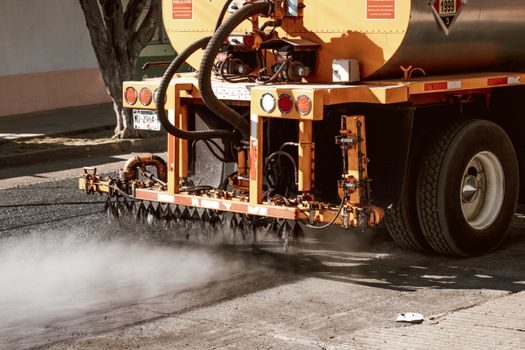
Coverage is not a single number on a TDS — it is a function of substrate absorbency, wind, sprayer pressure, and operator. CDS Group's concrete curing practice frames moisture and temperature control as the operative performance variable, with humidification chambers, curing racks, and acoustic rooms used to take wind and ambient RH off the critical path [S2]. On an open deck, a 5-7 bar airless sprayer with a 0.43 mm tip and 50 cm fan lays 0.20 L/m² at 750-900 m²/h; a knapsack at 1.5-2.5 bar lays the same film at 220-300 m²/h, with 30-50% more drift loss. That is the line item that quietly doubles the labour figure on windy pours.
Two operational rules hold across all three resin families: first, apply within 30 minutes of final finish and bleed-water disappearance, or the film is locking in evaporative loss that has already happened; second, do not over-apply past the manufacturer's wet-film rate, because the extra compound does not improve moisture retention — it lengthens tack-free time, prints under formwork, and adds a third cost line in surface preparation for the next trade. The TCO model should therefore carry coverage as a measured input, not a TDS assumption.
Site Constraints That Invalidate a Standard TCO Assumption
Four site conditions regularly break a generic TCO model. First, ambient RH below 40% with wind above 15 km/h — under this envelope, the 30-minute "apply after final finish" window collapses to 10-15 minutes, and the only way to hold the coverage line at 0.20 L/m² is to drop the sprayer pressure and shrink the fan, which drops productivity and inflates the labour line by 25-40%. Second, formed vertical surfaces, where 35-55% of the sprayed material runs off before film formation, and the practical coverage rises to 0.35-0.50 L/m² — a wax drum that is cheap on paper becomes the most expensive option on a wall pour [S3].
Third, post-tensioned or densely rebarred decks, where the operator cannot see the slab under the cable runs and over-sprays by 12-20% to compensate; fourth, slabs that will receive a moisture-sensitive floor finish, where the specifier pays for the wax, then pays again for mechanical or chemical film removal before the screed goes down. All four cases are why a curing compound spec should never be carried over from a previous project without re-running the four-line TCO.
Standards, Sourcing, and Trackable Signals

The two governing documents are ASTM C309 (liquid membrane-forming compounds for curing concrete, with Type 1 clear or Type 2 white-pigmented classes) and ASTM C1315 (specifically for acrylic curing compounds, with the higher solids and UV-resistance tier). The white-pigmented Type 2 class adds a heat-reflectance benefit on mass pours and on hot-weather decks — worth pricing into the TCO if the project sits in a hot climate and the pour thickness exceeds 600 mm. AASHTO M148 is the equivalent specification used on North American highway authority projects, and is the citation to use when the deck is publicly funded. [S2]
For sourcing, three trackable signals are worth watching. First, drum lead time: a 5,000 L project draw that has to be air-freighted from a regional hub adds 18-30% to the drum line and should be flagged in the TCO as a risk line, not absorbed. Third, shelf life: most wax and acrylic emulsions carry a 12-month shelf life from manufacture, and an expired drum on site is a documented cause of film failure. These three signals are auditable on a project as small as a single 200 m² pour and as large as a 40,000 m² deck [S2][S3].
Next, a verifiable node is the choice between wax and acrylic on a post-tensioned car-park deck in a hot climate: that single decision typically swings the 10-year TCO by 6-11% once re-walks, slip mitigation, and floor-finish preparation are counted, and it is the kind of choice the roller chain selection process and the bag filter housing TCO analyses both treat as a four-line audit rather than a single-line drum comparison.
For component-level specifications, see total station, and concrete admixture.