
Concrete groove cutter blades use cooling water to suppress silica dust, remove slurry, protect the steel core and reduce segment glazing.
Planning note: wet systems require a constant water flow rate of 2–4 L/min for optimal cooling and debris removal [S6].
Baseline flow rates by concrete saw class
A practical starting point is a constant water flow rate of 2–4 L/min for wet systems [S6].
Wet cutting systems require continuous flow of 2–4 L/min for effective cooling and debris removal [S6]. That lower band applies to the smaller equipment class and provides a useful cross-check against the handheld range, not a universal setpoint for every machine.
These are planning estimates rather than guaranteed metered volumes.
Why flow rate governs blade and cut performance
Cooling water performs three functions at the cut: it cools the diamond segments and steel core, flushes abrasive slurry from the kerf and suppresses respirable crystalline silica dust [S4].
Without adequate cooling, a blade can overheat, its segments can glaze and cutting speed can fall sharply [S2]. A hot blade is also more prone to distortion, while excess heat can damage diamond segments and reduce blade life [S2][S3].
Segmentation helps because the gaps between segments support cooling and debris removal [S5]. The selected concrete groove cutter should therefore be matched to the wet-cutting system rather than evaluated only by diameter.
Flow rate versus water pressure

Continuous volume at the blade matters more than maximum nozzle pressure because the rotating disc must carry enough water into the kerf to cool and flush it [S4].
Pressure has a legitimate role in overcoming friction loss through long hoses or correctly sized piping, but it does not replace flow [S4]. Excessive pressure can atomise the stream into airborne mist and push slurry sideways, reducing the amount of water that reaches the cut [S4].
Decision factors that change water demand
Blade diameter, rotational speed, concrete strength, aggregate abrasiveness, cut depth and feed rate also affect the operating condition [S5].
Wet operation can support a higher blade peripheral speed than dry cutting because water removes heat, and sustained water flow is especially important for long blade life [S3].
Blade speed must remain within the manufacturer’s limits. These figures apply to the referenced blades and should not be transferred to another blade without its own speed rating.
Where the water must be delivered

The stream should arrive continuously at the blade and enter the kerf, with both coolant tubes directed to the cutting area on a wet-cutting blade [S4][S7]. Correct nozzle positioning reduces wasted water and helps maintain cooling where the diamond segments engage the concrete [S1].
Delivery-system defects can reduce flow without producing an obvious alarm. Blocked nozzles, a worn pump impeller, solids in the tank and a crimped hose can all leave the blade undercooled [S4]. For a concrete-cutting cutting machine, inspect the tank, pump, filter, hose and nozzle, then confirm the delivered volume instead of judging performance from pump pressure alone.
Two coolant tubes on either side of the blade should be checked for unrestricted flow and proper alignment [S7]. A steady feed rate and correctly positioned nozzles limit both overheating and unnecessary water consumption [S1].
Application fit, controls and environmental limits
Wet cutting is appropriate where personnel need blade cooling, kerf flushing and dust suppression, but a constant 2–5 L/min supply may be unsuitable for a large walk-behind saw whose expected demand is 10–20 L/min [S1].
Water is used in concrete cutting for dust suppression, blade cooling, and lubrication [S1].
Silica control is not optional for wet work because inadequate water delivery directly weakens dust suppression [S4]. Slurry must still be contained and managed under applicable site and discharge requirements.
Commissioning checklist for a groove-cutting operation
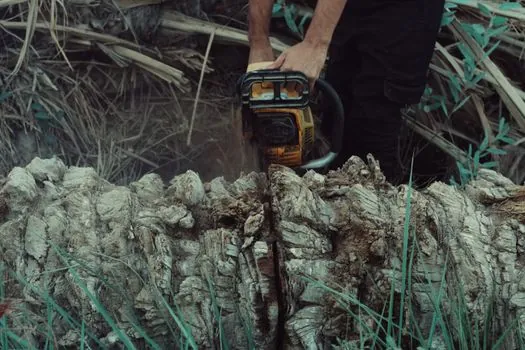
A completed wet-cutting setup should deliver its rated flow continuously, direct water into the kerf and keep the blade free of trapped debris [S4][S7].
Start with the saw and blade manufacturer’s flow requirement, then verify actual delivery with a container or calibrated flow meter. Check that both nozzles are open and aimed correctly, the hose is not kinked or crushed, the filter is clean and the pump can sustain the specified volume [S4][S7].
Track three operating signals during the first cuts: water reaching the kerf, visible spray and slurry removal at the cut, and segment or blade temperature behaviour. If performance falls or the blade heats, first verify coolant delivery before changing the diamond saw blade or increasing feed pressure [S2][S4].