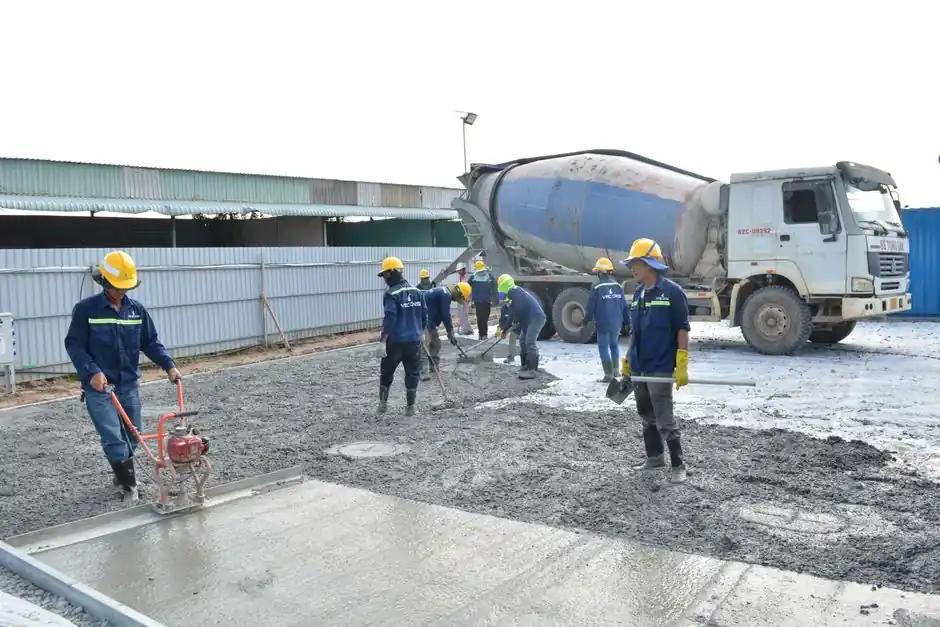
A cement specific gravity of 3.15 converts 400 lb of cement into an absolute volume of approximately 2.03 ft³ when water density is taken as 62.4 lb/ft³.
The value supports absolute-volume mix calculations for Type I cement, blended cements, supplementary cementitious materials, water, aggregates, admixtures, and entrapped air, but it remains a design input requiring material verification [S1][S2][S5].
Why Cement Specific Gravity Enters Absolute-Volume Design
Specific gravity is the ratio of a material’s mass to the mass of an equal volume of water. In the absolute-volume method, each ingredient is assigned a volume from its mass and specific gravity, and those volumes are summed to obtain the volume of concrete produced [S1][S2].
The governing relationship is “Absolute Volume = mass / (SG × 62.4)” when mass is in pounds, specific gravity is dimensionless, and water density is 62.4 lb/ft³ [S2]. A change in cement SG does not directly change the required water-cement ratio, but it changes cement volume and therefore the space available for aggregate and air.
For project-level review, the mix designer should identify the constituent and report its specific gravity to two or three decimal places. Aggregate requires separate dry and saturated-surface-dry values, while liquid admixture dosage is reported in lb/gal [S2].
Calculating Cement Volume With SG 3.15
At 400 lb/yd³, the cement volume is 400 ÷ (3.15 × 62.4) = 2.03 ft³, rounded to two decimal places. This makes SG 3.15 directly usable for the cement portion of a 1 yd³ batch calculation.
The SG value enters later during volume reconciliation, where it converts that cement mass into 5.24 ft³ of absolute volume [S3].
Comparison of Cement and Other Constituents
The comparison is straightforward when each material is judged by mass basis, density basis, volume contribution, and required state condition. Portland cement at SG 3.15 is much denser than Class C fly ash at 2.93 or blast-furnace slag at 2.85, so equal masses do not occupy equal volumes [S2].
For comparison, the same mass of lower-SG material occupies more volume: 250 lb at SG 2.93 occupies about 1.37 ft³, while 250 lb at SG 2.85 occupies about 1.41 ft³, using 62.4 lb/ft³ water density [S2]. These differences are why replacing cement with fly ash or slag changes aggregate demand even when total cementitious mass is held constant.
Choosing Cement SG 3.15 for a Mix
The value 3.15 is suitable for preliminary calculations when the product and source have not yet been established. A published Portland cement technical reference places Portland cement generally around 3.15, while Portland blast-furnace-slag and Portland-pozzolan cements may differ because of their changed composition [S5].
For final mix design, use the specific gravity of the cement actually supplied. The value applies most directly to ordinary Portland cement at approximately 3.15, not automatically to every blended or supplementary cementitious material [S1][S5]. The cement identified on the mix submittal should therefore be the material represented by the SG entry.
This parameter is suitable for engineers preparing an ready-mix concrete trial batch, estimating material volumes, and reconciling batch yield. It is not suitable as a substitute for measured material data, a strength trial, or an approved mix submittal. A 400 lb/yd³ cement dosage at SG 3.15 and a 340 lb/yd³ water dosage are design quantities, not acceptance criteria for a completed batch.
Blended Cement and Supplementary Materials
Concrete Technology Manual review guidance treats cementitious materials as distinct components whose proportions and properties must be checked.
A designer who applies 3.15 to all three materials overstates the volume occupied by the two lower-density binders and can incorrectly reduce aggregate volume.
For blended systems, the decision criterion is simple: use 3.15 for material whose documented SG is 3.15, and enter the verified value for every other binder or supplementary cementitious material. If the product is a blended cement, the supplier’s product data and the project’s approved submittal take precedence over a generic default [S1][S2][S5].
Aggregate Moisture, Air, and Yield Checks
Specific gravity is only one part of a complete volume balance. The absolute-volume calculation also includes water, aggregate, solids from admixtures, and air; the sum equals the volume of concrete produced per batch [S1][S2]. Air cannot be ignored because it occupies space that would otherwise be filled by paste or aggregate.
Aggregate values must match the condition used in the calculation. The ASCE example requires both oven-dried (OD) and saturated-surface-dry (SSD) specific-gravity values for aggregates and directs that absorption and moisture content be reported to the nearest 0.1%. Aggregate absorption and moisture percentages should be reported to the nearest 0.1% [S2].
Admixtures also require a separate quantity basis. The worked example specifies high-range water-reducing admixture at 6 fl oz/cwt with 47% solids by weight and 8.5 lb/gal, plus liquid dye at 20 fl oz/cwt with 50% solids and 10.0 lb/gal [S2]. The volume balance should include admixture solids rather than treating the full liquid dosage as solid material.
Verification Before Mix Approval
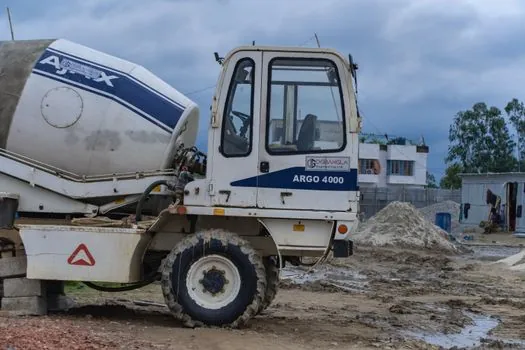
The first verification is documentary: confirm the cement type, source, and SG on the mix-design submittal. ASCE guidance explicitly warns that generalized SG values in an example are for mathematical demonstration and should not serve as the basis for project design calculations [S2].
The second verification is numerical. Recalculate cement volume with the submitted SG, compare it against the original 3.15 assumption, and inspect whether the change is physically plausible. A small SG change has a larger effect at high cement dosage, while a change in aggregate moisture can alter batch water and therefore effective water-cement ratio [S1][S2].
The third verification is production-based: compare calculated yield with measured unit weight and adjust the mix if the difference reflects an unaccounted input. ASCE’s example uses a 99.55 lb/ft³ wet design unit weight, 11.3% design air content, and a relative yield check, demonstrating that a mathematically complete table still requires production validation [S2].
Track the submitted cement SG, aggregate moisture and absorption percentages, and measured batch yield before releasing a final mix. If the project requires accelerated construction or controlled early strength, the separate selection of concrete admixtures must remain consistent with the selected water-cement ratio and air content rather than being adjusted after the volume balance is complete.