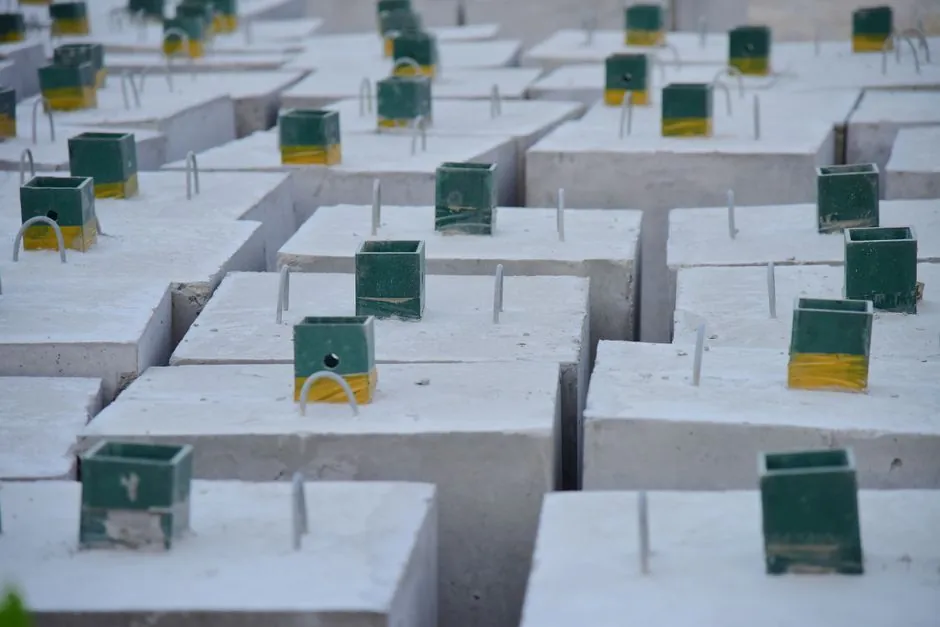
Prestressed concrete has a water-soluble chloride-ion limit of 0.06% by mass of cement, while a conservative 0.10% ceiling can apply where a code permits it [S2][S5][S7].
The limit covers chloride introduced through cement, aggregates, water, admixtures, and grout, with water-soluble chloride being the controlling measurement rather than total or acid-soluble chloride [S4].
Prestressed Concrete Has the Tightest Chloride Limit
Prestressing steel requires a stricter chloride limit than ordinary reinforcement because stressed strand has less tolerance for corrosion than unstressed reinforcing steel [S1]. A commonly cited limit for prestressed concrete is 0.06% water-soluble chloride ion by weight of cement [S6], while IS 456 permits up to 0.30% by mass of cement for reinforced concrete in mild and moderate exposure [S7].
IS 456 lists a maximum chloride content of 0.10% by mass of cement for prestressed concrete. The same framework permits 0.20% for reinforced concrete in severe, very severe, and extreme exposure and 0.30% for mild and moderate exposure [S7]. The 0.06% value is a commonly cited acceptance target for prestressed concrete [S6], while IS 456 specifies a maximum of 0.10% by mass of cement [S7].
This is not interchangeable with the cement-mass limit, so a compliant water supply can still produce a noncompliant finished mix if other ingredients add chloride.
Water-Soluble Chloride Is the Controlling Quantity
Concrete chloride limits are expressed as chloride ion, not as calcium chloride or another salt mass [S4]. Specifiers should therefore require a water-soluble chloride-ion result expressed as a percentage by cement mass.
Concrete admixtures can contribute chloride even when the mix is designed around chloride-free cement, and the baseline chloride in typical mixes made with local materials was measured at 0.05% to 0.10% by weight of cementitious materials [S3].
Chloride limits do not apply to plain concrete with minimum reinforcement or embedded welded wire mesh used for crack-width control [S4].
Code Limits Are Not Corrosion Thresholds

An allowable chloride limit is the maximum chloride content permitted in fresh concrete by the relevant authority, whereas a corrosion threshold is the concentration that actually initiates corrosion of passivated steel [S1]. The distinction matters because corrosion depends on more than a laboratory chloride number, including exposure, moisture, oxygen, stress level, and concrete composition.
A PCI study found that the threshold water-soluble chloride content above which corrosion of prestressed tendons occurred during and immediately after curing was between 0.11% and 0.17% [S5]. A PCI study found that development of active corrosion of prestressed tendons depends not only on the presence of chloride ions in the concrete but also on the environment into which the concrete member is placed [S5]. That behavior explains the engineering basis for a conservative prestressed-concrete limit rather than reliance on favorable field exposure.
Limits, Failure Modes, and Concrete Type
The principal failure mechanism is chloride-induced depassivation of steel, followed by corrosion when moisture and oxygen are available. Rust expansion then causes cracking and spalling of cover concrete [S4]. The concrete pore solution normally has a pH of about 13 to 13.8, while carbonation can reduce it below 9 and independently initiate corrosion [S4].
Permeability and diffusion matter as much as the initial batch value. Water-cement ratio influences moisture, oxygen movement, and chloride diffusion rates [S5].
For comparison, an IS 456 summary gives four clear exposure-based classes: 0.10% by cement mass for prestressed concrete, 0.20% for reinforced concrete in severe to extreme exposure, 0.30% for reinforced concrete in mild to moderate exposure, and 0.40% for plain concrete [S7]. This ordering makes the selection straightforward: prestressed members require the lowest limit, while reinforced and plain concrete allowances depend on exposure and reinforcement status.
Procurement Control Must Trace Every Chloride Input
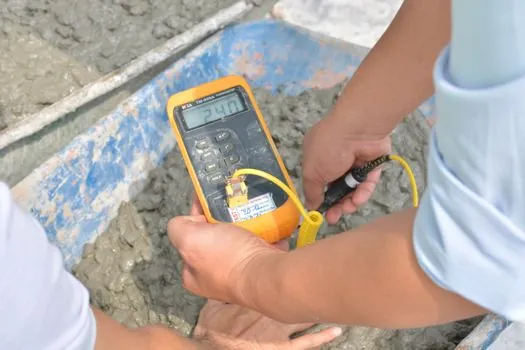
A defensible prestressed-concrete specification identifies 0.06% water-soluble chloride ion by mass of cement as the target limit and states the approved exception, if any, in writing [S2][S5]. It should also require the same chemical basis for laboratory reporting, because a total-chloride result cannot be substituted for a water-soluble result [S4].
Mix qualification should quantify chloride from the actual cement, aggregate, batching water, and admixtures rather than checking each material in isolation. Aggregate wash water and recycled water are easy omissions, while calcium chloride or chloride-bearing accelerators are direct additions [S5]. For post-tensioned work, grout requires separate scrutiny because contamination can bypass the limits applied to the structural concrete.
The FHWA found 5.27% chloride by cement mass in an anchorage area of a Texas post-tensioned bridge and concentrations up to 0.5% in retained grout bags [S1]. Those values exceed prestressed-concrete and grout limits, demonstrating why concrete compliance does not establish grout compliance. Prestressing systems can include several corrosion-protection layers, but those layers do not justify contamination or replace material acceptance controls [S1].
Testing and Acceptance Need a Closed Decision Chain
Material certificates should state the chloride-ion contribution on a consistent cement-mass basis, and the producer should calculate the combined batch contribution before concrete production. The ready-mix concrete delivery record should identify the actual cementitious materials and admixtures so a laboratory result can be traced to the submitted mixture rather than to a generic formulation. [S3]
Confirmation testing should examine water-soluble chloride ion at the required percentage by cement mass, with the laboratory method stated on the report. A result of 0.06% meets the common prestressed-concrete limit, while 0.10% requires acceptance under a specification or authority that expressly permits that higher ceiling [S2][S5][S7]. A batch at 0.24%, for example, remains unsuitable even though laboratory work identified that level as a depassivation point for stressed strand under particular conditions [S3].
For project records, retain the constituent certificates, calculated chloride contribution, sampled concrete test, approval authority, and any approved deviation as one package. That package makes the decision auditable if field results later require investigation. For further guidance on specifying compatible cement types, see CEM II/A-L vs CEM II/B-L limestone cement.
The next trackable check is the delivered mix: verify that its combined water-soluble chloride is at or below 0.06% by cement mass unless the governing specification expressly permits 0.10%, and confirm that grout and curing compounds are controlled under the same chloride-management discipline.