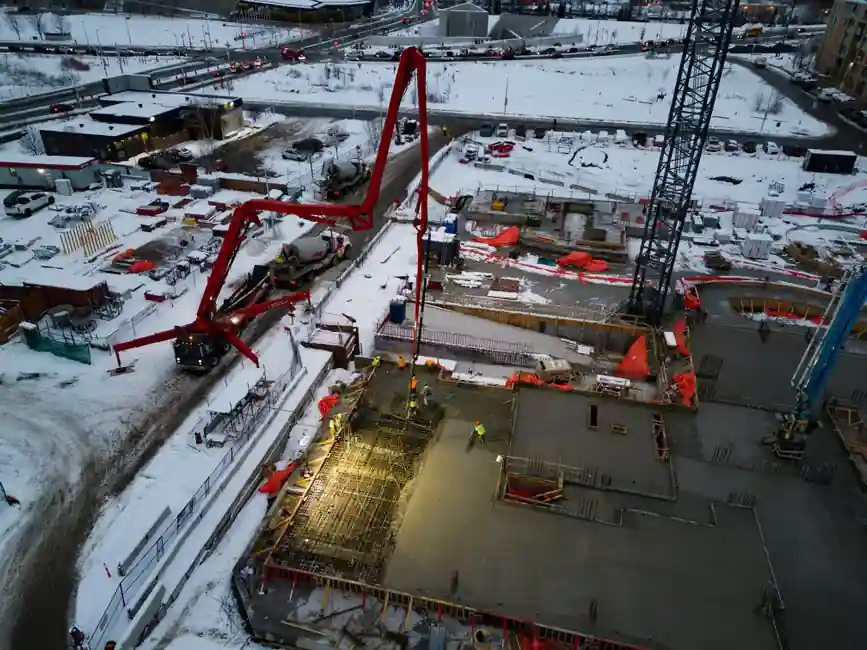
A truck-mixer drum turning 12-18 revolutions per minute during the mixing stage and 2-6 RPM in transit, with 70-100 revolutions at mixing speed required after the last ingredient enters, per ASTM C94 as cited in transit-mixer operating guidance [S3].
Mixing speed and agitation speed are not interchangeable terms; they describe two distinct drum regimes on the same truck, separated by roughly a 3-9x RPM ratio, and the boundary between them is enforced by the hydraulic drive and by the operator's drum-speed selector rather than by the drum geometry itself [S5].
Mixing Speed: 12-18 RPM, 70-100 Revolutions
Charging and mixing speed sits at 12-18 RPM on a typical rear-discharge transit mixer, with the drum turning fast enough that the internal helical blades lift the batch up the back wall, drop it through the centre, and fold it forward toward the charging end [S3][S4]. At 18 RPM, 100 revolutions resolve to roughly 5.6 minutes of contact time between cement and water, which is the lower bound for a homogenous batch; at 12 RPM, the same 100 revolutions stretch to about 8.3 minutes, which is why batching plants hold the higher figure as the default on long haul windows [S3].
The 70-revolution minimum comes from yard-mixed transit-mix practice: complete the mix at the plant, then check and adjust slump and air content before the truck leaves [S4]. The 100-revolution figure is the upper end of the C94 mixing window and is typically called out when the drum is fed dry-batched ingredients and water is added at the chute [S2][S3]. Pushing past roughly 300 revolutions begins grinding the coarse aggregate and turns the mix harsh, a field failure that shows up as a wet ring of un-mixed slurry in the discharge end of the drum [S3].
Agitation Speed: 2-6 RPM, Drum Always Turning
Once the truck leaves the plant, the drum rotation drops to less than 6 RPM for the haul, with 2-6 RPM being the operating window cited in transit-mixer and ready-mix reference material [S2][S3]. The function at agitation speed is not to mix; it is to keep coarse aggregate from settling below the paste and to keep the mix from skinning over during the haul window [S5]. Sany's operating description names this regime explicitly: the drum "continuously rotates in a clockwise direction at a set speed" using the internal blades, preventing segregation and moisture separation, with the option for the operator to add water through the truck's onboard tank if the mix stiffens in traffic [S5].
Agitation speed is bounded by a hard upper limit for a reason that is thermal as much as mechanical. Above 6 RPM in transit, the drum generates frictional heat against the paste, accelerates cement hydration, and the load arrives at the pour with measurable slump loss, a problem compounded in 35 °C ambient where the truck has been fighting traffic [S2][S3]. Lower bound of the 2-6 RPM range is set by segregation risk: below roughly 2 RPM, the coarse aggregate settles through the paste in 30-45 minutes and the load has to be re-mixed at the site, which counts toward the 300-revolution over-mixing ceiling [S3]. For a primer on the concrete mixer truck itself, the operating envelope is defined by this two-speed hydraulic regime rather than by drum capacity.
Three Mixing Methods, One Drum
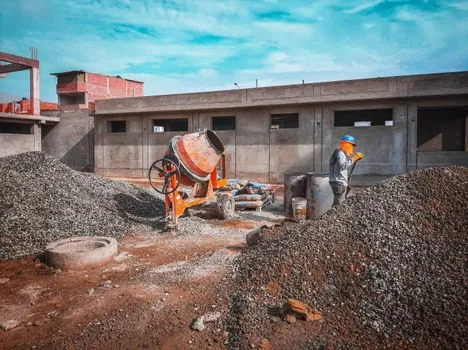
Concrete Alberta's transport guidance identifies three ways a transit mixer can be loaded and run, and the drum speed profile changes for each [S4]. In yard-mixed transit mix, the drum turns at 12-18 RPM for about 70 revolutions at the plant, then drops to agitation speed for the haul, which is the most common configuration and the only one that allows the batch team to verify slump and air before the truck pulls out [S4]. In jobsite-mixed, the drum is held at slow agitation while travelling, then the operator brings it back up to mixing speed on arrival; this approach is falling out of favour as set-control admixtures extend the workable haul window [S4]. In transit-mixed, the drum turns at a medium speed during the haul, then slows to agitation near the site, a method that saves drum wear and fuel but skips the pre-departure slump check [S4].
Shrink-mixed concrete uses a fourth regime: a stationary central mixer does the partial mix, the truck drum charges at high speed, and roughly 30 additional turns at mixing speed finish the homogenisation [S4]. A truck used in central-mix service runs only as an agitator on the highway, because the work is done before the concrete ever enters the drum [S4].
Hydraulic Drive, Reversible Drum, Single Blade Set
Both directions of rotation use the same helical blade set; reversing the drum flips the blades from charge-direction to discharge-direction, which is why the operator panel has a direction selector as well as a speed selector [S3][S5]. Power flows from the truck engine through a hydraulic pump, motor, and gearbox to a ring gear or hydraulic motor mounted on the drum, with the water supply system plumbed separately for in-transit slump correction and end-of-day drum washout [S5].
For a related truck-mounted concrete pump running on a different operating cycle, the hydraulic architecture is similar but the speed envelope is fixed at one work range, not two. A more granular look at 8 m³ vs 12 m³ drum sizing shows why fill ratio matters at 12-18 RPM: the same blade geometry is asked to lift a heavier mass at mixing speed, which is one reason operators see a wet ring of un-mixed slurry when blades are worn and the fill level approaches the upper end of the rated volume [S3].
Revolutions, Not Minutes, Are the Real Spec
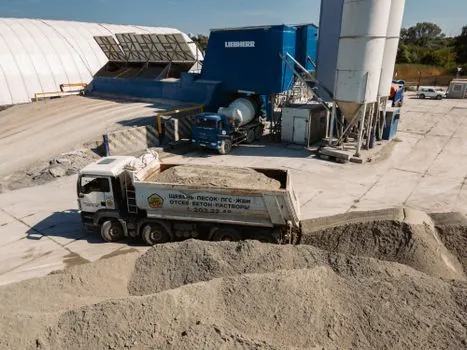
The mixing requirement is written in revolutions, not minutes, and that is intentional because drum speed on a truck is not constant: a hydraulic system running at low engine RPM may hold 12 RPM, while a truck running the engine at governed RPM on a downgrade can creep toward 18 RPM without the operator touching the drum-speed selector [S3]. ACI's FAQ states the requirement as 100 revolutions at mixing speed after the last ingredient enters, with agitation speed held below 6 RPM, and a cap on total revolutions before discharge to limit the over-mixing failure mode [S2].
For a concrete pump on the receiving side of the chute, the concrete pump truck sees a load whose homogeneity was set by those 70-100 revolutions at 12-18 RPM; an under-mixed or over-mixed load at the pump shows up as blockages in the boom pipe and as variable slump at the nozzle, both of which the pump operator blames on the mixer truck [S3][S5]. Operators who run a drum too hot during haul pay for it twice: once as slump loss at the pour, and once as drum-blade wear on the next 10-20 loads [S3].
Spec Summary: Mixing vs Agitation
Mixing speed: 12-18 RPM, 70-100 revolutions minimum after last ingredient, with roughly 300 revolutions as the over-mixing ceiling [S3][S4]. Agitation speed: 2-6 RPM, kept below 6 RPM to limit frictional heat and slump loss, with the drum turning continuously during haul [S2][S3][S5]. Yard-mixed transit mix: 12-18 RPM for about 70 revolutions at the plant, then drop to agitation [S4]. Shrink-mixed: partial mix in stationary mixer, then 12-18 RPM for roughly 30 finishing turns in the truck drum [S4]. Central-mix truck service: agitation only, no mixing duty on the truck [S4].
Drum-blade wear remains the field failure most often traced to speed-and-revolution mistakes: a worn blade set no longer scoops the bottom of the drum at 12-18 RPM, and a wet ring of un-mixed slurry sits in the discharge end, which is the visual signal an operator uses to call for blade replacement before the next 300-revolution cycle [S3]. The drum speed selector on the cab panel is the only enforcement point for the 12-18 / 2-6 RPM split, and on a hydraulic-drive truck the speed ratio is fixed by gear reduction in the drum motor, not by operator discretion [S5].