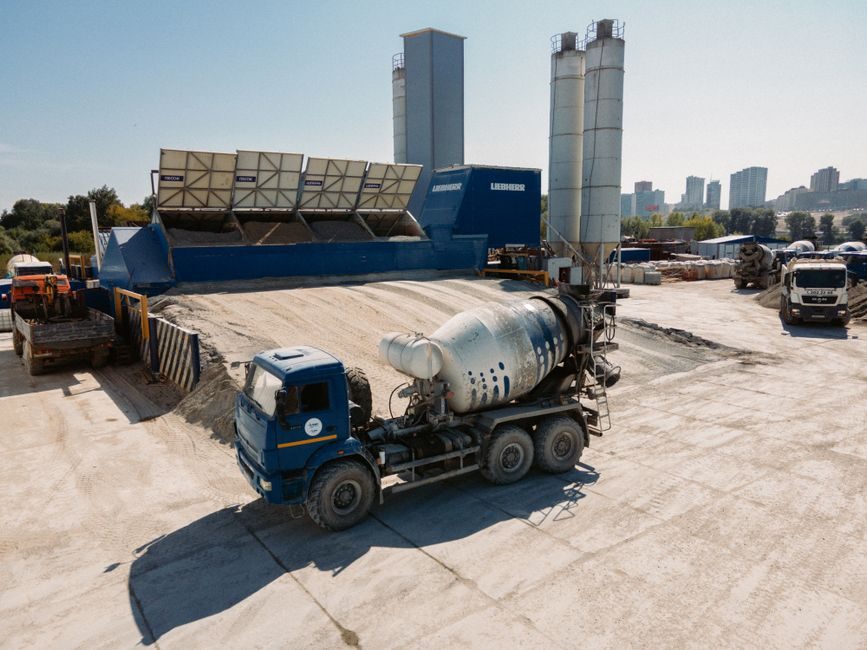
Concrete pump trucks split into truck-mounted boom pumps and line (stationary) pumps; the four buying gates are vertical reach, hourly output, chassis GVW class, and delivery-pipe wear-life, and getting any one of them wrong burns the rest of the budget [S2].
The two-machine taxonomy is fixed: a boom pump uses a remote-controlled articulating arm on a truck or semi-trailer for high-rise and large deck pours, while a line pump mounts a hose reel on a truck bed for horizontal runs on small jobs [S2]. Output, reach and placement precision scale with the boom, not the chassis, so chassis selection is downstream of reach.
Boom Reach and Output: the First Spec Gate
Boom reach is the single number that determines whether a truck can pour a given slab, deck or wall without repositioning, and it ranges roughly from 28 m on compact four-axle units to 70 m+ on six-axle premium builds [S2][S6].
Output is set by the hydraulic pump and the concrete cylinder geometry. The Schwing KVM37XG is published at 90 m³/h with welded-type hydraulic cylinder construction and ISO 9001:2000 build certification [S6]. Hangzhou Truemax markets a stationary pump line spanning the SP50.10.60D up to the SP100.23.264D, where the model code encodes 50-100 m³/h theoretical output and 10-23 MPa pressure class [S3].
A useful rule for U.S. deck pours: 1,500-3,000 m³ placements are usually covered by a 47-ton class (HB52) boom truck, with single-unit throughput in the 90-170 m³/h band when concrete supply keeps up [S7]. Bigger reach means longer setup time, more outrigger pad load, and a chassis heavier than 47 t.
Chassis and Axle Class: the Second Gate
Chassis gross vehicle weight is the second gate, because bridges, jobsite access roads and axle-load laws all constrain it. The HB52-class 47-ton boom truck sits on a 4- or 5-axle chassis, while KVM37XG and similar 37-37.5 m units use a 4-axle chassis suitable for tighter urban sites [S6][S7].
For pours above 52 m of vertical reach, expect a 5- or 6-axle chassis at 50-63 t GVW; below 37 m, a 3- or 4-axle chassis at 30-40 t is the norm. Pay attention to bridge and jobsite axle limits, since the rear-axle load with the boom deployed can exceed 12 t per axle and outriggers need 4 m × 4 m of clear pad [S6][S7].
Dongfeng Xinda, a specialist concrete-pump-truck manufacturer, frames chassis choice as part of an integrated urban-rural infrastructure package, pairing boom pump builds with sanitation and logistics vehicles on shared platforms [S8]. That bundling matters in fleet procurement, since service parts and operator training stay common across SKUs.
Delivery Pipe and Wear-Bend Life: the Third Gate

The DN125 delivery pipeline is the consumable core of any boom pump, and bend material choice sets operating cost more than any other spec. The Putzmeister-class elbows published on OEM part catalogues split into four tiers [S5]:
Tier 1 — Normal bend in ZG40Mn2 cast steel, 16 kg, 6,000-8,000 m³ full-pipe life and 1,000-3,000 m³ two-end life, max working pressure 126 bar. Tier 2 — Wear-resistant Mn13-4 austenitic high-manganese casting, 16.5 kg, 20,000-25,000 m³ full / 2,000-7,000 m³ two-end, 132 bar. Tier 3 — Twin-wall Cr20NiCu1Mo shell with G20 inner liner, 15 kg, 60,000-80,000 m³ full / 20,000-30,000 m³ two-end, 91 bar. Tier 4 — Twin-wall GX350 + G20 inner, 15 kg, 80,000-150,000 m³ full / 40,000-50,000 m³ two-end, 98 bar [S5].
That range — roughly 13× between the cheapest and the longest-life twin-wall bend — is the largest single cost swing in a pump's lifetime. The same DN125 R1000 45° geometry appears across the catalogue, confirming that wear life is a function of the liner alloy, not the elbow radius [S9][S10]. For high-abrasion mixes (crushed basalt, high-slump fluid concrete), step up to a twin-wall bend; for civil-grade ready-mix, a single-wall Mn13-4 wear-bend gives the best €/m³.
Hydraulic Drive and Pumping Circuit: the Fourth Gate
All modern truck-mounted boom pumps run open-circuit hydraulics with an axial-piston main pump driving differential-cylinder concrete cylinders. The Machining Process field on Schwing's KVM37XG datasheet confirms the welded-type, hydraulic-cylinder category, which is the dominant architecture in this class [S6].
Main pump control is typically load-sensing hydraulic with electric proportional (or servo) valves, not pure electric, since pressure peaks on the concrete side reach the 85-130 bar band shown by the elbow ratings [S5][S9]. Reverse pumping for siphon-clear and pipe-prime is standard, and S-valve or gate-valve rock-hoppers handle aggregate up to 40-65 mm depending on model [S6].
Maintenance intervals to budget: boom lubrication every 50-100 h, S-valve wear-plate inspection every 2,000 m³, and concrete-delivery-pipeline rotation/replacement aligned to the bend life table above.
Selection Criteria Comparison: Line Pump vs Boom Pump vs Stationary
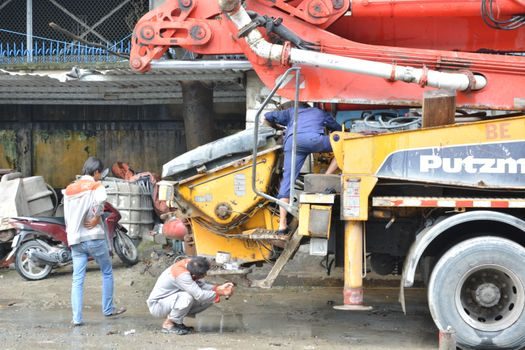
The three deployment options are not interchangeable. A line pump (truck-mounted hose reel) is the right pick for residential slabs, pool decks and sidewalks where horizontal run + access to 2-3 discharge points is the bottleneck; it costs less, but caps at roughly 80-90 m³/h and short reach [S2].
A truck-mounted boom pump is the right pick for commercial decks, mid-rise columns and bridge piers; the articulating arm places concrete within a 28-70 m radius, output sits at 90-170 m³/h, and total cost rises sharply with reach [S2][S6][S7]. A stationary (trailer or skid-mounted) pump is the right pick for tunnelling, dam placements and long-distance horizontal runs, often paired with a separate placing boom — see truck-mounted concrete pump for the architectural distinction.
Decision rule used on the job: if the pour requires more than 25 m of vertical lift or more than 40 m of horizontal reach, specify a boom truck; if total volume is below 200 m³ and access is tight, a line pump wins on cost; if total volume exceeds 5,000 m³ and the site has fixed delivery points, use a stationary pump plus separate placing boom.
Who It's For — and Who Shouldn't Buy
A 47-63 t boom truck pays back in any region with monthly ready-mix placements above 8,000 m³, or on sites where crane-and-bucket placement is unionised or insurance-restricted [S6][S7]. It is the wrong tool for one-off residential pours under 100 m³, where a concrete mixer truck + wheelbarrow crew or a small line-pump rental is cheaper.
Buyers who do not have a service radius within ~150 km of a dealer-stocked wear-bend warehouse should not buy a boom truck; lead time on DN125 twin-wall bends runs 4-6 weeks, and one wear-bend failure on a high-rise pour can exceed the value of the truck's monthly output [S5][S9]. For operations that already run dump-truck or mixer-truck fleets and have in-house heavy-truck service bays, the dump truck platform shares axle and brake parts with the lower boom-truck chassis, which simplifies spares.
Failure Modes, Limits and Operator Risk
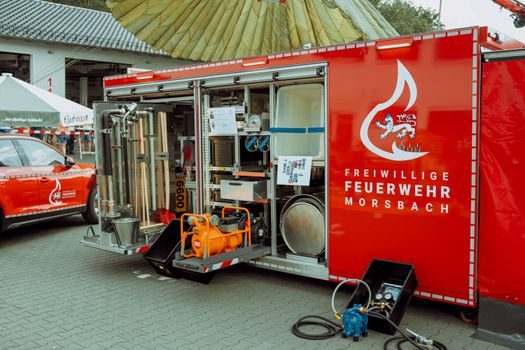
The three dominant field failures on boom pumps are delivery-pipe blockages, boom hydraulic-hose bursts, and S-valve wear-plate scoring. All three trace back to mix design, pipe-priming discipline, or operator technique rather than the machine itself [S2].
Concrete boom pumps have a documented tip-over risk when outriggers are set on uncompacted backfill; field data and operator guidance consistently call for 4 m × 4 m of cleared, level pad per outrigger and a mandatory pre-pour hand-dug inspection at the outrigger foot [S2]. The operator is also responsible for daily boom lubrication, end-hose cleaning, and post-pour pipe-flush, all of which directly extend elbow life.
Working-pressure ceilings on the DN125 system (85-132 bar depending on bend tier) set the upper bound on cylinder hydraulic pressure; exceeding this for sustained periods accelerates S-valve wear and risks pipe-joint blowout, which is why suppliers publish max working pressure on every elbow SKU [S5][S9][S10].
Standards, Sourcing and 2026 Market Signals
Build quality on the major Chinese OEM lines (Schwing, Putzmeister-licensed, Truemax, Hongda, Dongfeng Xinda) is typically certified to ISO 9001:2000 build standards for the pump assembly, with welding procedure and non-destructive testing on the boom and outrigger structures following separate national standards [S6][S7]. Buyers should request the actual certificate numbers and audit dates, not just the standard reference, since ISO 9001:2000 is the older revision and current plants have migrated to ISO 9001:2015.
Sourcing signal as of mid-2026: Shandong Hongda Heavy Industry lists concrete pump trucks alongside tower cranes, construction elevators, mixer trucks and trailer pumps under standard T/T and L/C payment terms with FOB China-main-port loading, signalling that integrated Chinese OEMs are still consolidating the full product family on shared platforms [S1]. The Twin-wall GX350 + G20 wear-bend tier (80,000-150,000 m³ life) is now routinely stocked by the same exporters that handle DN125 R1000 45° spare bends, which means spares for a mid-2026 boom truck are available off-the-shelf rather than custom-cast [S9][S10].
For a broader look at the equipment class itself, the concrete pump truck reference page cross-checks chassis, boom and pump data; for adjacent heavy-machinery selection work, the hydraulic press selection guide and the core drilling machine price 2026: rig class, power pack and spec cost map follow the same four-gate spec discipline. Next verifiable signal to track: any ISO 9001:2015 audit certificate re-issued for the OEM plant that built the truck, plus the next wear-bend price revision, which historically moves every 6-9 months.