A concrete pump truck concrete-pump-truck operated 1,800 hours per year will accumulate roughly 18,000 hours over a 10-year holding period, and the wear-part line items — S-tube wear plate, delivery cylinders, hopper gates, and outrigger pads — dominate mid-life cost when modeled against original capital [S8].
Spec-driven fleets that benchmark cost per cubic yard rather than per machine-hour typically run 20–63 m vertical reach units paired with truck-mounted-concrete-pump configurations suited to bridge, high-rise, and slab pours; both are recorded as the standard answer classes on the Castle Pump California fleet, which spans 20 m line pumps through 58 m boom units [S3].
Capital acquisition and how it scales with reach class
New boom reach from 24 m to 63 m drives the single largest purchase-price jump: a 24 m unit typically lists at the low end of the used-truck import bracket, while a 63 m five-section boom unit commands a multi-fold premium, and second-hand Chinese OEM stock (SANY, Zoomlion, XCMG) imported via dealers such as Juyi International lists ten concrete pump truck SKUs alongside 318 crawler cranes, indicating active cross-border supply at sub-new pricing [S2].
Buyers evaluating capital should anchor on three concrete numbers: chassis GVW rating, boom section count, and theoretical output (m³/h). Chassis GVW must exceed the wet-pour mass of the truck plus water tank plus boom dead-load; a 4-axle 63 m unit typically requires an 8×4 or heavier configuration to remain road-legal, and a smaller 3-axle 28–38 m truck is the common urban-delivery class on the Quality Concrete Pumping Florida fleet, which runs twelve Putzmeister hydraulic units from 30 yd³/hr to 70 yd³/hr (≈23–54 m³/hr) [S6].
Fuel, DEF, and energy share of operating cost
Electric-pump trailer configurations exist for indoor or low-emission sites, but the truck-mounted boom class remains diesel-driven, and the operating-cost differential between a 24 m and a 63 m unit narrows once fuel is allocated per cubic yard delivered, because the larger pump places more volume per mobilisation and amortises engine hours across more billed yards [S3].
Wear parts, boom overhaul, and the maintenance cost stack
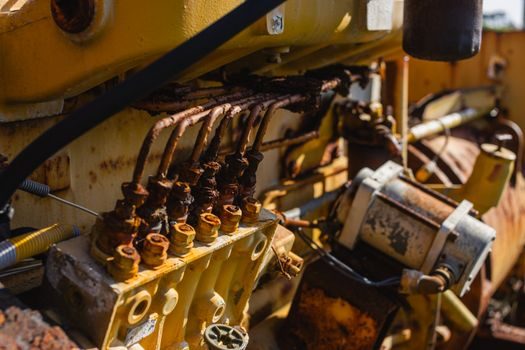
Wear parts supplied through dedicated OEM channels (Putzmeister, Schwing, SANY, Zoomlion, XCMG) form the recurring cost layer: S-tube and wear-plate replacement intervals on a 50–70 m³/h machine typically fall in the 8,000–15,000 m³ pumped range, and aftermarket suppliers such as SANF explicitly market this as a total-cost minimisation lever — "consistent product quality for 15 years" and parts coverage across all four major OEM lines [S8].
Boom structural inspection and hydraulic-cylinder rebuild cycles are the second maintenance layer, and a 10-year cost stack should reserve one full boom overhaul between years 6 and 8, sized in line with the OEM's cycle-hour bulletin. Cross-brand parts supply through dealers stocking Putzmeister, Schwing, SANY, Zoomlion, and XCMG references means fleets are not locked to OEM service centres for wear items, although boom-section welding and certification still requires OEM-trained personnel [S8].
Financing, resale, and how depreciation moves the answer
Depreciation on a concrete pump truck follows a steeper curve than on a concrete-mixer-truck because boom reach and pump-hour metres are tracked in the resale market; a unit with documented low hours, full service history, and a recent boom inspection commands a clear premium over an undocumented truck of the same calendar age [S2].
Financing cost is set by chassis residual values, which in turn reflect Tier rating and emission standard; pre-Tier 4 trucks imported as used inventory have shorter remaining service life in regulated markets and correspondingly lower finance advance rates, so the effective TCO spread between a new Stage V 63 m unit and a used Stage III-A 47 m unit narrows once financing is included in the comparison.
Utilisation profile: who the 10-year TCO math is FOR (and who it is NOT for)
The 10-year TCO model fits mid-size pumping contractors running 1,500–2,500 hours per year on a mixed reach fleet of 28–58 m boom units with two to four truck-mounted pumps and one to two line pumps — the operating profile Castle Pump documents in Northern California, with boom units spanning 20–58 m and ACPA-certified operators scheduled across multiple daily pours [S3].
It is NOT for owner-operators running below 800 hours per year; in that band purchase cost per hour is dominated by depreciation, and a rental or subcontractor model typically beats ownership. It is also not a useful frame for mega-fleet buyers who negotiate direct OEM frame agreements, since their per-unit capital and parts cost falls well below the mid-market assumptions used in any public TCO model.
Cost-driver comparison across the main concrete-pump options
Three configurations cover most contractor decisions, and a side-by-side read of cost drivers looks like this: a 24–28 m boom pump on a 3-axle chassis scores lowest on capital and fuel per hour, but highest on cost-per-cubic-yard for high-rise pours because mobilisation count rises; a 38–47 m four-section boom pump sits in the middle on every line and is the common fleet backbone; a 56–63 m five- or six-section boom pump scores highest on capital, fuel per hour, and boom overhaul reserve, but lowest on cost-per-cubic-yard for tall-core pours where fewer mobilisations cover more volume per shift [S3][S6].
Selection therefore depends on the dominant project type: low-rise slab and foundation work rewards the 24–28 m class; mixed commercial and mid-rise work rewards the 38–47 m class; high-rise core and long-span infrastructure rewards the 56–63 m class. The TCO math shifts accordingly, and the same machine will return a different cost-per-yard number under each utilisation profile. For related cost-stack logic on a sister machine class, see concrete mixer truck TCO 10-year analysis, and for a types-and-reach comparison that informs the option above see concrete pump truck types reach and chassis map.
Trackable signals for the next buying cycle
Two signals are worth monitoring over the next two quarters: OEM warranty bulletin changes for S-tube and wear-plate replacement intervals, which directly cut the wear-part line item, and dealer-reported import volume for used 47–63 m units, which sets the residual-value assumption that the 10-year TCO model is most sensitive to [S2][S8].