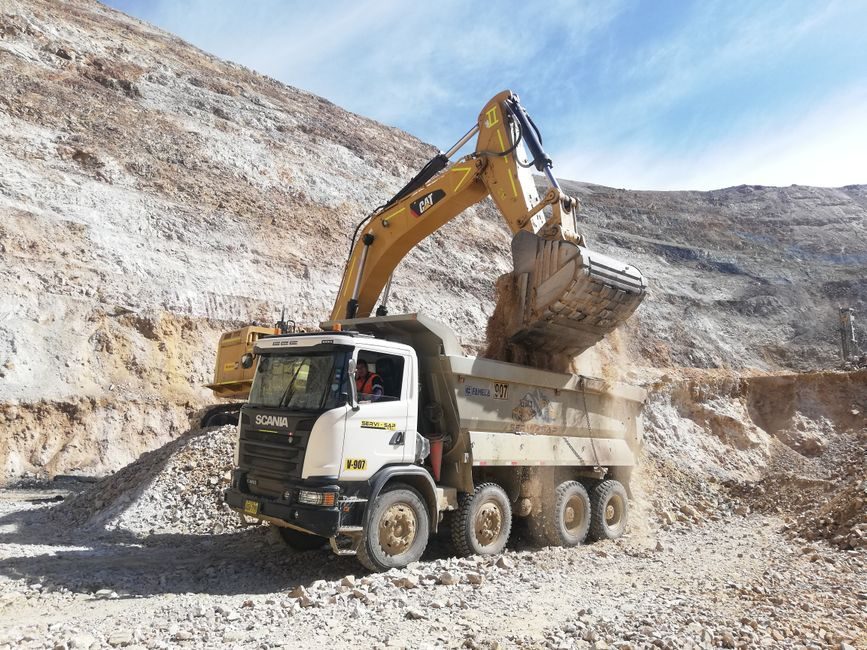
On a 6×4 chassis, a 38 m concrete pump truck is offered with a 1500 PCS/month supply capability out of Shanghai [S4], while a comparable heavy-duty dump truck rolls off lines from SAIC Hongyan-class builders at multi-model scale [S3] — the two machine classes are built on overlapping truck platforms yet serve opposite ends of a pour-and-haul job site.
The split comes down to function: a concrete pump truck pushes liquid concrete vertically and horizontally through a multi-section boom, while a dump truck hauls aggregate, spoil or mixed demolition mass. Both run on similar 6×4 / 8×4 / 6×R4 axle layouts, and both are typically sourced alongside batching plants, stone crushers and concrete mixer trucks from the same Chinese OEM cluster [S5][S6].
Reach and Output: Pump Truck Boom vs Dump Truck Bed
A 38 m concrete pump truck on a 6×R4 chassis is the current mid-band workhorse, with placement booms typically folding in 4–5 sections and theoretical output in the 120–170 m³/h band depending on the piston/valve generation [S4]. At the top end, 62 m concrete pump trucks are listed as flagship offerings in 2026 OEM catalogs, sharing the same 5–6-section RZ-fold geometry but on multi-axle (7-axle or 8×4-class) subframes [S1]. A 45 m ladder-lift variant and a 45 m aerial-platform variant are sold off the same modular boom family, which is why OEM catalogs from JUHE GROUP market 38/45/62 m as a coherent range rather than three unrelated SKUs [S1].
A dump truck, by contrast, has no boom. Capacity is rated by payload tonne and struck/heap body volume; on-road 6×4 dump trucks commonly sit in the 25–40 t payload band, while off-highway mining dump trucks jump to 90–360 t class with rigid-frame construction and mechanical or AC-drive powertrains. A useful rule on a job site: if the concrete has to move further than roughly 100 m horizontally or climb more than one floor, the pump truck earns its keep; if the material is dry aggregate, muck or demolition rubble, the dump truck is the only relevant tool.
Chassis, Driveline and Axle Logic
Both classes lean on 6×4 and 8×4 configurations as the baseline, with 6×R4 (R = reinforced double-drive rear bogie) listed for higher-payload pump applications [S4]. SAIC Hongyan's heavy-duty range — tractor unit, dump truck, cargo truck, special truck — is built around this same axle family, which is why fleets frequently cross-spec components like drive axles, retarders and ABS/EBS controllers across pump, mixer and dump variants [S3].
Pump trucks add a rear outrigger matrix (front X, rear H or X) for boom stability; dump trucks add a hydraulic tipping cylinder, reinforced subframe and a HARDOX-grade body floor. The stabiliser spread on a 62 m pump can exceed 9 m each side, which dictates site footprint and often forces one-way access roads on tight pours [S1]. For dump trucks, the same 6×4 chassis is leveraged with different body lengths (4.2–6 m struck, 5.8–8 m heaped) and tailgate/round-bottom options, with no stabiliser footprint to plan around.
Throughput and Cycle Time on a Live Site
Pump-truck throughput is governed by hydraulic pressure (typically 350–450 bar on modern S-valve closed-circuit pumps), piston bore/stroke (commonly 230×1400 mm or 260×2000 mm), and concrete slump — slump loss of 30–50 mm across a 90-minute pour window is normal and is the single biggest hidden variable on a pump day. Boom slewing speed and section-extension sequencing set a ceiling around 4–6 cycles per minute at the tip, but real-world placement is usually limited by rebar congestion, slab-edge formwork and crew pace, not the machine's hydraulic envelope. [S1]
Dump-truck throughput is a haul-distance and loading-time problem: typical 25–40 t on-road dumpers run 20–30 km/h loaded on pit roads, with 2–4 minute loaders and 1–2 minute tip cycles. A 100-tonne-class mining dump truck cuts load-and-haul cycle times in half compared to a 6×4 on-highway unit over the same 1–2 km bench haul, which is the operational reason fleets graduate to rigid-frame mining dump trucks above a certain tonnage.
Standards, Safety and Compliance Gates
Boom stability calculations on a concrete pump truck reference EN 16228 (drilling and foundation equipment — the family used for rotary/percussive rigs, often cited for hydraulic-platform structural rules) and the OEM's own chart-based outrigger load cases; on the China-domestic side, GB/T 6068.1 and GB/T 13328 cover truck-mounted pump truck safety and outrigger load rules, while the boom's own structural design draws on ASME B30.28 / ISO 16368 for mobile elevating work platforms. ECE R29 (cab strength), GB 7258 (vehicle safety) and GB 18306 (gross-vehicle-weight limits) gate registration. [S2]
Dump trucks sit under a different stack: ECE R29 for the cab, GB 7258 for running gear, plus application-specific rules for tipper body reinforcements and tailgate latches. Off-highway mining dumps in China additionally work to GB/T 35180 (off-highway dump truck safety requirements), with payload monitoring and brake-temperature interlocks increasingly specified on new builds. Fleet managers buying either class should confirm ECE R29 compliance plus the relevant GB/T clauses in the mill cert before delivery, since mixed-homologation stock is common in export channels [S3][S6].
Cost Levers and Total-Cost-of-Ownership Cut

List price on a 38 m 6×R4 pump truck is dominated by the boom sub-assembly, the hydraulic pump, and the S-valve hopper — together typically 55–65% of ex-works value [S4]. Maintenance cost is also boom-centric: slewing ring, wear plates, and delivery cylinder consumables dominate parts spend over a 7–10 year life.
Dump-truck cost is split differently: chassis, body, hoist cylinder, and tyres (mining-class dumpers run 24.00R35 to 40.00R57, with single-tyre replacement easily clearing five figures per axle in lost downtime). A 6×4 on-highway dumpper sees hard-road tyre wear; a 90–360 t mining dump consumes body liners, hoist pumps, and AC traction-motor overhauls at 12,000–20,000-hour intervals. When comparing the two, anchor on <em>cost per cubic metre placed</em> for pump trucks and <em>cost per tonne-kilometre hauled</em> for dumps — apples-to-apples only when the two are paired with the same concrete mixer truck feed chain.
Selection Criteria: When Each Class Wins
Choose a concrete pump truck when the pour is concentrated, vertical or restricted-access: high-rise cores, bridge decks, tunnel linings, raft pours above 500 m³, or any pour where the agitator truck cannot back in within one boom-reach of the formwork. Choose a dump truck when the material is dry bulk, the haul distance exceeds roughly 5–10 km one-way, or the receiving face is a stockpile rather than a form. The two are complementary, not interchangeable — a 38 m 6×R4 pump [S4] paired with a 6×4 dump and a concrete mixer feed loop is the textbook mid-rise trio, and the same logic scales up to a 62 m boom [S1] for tower-crane-free cores.
Skip the pump truck when daily placement is below ~80 m³ (rental economics collapse) or when boom unfold is blocked by overhead power lines. Skip the dump truck when the haul is wet, when the road is short and the site has tight turning radii that a 6×4 cannot repeat, or when the material is in-situ concrete that has to stay above 100 mm slump for 60+ minutes — that is a mixer/pump problem, not a haul problem.
Sourcing and Supply Signals (2026-06)
Three supply signals to track into H2 2026: first, 38 m 6×R4 concrete pump truck supply is openly listed at 1500 PCS/month out of Shanghai ports, indicating normalised inventory rather than allocation [S4]. Second, OEM catalogs have converged on 38/45/62 m as a three-tier reach band, with 45 m ladder-lift and 45 m aerial variants sharing boom modules [S1] — a sign that boom sub-suppliers (rather than whole-machine builders) are the rate-limiting node. Third, mixed-line builders such as Shandong Hantang continue to bundle wheel loaders, crawler cranes and concrete pump trucks in single export SKUs [S6], so procurement can leverage one supplier across pump, mix and dump categories if homologation paperwork lines up. For adjacent selection logic on the mixer side of the same feed chain, the Concrete Mixer Truck Selection: Chassis, Drum, Drive & Fleet Specs cut applies the same chassis-and-axle reasoning to the drum-truck cousin.