
A truck-mounted concrete pump is a placement machine — its job is to move already-mixed concrete from a delivery truck's drum to the formwork, across horizontal reaches and vertical heights the chute truck cannot serve [S1]. A ready-mix concrete (RMC) supplier, by contrast, sells the material itself, batched to a performance spec such as 3,000 or 4,000 PSI and delivered in a rotating drum mixer within a tight working window [S2].
The two show up on the same site, often owned by different companies, and the MEREC-DNMARCOS multi-criteria study published in the Archives of Civil and Mechanical Engineering evaluates truck-mixer concrete pumps specifically as a hybrid equipment class, weighing drum capacity, pump output, boom reach, and ownership cost against project constraints [S1]. That distinction — equipment versus material — is the first thing a buyer, contractor, or specifying engineer has to lock down before any datasheet is read.
What each asset actually does on a site
A concrete pump truck carries a boom (commonly 38 m to 62 m on used Chinese OEM stock) and a high-pressure pumping circuit fed by the delivery concrete mixer truck [S4]. It does not batch concrete; it consumes it. Used inventory pages list a 2020 Sany 62 m unit on a Mercedes-Benz chassis and a 2023 Zoomlion 52 m unit on the same chassis as two of the larger boom configurations in active resale channels [S4]. A separate Hb41-class truck-mounted pump product line is offered at a reported supply capability of 1,500 units per month on a Shanghai loading-port basis, indicating that this class is treated as a high-volume product category by Chinese OEMs [S6].
Ready-mix concrete, in contrast, is a per-cubic-yard material. American Concrete Company in Pittsburg, KS publishes common mixes at 3,000 and 4,000 PSI alongside DOT-approved variants as their standard delivery offering, with a service area described as the broader Pittsburg region and a three-generation operating history [S2]. All American Ready-Mix in Sarasota describes itself as a quality-leader ready-mix supplier serving the west-Florida coast with a published phone estimate line [S5]. Neither supplier touches placement — that is the pump truck's job downstream of the drum.
Decision criteria when the two are evaluated together
The MEREC-DNMARCOS model in [S1] ranks truck-mixer concrete pumps against criteria that include drum capacity, pump output, boom geometry, fuel and maintenance cost, and delivery lead time, treating the integrated truck as a single capital decision rather than as two separate buys. That framework is useful for any contractor trying to decide whether to own the pump or to rent it and pay a ready-mix supplier to handle only the material [S1]. Four criteria consistently separate the two:
1. Output rate. A trailer or truck-mounted pump can move 40 to 170 m³/h depending on pressure class, while a ready-mix truck is throttled by drum capacity (typically 6 to 10 m³) and the ASTM C94 delivery window of 90 minutes from batching to discharge. If the pour rate is set by the formwork crew, the pump is the bottleneck; if the pour rate is set by truck count, the mixer is.
2. Reach. A 56 m to 62 m boom covers most mid- and high-rise pours without re-rigging; a chute-only ready-mix truck reaches roughly 3 to 4 m from the truck's rear axle. Sites with restricted set-up, deep basements, or cores wider than 8 m usually cannot be served by chute alone and require a concrete pump truck [S4].
3. Mix sensitivity. Pumpable mixes require tighter aggregate grading, more paste content, and slump retention out to 90 minutes; a standard 3,000 or 4,000 PSI ready-mix ordered for slab-on-grade may not pump cleanly without a redesign that adds cement and admixture cost [S2].
4. Cost structure. A truck-mounted pump represents a capital line item in the hundreds of thousands of USD, while ready-mix is a per-cubic-yard operating expense. The MEREC-DNMARCOS paper explicitly treats the trade-off between owning a high-reach truck-mixer pump and renting capacity, with cost weighted as a primary criterion [S1].
Where ready-mix alone is the right answer
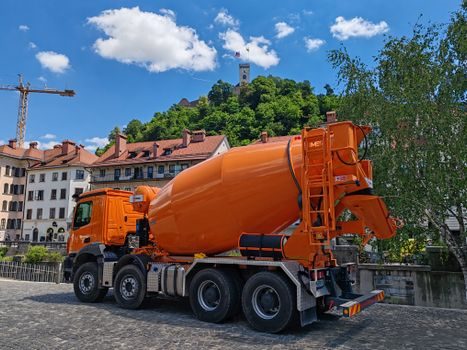
Residential driveways, sidewalks, slabs-on-grade, and small commercial pads within chute reach are the canonical ready-mix-only jobs. American Concrete Co. positions its 3,000 and 4,000 PSI offerings and DOT-approved mixes for exactly this segment, with no placement service attached [S2]. All American Ready-Mix in Sarasota targets the same straightforward-pour market with a free-estimate phone line and a self-description as a quality-concrete leader [S5]. For these pours, adding a truck-mounted concrete pump to the BOM is a cost without a benefit — the chute reaches the form, the slump is at the spec'd 4 to 6 in., and the crew finishes the slab.
Where a concrete pump truck becomes mandatory
High-rise cores, bridge decks, tunnel linings, and any pour where the truck cannot set within chute distance of the formwork require a concrete pump truck with a placing boom. HAMAC's published global case in Kyrgyzstan pairs a 100 m³/h mobile batching plant with 10 m³ mixer trucks feeding a concrete pump truck with boom — exactly the production chain that makes mid-rise pours economical on remote sites [S3]. The same vendor's Piura, Peru case shows the lower-output path: a 14 m³/h self-loading concrete mixer feeding a DHBT50 diesel concrete pump, with no boom, for low-rise rural work [S3]. The deciding factor is reach and pour rate, not material type.
Comparison: pump truck vs ready-mix-only placement
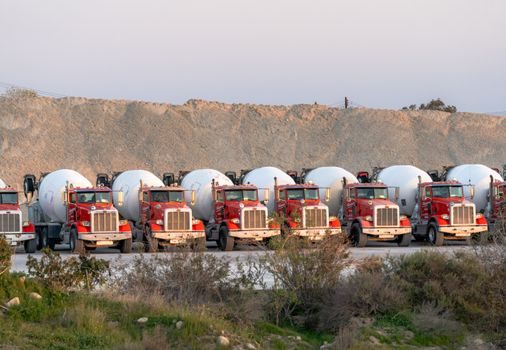
Side by side, the two options line up against the same job characteristics with very different profiles. Pour rate: a truck-mounted pump with boom typically sustains 60 to 150 m³/h against a chute truck's 15 to 25 m³/h. Horizontal reach: a 52 m to 62 m boom covers 40 to 55 m from the truck's set point; a chute reaches 3 to 4 m [S4]. Capital exposure: a used 2020 Sany 62 m unit on a Mercedes chassis is listed in the active resale channel in mid-July 2026, indicating that secondary-market pricing on this class is being actively quoted; a ready-mix-only site avoids that capital line entirely [S4]. Mix redesign cost: zero for chute work on standard 3,000 / 4,000 PSI mixes, plus 5 to 15 percent cement and admixture uplift for a pumpable mix [S1][S2]. Crew and scheduling: pump placement needs a certified operator and a hose hand in addition to the chute crew, and the pump's setup footprint (outrigger spread, boom swing arc) must be planned against the site logistics.
Standards, certifications, and what to verify before signing
Ready-mix delivered to a US job is typically specified to ASTM C94 (now published as ASTM C94/C94M) for production and delivery, with strength verified by trial batches at 3,000 or 4,000 PSI as the entry-level structural grades [S2]. Pump-truck placement falls under different documents: the American Concrete Institute's "Guide for the Use of Concrete Pumps" and OSHA 1926.952 for concrete-pump setup and outrigger load, both of which sit on top of the manufacturer's rated boom-load charts. Truck chassis certification is typically European CE or US DOT per axle, with Mercedes-Benz and other OEM chassis listed explicitly on used-unit reseller pages [S4]. The MEREC-DNMARCOS paper also emphasises that safety and environmental criteria — not just throughput — should be weighted in any multi-criteria selection of a truck-mixer pump, since pump failures and slump loss at the boom end are the two largest sources of site delay [S1].
Selection workflow for a project engineer

Step one: lock the pour rate. If the structural schedule demands more than 25 m³/h sustained, or if any element is more than 4 m above grade or 4 m from the set-up point, a concrete pump truck goes into the BOM. Step two: lock the mix. Specify pumpable mix with verified 90-minute slump retention and aggregate top size matched to the boom-pipe diameter; otherwise the order goes through as a standard 3,000 / 4,000 PSI ready-mix for chute placement [S1][S2]. Step three: decide own-versus-rent. The MEREC-DNMARCOS analysis is built for exactly this question, treating ownership cost, utilization rate, and lead time as weighted criteria [S1]. Step four: book the ready-mix concrete supplier against the pour window — the smaller of drum size, haul distance, and C94 delivery window drives the truck count, not the pump. Step five: confirm placement, including the dump truck cycle for any waste concrete and the placing-boom swing arc if a boom is in use.
Track for the next 60 to 90 days: any new MEREC-DNMARCOS-style comparison of electric-drive truck-mounted pumps versus diesel, since OEM pipelines increasingly list battery-electric and hybrid chassis for urban low-emission zones, and any revision to ASTM C94 mix-design tables that tightens 90-minute slump retention — both will shift the cost line between owning a pump and renting one.
See also our earlier report, PU Sandwich Panel vs Fire Alarm Control Panel: Spec-First Selection Map.