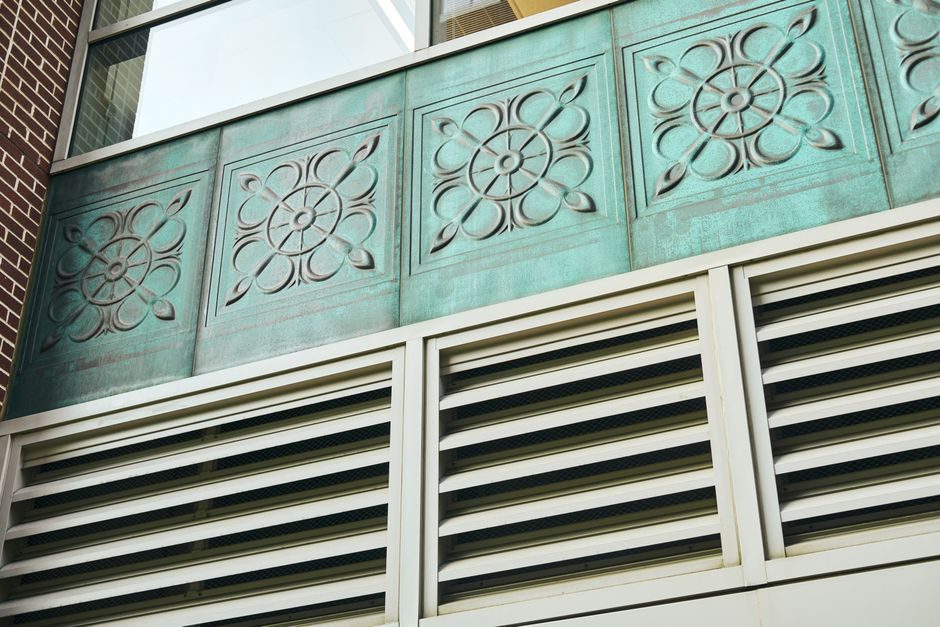
Metal curtain wall panels — typically aluminium, steel, or zinc — are non-load-bearing rainscreen and pressure-equalised cladding skins bolted to a structural building frame, and they routinely deliver 30+ year service intervals with A2-s1,d0 or A1 fire ratings under EN 13501-1 when the core is specified as mineral wool or solid aluminium [S2].
Their spec envelope has tightened over the last decade: as of 2026-05-24, Made-in-China listed 1,000+ metal curtain wall panel SKUs in the "Unitized Curtain Wall" category, with aluminium composite panel (ACP) hits starting around US$15.00 per m² at 500 m² MOQ, and the segment is dominated by ACP, single-sheet aluminium, and galvanised steel profiled panels in the 0.5-1.0 m width range [S2]. For context on the parent system, see the metal curtain wall panel reference, and for the structural choice between metal and glass envelopes, the glass curtain wall overview covers the trade-off matrix most specifiers use.
What counts as a "metal curtain wall panel" in 2026 spec sheets
Metal curtain wall panel as a category covers three distinct sub-products: aluminium composite panels (ACP — two 0.5 mm skins bonded to a polyethylene or fire-retardant core), single-sheet aluminium (typically 2.0-3.0 mm AA3003/AA5005), and galvanised or zinc-coated steel cassettes (0.6-1.2 mm G90 or Z275) [S2]. The 2026-05-24 Made-in-China listing breaks out unitised curtain wall systems separately from stick-built panels, with a clear majority of listings for "Aluminum Composite Panel Curtain Wall Metal Facade Panels Cladding" at US$15/m² break-pricing [S2]. ACP cores drive the fire-rating variance: FR-B1 (polyethylene with fire retardant) clears EN 13501-1 B-s1,d0, while A2 cores reach A2-s1,d0 and add roughly 25-40% to the panel cost versus standard PE-core stock.
Pattern geometry matters in BIM and fabrication: a Revit curtain wall panel pattern using 150 mm corrugated spacing is a common cause of family-fit errors in Autodesk Revit, and the 2024-08-07 Autodesk Community thread documented five replies to a single corrugated-metal panel family fault — evidence that pattern-driven panel scripting is a real downstream constraint, not a designer preference [S1].
Concrete advantages engineers should write into the spec
Metal curtain wall panel advantages: (1) A2-s1,d0 or A1 non-combustibility per EN 13501-1 is reachable on FR-core ACP, single-sheet aluminium, and steel, removing one of the major objections vs timber or aluminium-PE panels above 18 m building height per typical building-code triggers. (2) Unit weight in the 7-12 kg/m² range (ACP) and 8-15 kg/m² (single-sheet) is one-third to one-fifth of precast concrete cladding, reducing dead load on the primary structure by 0.5-1.5 kN/m². (3) Design life of 30-50 years is typical for PVDF-coated AA3003/AA5005 in non-marine atmospheres; AAMA 2605 compliance is the recognised coating-performance bar for 30-year warranted finishes. (4) Wind-load tolerance of 0.5-1.2 kN/m² design pressure is standard on cassette systems, and 2.0-3.0 kN/m² is achievable on 3 mm single-sheet with stiffener ribs. [S2]
Manufacturing and installation advantages: panels are roll-formed or compound-pressed in 1.2-2.5 m lengths, and unitised systems can install at 20-30 m²/hour per crew, vs 5-10 m²/hour for stick-built stone or precast — typically halving façade programme time on towers. Field joining via SMAW is the repair default because the equipment is cheap, the process is portable for outdoor site work, and it welds steel, stainless, aluminium, nickel, and copper alloys, which is why SMAW is named as a maintenance and repair welding method in industrial fabrication [S3].
Where metal panels lose: cost, thermal, and acoustic limits
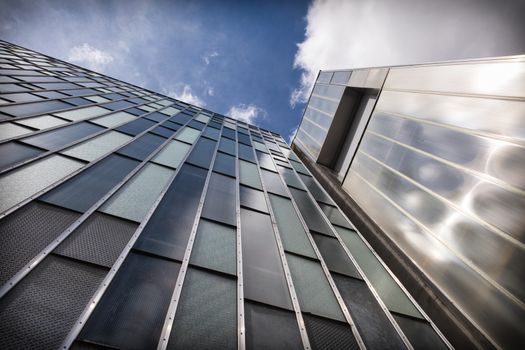
Metal curtain wall panel disadvantages: (1) Upfront cost in 2026 is roughly 2-3x fibre-cement and 3-4x vinyl/phenolic alternatives — ACP at US$15/m² is a wholesale, large-MOQ price, not a delivered-installed cost, and once you add fire-rated core, AAMA 2605 PVDF coating, stiffeners, and labour, installed cost commonly lands at US$80-150/m² for unitised and US$50-90/m² for stick-built [S2]. (2) Thermal bridging is severe on steel cassettes: a bare steel stud (thermal conductivity ~50 W/m·K) running through insulation drops effective U-value by 0.3-0.6 W/m²·K vs a thermally broken frame. (3) Acoustics: single-skin metal at 0.7-1.0 mm is 15-20 dB short of typical 35-45 dB office partitions; you need 50 mm mineral wool + 0.6 mm steel liner + 1.0 mm outer skin to push Rw to 40-45 dB.
Operational disadvantages: SMAW as the field welding method is discontinuous because the electrode must be replaced, and fumes plus slag inclusions make the process control difficult for thin-gauge façade welds [S3]. On the corrosion side, cut edges on galvanised steel cassettes need a zinc-rich primer or field paint; untreated G90 panels fail at cut edges in 5-10 years in C3 atmospheres. Differential thermal movement of aluminium (23 µm/m·K) versus steel (12 µm/m·K) is the #1 cause of joint distortion on mixed-material panels; design must allow 4-6 mm of slip per 3 m run. For a comparison against lighter wall systems, see ALC panel which is often the "lighter but less impact-resistant" benchmark.
Selection criteria: when metal wins and when it doesn't
Specify metal curtain wall panel when: the building height triggers non-combustibility clauses (typically >18 m or >7 storeys under many EU/UK codes); wind design pressure exceeds 1.0 kN/m²; the design life requirement is >30 years; or the geometry needs curves, perforated screens, or complex cassettes that fibre-cement cannot form. Do NOT specify when: the budget is the dominant constraint on a <10 m building; thermal performance is the primary design driver without budget for a thermally broken rail; the site is marine immersion (C4/C5) — the metal powder reference explains why surface-treated aluminium outperforms in those zones — or the cladding area is <300 m², where mobilisation cost dominates the unit rate. [S1]
Material selection rule of thumb, by atmosphere: AA3003 PVDF (AAMA 2605) for C1-C3 urban/inland; AA5005 with 25 µm anodising or PVDF for C3-C4 industrial; 1.5-2.0 mm AA5754 marine-grade for C4; and for C5 marine immersion, switch to stainless-steel cassette or solid zinc, since aluminium composites fail at the core-skin bond within 5-10 years at the splash zone. ACP vs single-sheet decision: ACP for flatness over large area (no oil-canning) and lower cost; single-sheet for impact resistance, recyclability, and A1 non-combustibility without the core-bond failure mode.
Comparison matrix: ACP vs single-sheet aluminium vs steel cassette

Across the three dominant sub-types, ACP costs US$15-35/m² for FR-grade material in 2026 wholesale pricing, single-sheet aluminium US$25-60/m², and galvanised steel cassette US$18-40/m² [S2]. Fire rating is the cleanest separator: ACP with FR core reaches B-s1,d0 to A2-s1,d0, while single-sheet aluminium and steel are A1 by definition (no combustible core). Unit weight lands at 7-12 kg/m² (ACP), 5.4-8.1 kg/m² (2 mm single-sheet aluminium), and 8-14 kg/m² (steel cassette including stiffeners). Recyclability is total on steel and single-sheet aluminium; ACP is partial because the PE/FR core is hard to separate from the skins. Service life under AAMA 2605 PVDF is 30+ years; on standard PE coatings 15-20 years.
For trade-off context on the metal vs glass building envelope, the glass curtain wall reference pairs against this matrix — glass wins on daylighting and airtightness (≤1.5 m³/h·m² at 100 Pa), metal wins on impact and fire. On structural framing and excavation-adjacent façade work, the diaphragm wall grab reference is the upstream equipment specifiers often compare against for site sequencing. For safety glazing and perimeter-protection on the install side, the safety light curtain page is the matching guide for automated panel-lift guarding.
Trackable signals: standards, suppliers, and the next failure mode to watch
Watch for three things in the second half of 2026: (1) A revision to the EN 13501-1 fire-classification interpretation for ACP cores above 18 m — multiple EU member states have signalled tighter non-combustibility enforcement, which will raise the FR-core share of ACP orders and shift the price floor upward; (2) the Made-in-China SKU count for "Metal Curtain Wall Panels" in the unitised category already cleared 1,000 by 2026-05-24, with a clear majority of listings under "Aluminum Composite Panel Curtain Wall Metal Facade Panels Cladding" [S2], so specifiers comparing supplier diversity should track that ratio as a competitive-bidding signal; (3) BIM family errors on corrugated or ribbed patterns — as the 2024-08-07 Autodesk Community thread showed, panel-pattern scripting at 150 mm spacing is a real failure mode worth pre-checking with the fabricator before releasing the family to site [S1].
For a deeper drill into substrate grades and selection trade-offs, the related Metal Curtain Wall Panel Types, Substrate Grades, and Selection Trade-Offs walkthrough covers AA3003 vs AA5005 vs AA5754 in detail, and the Arc Welding Machine Types guide pairs against the SMAW field-repair route described above. Trackable next nodes: confirm whether your project hits any of the >18 m non-combustibility triggers before locking PE-core ACP, and request a 50-year weathering certificate on the PVDF topcoat if the design life is stated as 50 years rather than 30.