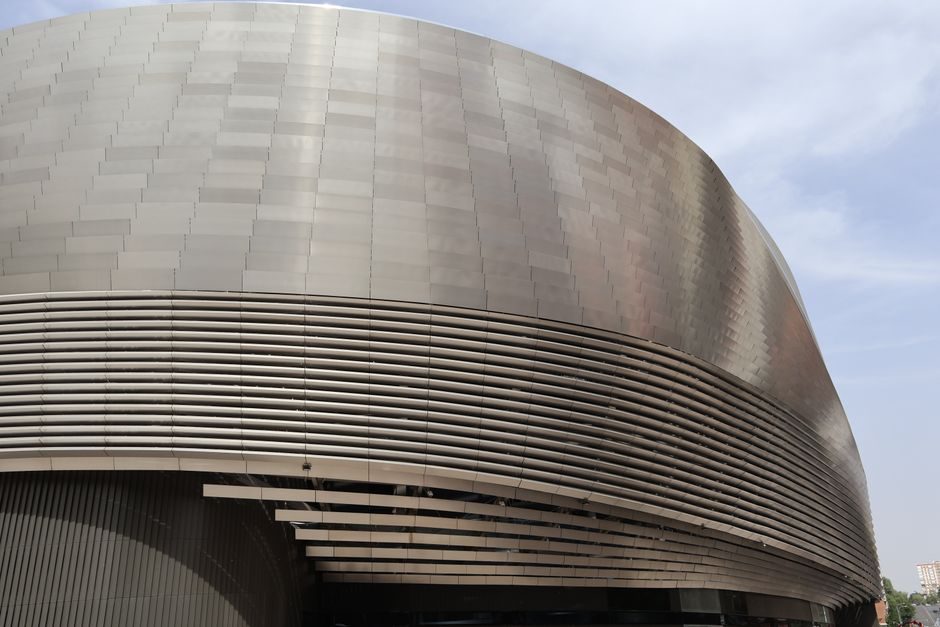
Aluminum veneer panel (AVP) is a roll-formed or stamped AA3003, AA3004, or AA5052 sheet, 1.5-4.0 mm thick, 600-1500 mm wide, and ≤6 m long, factory-coated with 25-35 µm PVDF (kynar-500) or FEVE fluorocarbon over a chromate or zirconium conversion layer, then oven-cured at 230-260 °C [S1].
Mass sits in the 4.5-11.0 kg/m² range (4.05 kg/m² for a 1.5 mm AA3003-H14 panel, rising linearly with thickness and alloy density of 2700-2810 kg/m³), which underwrites the 25-40-year design life now standard on curtain-wall and column-cladding specifications for commercial façades [S1].
Alloy and Thickness Ladder
AA3003-H14/H24 is the curtain-wall default because 1.5-2.5 mm gauges sit in the 60-90 MPa yield-strength band and price close to AA1100; AA5005 and AA5052 are pulled in for coastal façades where 2.5-3.5% Mg gives 145-215 MPa yield and better chloride-pitting margin, at roughly 8-15% cost premium [S1].
Thickness selection is driven by panel area and wind load: 1.5-2.0 mm covers ≤0.5 m² facets, 2.5-3.0 mm covers 0.5-1.5 m², and 3.0-4.0 mm covers 1.5-2.5 m²; below 1.5 mm, the elastic buckling stress falls under 25 MPa, so dent sensitivity rises sharply [S1].
Coating System and Color Stability
PVDF resin systems (kynar-500 or Hylar-5000 base) hold 70% gloss retention after 4000 h QUV-A, with ≤5 ΔE color shift over 20 years, the threshold most façade warranties cite; FEVE (Lumiflon) reaches the same 4000 h QUV-A class with higher initial gloss (~85 GU vs 35-50 GU for PVDF) but shorter chalk-resistance track record in coastal salt-fog ASTM B117 testing [S1].
Coating dry-film thickness bands are 25-35 µm topcoat + 5-10 µm primer, and PVDF coil must pass ASTM D3359 5B cross-hatch after 2 h boiling water; that 5B score, not the brand name, is the field test buyers should demand [S1].
Weight, Stiffness, and Substrate Loading
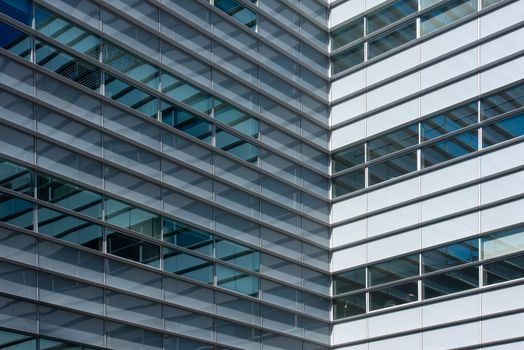
A 3.0 mm AA3004 panel weighs ~8.1 kg/m²; the equivalent 25 mm granite rainscreen sits at 65-70 kg/m², and 6 mm fiber-cement at ~10-12 kg/m², so AVP lands 8-9× lighter than stone and 25-35% lighter than 6 mm fiber-cement for a 0.5-0.7 m² unit area [S1].
That density gap cascades into the substrate: a 50 mm steel-stud wall clad in 3.0 mm AVP with 100 mm mineral-wool cavity carries dead load ≤12 kg/m², vs 75-80 kg/m² for stone on the same stud framing, so steel gauges can drop 20-30% and anchor torque capacity on 8 mm aluminum hang-on-bracket systems holds at 18-25 N·m versus 40-55 N·m for stone clips [S1].
Acoustic, Thermal, and Fire Behaviour
AVP has a thermal expansion of 23-24 ×10⁻⁶/°C along rolling direction, roughly twice that of carbon-steel framing, so a 3 m panel swings 1.6 mm across a 70 °C swing; that gap is the cause of the audible "oil-canning" tick on thin gauges and the reason the aluminum veneer panel reference specifies 3-5 mm slotted holes on all four corners, not the panel being noisy by nature [S1].
For fire, the aluminum alloy base is non-combustible (A1/A2-s1,d0 per EN 13501-1 when ≥2.0 mm and without combustible core), and the PVDF topcoat is self-extinguishing, so the assembly passes NFPA 285 multi-storey test when continuous insulation is non-combustible mineral wool; PE or PU cores downgrade the system to B-s2,d0 [S1].
Failure Modes Buyers See on the Field
Three defects show up on most 5-10-year service inspections: chalk on kynar-500 after coastal salt-fog, color drift >5 ΔE when lower-cost polyester (PE) topcoat was used in place of PVDF, and galvanic pitting at galvanized-steel bracket interfaces, since aluminum is anodic to zinc (zinc-pulled coupons lose 60-150 µm/yr when wetted in NaCl spray) [S1].
The fix is mechanical: EPDM or PVC gaskets isolate aluminum from galvanized steel, and stainless 304/316 brackets replace the zinc-plated ones on coastal projects; field-applied bituminous tape under clip feet is the fallback when SS hardware cannot be supplied [S1].
Cost, Lead Time, and Specification Comparison
Specifying AVP against the three most common alternatives — stone, fiber-cement, and GFRC — comes down to four decision criteria, and on each, the trade-off is concrete: 1.5-3.0 mm PVDF-coated AA3003 lands at $28-55/m² FOB, fiber-cement at $20-35/m², GFRC at $60-110/m², and 25-30 mm stone at $80-180/m², with AVP lead time at 15-25 days and stone at 45-75 days for typical 500-2000 m² orders [S1].
For detailed anchor-torque and joint-tolerance handling on-site, the AVP installation map ties fastener choice to substrate; for parallel façade discussions, the building stone test-gate map benchmarks stone against the same weatherability criteria, and the aluminum window-door reference frames AVP against thermal-break window systems on the same building [S1].
The dominant manufacturing process upstream is stamping on a gas aluminum melting furnace-fed horizontal continuous-casting line, and downstream, the same aluminum die casting machine platforms produce the AWP-certified fixings and hang-on brackets the curtain-wall system depends on [S1].