
T6 is a dark-brown concrete mould release agent applied to the inner face of shuttering, formwork and moulds before the casting of concrete, acting as a carrier to allow easy release between the cast concrete and the formwork [S2]. Coverage typically runs 20–60 m²/L depending on substrate porosity and application method, and choice of chemistry (mould oil, water-based emulsion, wax-based, or reactive varnish) drives both the finish class produced and the release reliability on steel, timber, plywood or plastic form faces [S1][S2].
For 2026 procurement, the decision is not brand-led but chemistry-led: which base fluid, which dilution ratio, which film build on the form, and which surface result the structural or architectural spec demands. Procurement teams that lock those four gates before RFQ cut rework at the form-strip stage and keep concrete vibrator cycles from being slowed by stuck formwork.
Chemistry Types and What They Cost You at the Form Face
Mould oil (neat mineral or vegetable oil) is the legacy default, cheap per litre but prone to bleed, sag on vertical formwork, and staining of the cast face — useful on temporary timber shutters where finish class is not specified, wasteful on architectural white-concrete pours [S1].
Water-based emulsions (typically 1:4 to 1:8 water-to-concentrate dilution, applied by spray at 30–50 m²/L) dominate 2026 site practice because they cut VOC, dry tack-free in 5–15 min at 20 °C, and produce a uniform Class A or B finish on steel forms; T6 is a representative dark-brown emulsion product on the merchant market [S2].
Wax-based and reactive-varnish release agents (synthetic paraffin, carnauba, or chemically-reactive fatty-acid films) cost more per litre (commonly 2–4× a basic mould oil) but deliver release on heated curing moulds, on precast battery forms cycled 5–10× per shift, and on plastic or GRP moulds where oil would craze the face [S1].
For precast plants and tunnel-segment operations, the concrete admixture package and the release-agent chemistry have to be co-specified — a high-water-reducer mix against a basic mould oil can pull air voids at the form face that no release agent can mask.
Mould Material Drives the Compatibility Gate
Steel formwork accepts almost any release agent chemistry, but bare steel wants a corrosion-inhibitor package in the film — straight mineral oil on damp steel panels will flash-rust overnight and print orange stains on the next lift [S1].
Timber and plywood (especially birch-faced plywood) absorb water-based emulsions at first contact, so the first cycle on a new timber form needs a higher film build (~80–100 g/m² wet) to saturate the face; from cycle 2 onward coverage reverts to the normal 30–50 m²/L band [S2].
Plastic, ABS, and GRP moulds used in architectural precast are sensitive to solvent attack: avoid aromatic and high-aromatic mould oils on these substrates, and prefer wax or reactive-varnish films; a solvent-crazed mould face is non-repairable short of re-laminating [S1].
For high-shear placements where the concrete vibrator head works the mix against the form face, the release film has to survive entrained sand blast — wax and reactive films outperform thin oil films in that service.
Coverage, Dilution, and the Real Per-Metre Cost

Published coverage figures for water-based emulsions cluster at 20–60 m²/L of concentrate; at a 1:6 dilution this drops the effective diluted coverage to roughly 140–420 m²/L of mixed fluid, which is the figure site supervisors actually plan spray pass rates against [S1][S2].
T6-type emulsions, applied as supplied or cut 1:1 with water on smooth steel, give 1 L covering 30–40 m² of steel formwork and 20–25 m² of new plywood; the gap is the substrate-absorption correction the supplier data sheets quote as "first-cycle penalty" [S2].
Procurement should price release agent on cost per square metre of finished form face, not per litre: a 1.8 USD/L emulsion at 1:4 dilution covering 30 m²/L on steel runs 0.06 USD/m², while a 0.9 USD/L neat oil covering 25 m²/L on steel runs 0.036 USD/m² — the apparent cheap option is only cheap if finish class is unrestricted.
For full precast-panel operations, release-agent cost typically lands at 0.5–1.5 % of the panel ex-works price; pushing that to 0.3 % with cheap mould oil is one of the most expensive false economies on a precast yard, because the form-strip repair and re-oiling labour swamps the chemistry saving.
Finish Class and the Defect Modes You Are Actually Buying Against
Finish classes for formed concrete surfaces follow the same logic as ACI 301 Class A/B/C/D, with the release agent choice being the single biggest controllable variable between adjacent pours on the same formwork [S1].
Common defects traced to wrong release-agent selection include bug-holes (entrained air against an over-wet oil film), discolouration bands (reactive varnish reacting with cement alkalis on the first cycle), staining (oil migration into porous plywood), and sand-pull at form corners where film build was too thin to survive the concrete vibrator head's lateral pressure.
On architectural white-concrete and pigmented mixes, the release agent has to be tested for alkali-reactivity with the cement-aggregate system; ASTM C1260-2014 is the standard mortar-bar method for assessing aggregate potential alkali reactivity, and any release-agent residue that shifts pore-fluid pH at the form face can re-trigger that mechanism in marginal aggregate [S3].
Special-cement systems (calcium-aluminate, sulfoaluminate, low-alkali) interact with release-agent chemistry differently than Portland; pairing these cements with a standard mould oil is a known cause of discolouration and is one of the cases covered in special cement vs concrete curing compound: two different jobs on the same slab.
Application, Re-Coat Interval, and Site Discipline
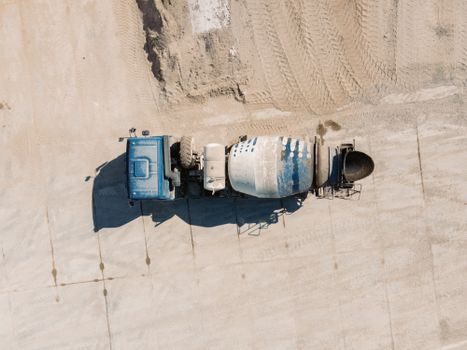
Spray application with a flat-fan nozzle at 2–4 bar gives the most uniform film and the lowest per-m² cost; brush or roller application is reserved for form edges, blockouts, and rebar congested zones where over-spray would contaminate the reinforcement [S2].
Re-coat interval between passes on multi-couple forms is a 5–15 min touch-dry window for water-based emulsions at 20 °C; over-coating on a still-wet film builds up a thicker layer that can slump and cause bug-holes, while under-coating on a fully-cured film can cause inter-layer adhesion and patchy release [S1][S2].
Form-face temperature below 5 °C pushes water-based emulsions outside their published application window; cold-weather sites should switch to a solvent-based or wax-based release agent, or pre-warm the form with a concrete vibrator probe on low amplitude before spraying.
For ready-mix and site-batched operations that share a concrete release agent inventory with the precast yard, segregate emulsion stock by base chemistry — cross-contamination of a wax film with a residual mould oil on the spray rig is a top cause of inter-batch finish variation.
Standards, Storage, and Shelf Life Gates
No single ISO or EN standard governs the release agent itself; the relevant standard chain is the formwork standard (EN 12812 for falsework, ACI 347 for formwork), the surface-finish standard (ACI 301 finish classes), and the aggregate-alkali test ASTM C1260-2014 on the cement side [S3].
Storage of water-based emulsions at 5–35 °C gives a typical 12-month shelf life; below 0 °C the emulsion breaks and the drum is scrap, above 45 °C accelerated separation occurs within weeks — both are common failures on poorly-stocked sites [S1][S2].
VOC and worker-exposure rules on European and California sites effectively rule out neat solvent-based mould oils in 2026; water-based emulsions and reactive-varnish films have replaced them in most public-infrastructure pours, and suppliers publish VOC < 50 g/L as the default green-tier spec [S1].
Buyers running plant and formwork selection in parallel with concrete-system sourcing should treat the release-agent RFQ as a 2-week tail item, not a 6-month lead — a typical T6-class emulsion is ex-stock at the merchant level, and chasing exotic chemistries when standard emulsions will do adds cost without raising finish class [S2].
Trackable signals for the next 90 days: (1) supplier VOC disclosures moving under 30 g/L for the water-based tier; (2) ASTM C1260-2014 re-ballot activity in the aggregate-alkali space which will tighten the cement-side specification that interacts with release-agent residue [S3]; (3) precast-yard rollouts of wax-based films for heated-cure battery forms, which would shift the per-litre cost benchmark roughly 2–4× above the current emulsion baseline [S1].