Concrete vibrator compatibility is decided at the head-to-whip thread, the whip-to-motor coupler, the power source, and the mix's slump and rebar density; getting those four interfaces right is what keeps a pour on schedule [S1][S3]. Industrial-grade immersion-type units run 12,000 to 20,000 VPM (vibrations per minute), enough to liquefy stiff mixes around dense reinforcement [S3].
Lead time is a separate compatibility layer: in normal stock conditions contractors receive a vibrator within roughly one week of order, and many OEM models are also stocked through regional dealer networks for walk-up pickup [S1]. The 21 ft whip length (1-3/16 in. diameter) is the practical upper end most US suppliers will ship, and two whips can be joined with a ball-bearing coupler when a single reach is not enough [S1].
Mechanical Interface: Head, Whip, and Coupler Fit
The head-to-whip joint is reverse-threaded on most OEM systems to prevent loosening under rotation, and head changes are designed for clamp-assisted field swap in under a minute [S1]. Adapter sleeves let a single brand of head mate to competitive whips of differing diameters, which is the practical fix when a contractor already owns one brand of whip but needs a different head size [S1].
For a deeper look at how this vibration step fits into the broader pour cycle, the concrete tool selection framework treats consolidation as a sub-step between placement and finishing. Radius of action per head diameter governs how fast a given pour can be covered; under-sized heads leave the operator chasing the same bay for too long, over-sized heads blow out form faces and segregate aggregate [S7].
Power-Source Interface: AC, DC, Gas, and Air
Electric-cord vibrators in 120 V single-phase dominate indoor and commercial work because they are quiet and emit no fumes; high-frequency models convert single-phase to three-phase internally for power consistency on commercial and Department of Transportation pours [S2]. Cordless 18 V DC brushless tools that share a battery platform with a contractor's existing drill or impact driver are now common for small-diameter head work, with the battery sold separately and the tool only listed as the standard SKU [S6].
Internal gasoline-driven vibrators are the right call when electricity is unavailable at the pour face or where a trailing cord is a trip and spark hazard, especially in curb, gutter, and construction-joint work [S2]. For hazardous-area pours, the broader explosion-proof electrical selection logic is the upstream decision that determines whether any electric vibrator can even enter the work zone. Compressed-air and hydraulic external form vibrators are the third path, used when internal steel or mesh leaves no room for an immersion head [S5].
Mix and Pour-Volume Interface: Slump, Rebar, and VPM
VPM is the spec that has to be matched to the mix, not to the motor. Industrial motor-in-head systems running 12,000 to 20,000 VPM are the right pick for low-slump concrete, close-meshed rebar, high-strength mixes, and architectural concrete where surface finish matters [S3][S7]. Light-duty backpack and stinger-style immersion vibrators sit in the 9,000 to 13,000 VPM band, which is enough for slab and footing pours with normal rebar spacing but under-powered for heavily reinforced columns [S1].
Concrete strength and surface finish both depend on getting the consolidation step right: improper vibration costs both money (rework, honeycomb repair) and safety (reduced structural capacity) [S5]. For mixes that already push the envelope on workability, concrete admixture choice interacts with vibration time, because highly plasticized mixes need less immersion to consolidate and over-vibration causes segregation. Fiber-reinforced mixes follow a similar but more sensitive rule; the fiber-reinforced concrete consolidation note explains why head spacing must tighten when steel or macro-synthetic fibers are present.
Type Comparison Across Decision Criteria
Four decision criteria separate the main options: power source availability, head access (internal slot vs external form), required VPM band, and operator skill dependency. Internal electric immersion vibrators score high on availability and VPM but require a skilled operator, which is the single biggest variability on a pour [S2][S5]. Internal gas-powered immersion vibrators trade fumes and noise for total power independence on remote pours [S2].
External form vibrators trade penetration depth for operator-independence: mounted to the formwork and powered by electricity, compressed air, or hydraulics, they "simply do the job, consistently and efficiently, each and every time" without depending on a focused human at the head [S5]. High-frequency motor-in-head immersion units are the premium choice for columns, deep core walls, bridge piers, and large footings because they deliver the strongest penetration with minimal shaft vibration reaching the operator [S3]. For procurement teams that also pour cement-bound structural concrete on tight schedules, the comparison usually collapses to: cordless DC for finish and patch work, single-phase high-frequency for general structural, and external form for precast where the panel layout is fixed.
On-Site Availability Signals and Stock Path
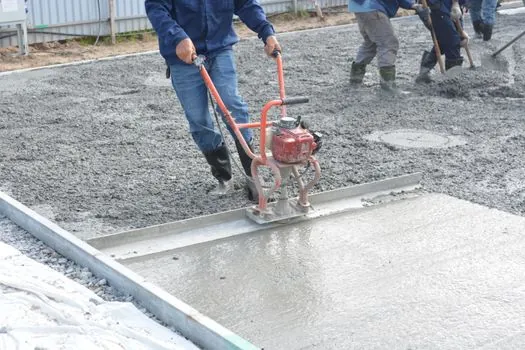
Same-week shipment from the OEM to the contractor is the baseline when no regional stock-out exists, and major US vibrator makers distribute through dozens of dealers so a local pickup is often possible the same day [S1]. Cordless 18 V vibrators sold as "tool only" SKUs are a separate availability lever: a contractor already holding batteries on the Milwaukee M18 platform can put a vibrator to work without waiting on a separate battery order [S6].
Watch two signals when availability tightens: dealer floor-stock of high-frequency motor-in-head units (the longest-lead industrial SKU), and rental fleet turnover on external form vibrators, which precast plants tend to rotate seasonally. Specifying the whip length and head diameter up front, plus the power source, removes the back-and-forth that delays shipment on most orders [S1].