
OSHA 29 CFR 1910.146 requires employers to post danger signs at the entrance of every Permit-Required Confined Space (PRCS), and the practical spec gate in 2026 is a DANGER-red header, the literal phrase "Confined Space," and either "Permit Required" or "Enter By Permit Only" combined with a direct instruction such as "Do Not Enter" or "Authorized Personnel Only" [S1][S3].
Across current US safety-catalog SKUs, base confined-space signs in the 7"×10" to 10"×14" range list between $5.29 and $8.85 per unit, bilingual English/Spanish variants run $8.24, and heavy-duty InfiniStick or floor-mount versions step up to $14.94 to $21.48 per piece, so a per-unit material decision is often cheaper than re-issuing a faded sign [S1][S3].
OSHA 1910.146 vs 1926 Subpart AA vs ANSI Z535: Which Rule Actually Governs the Sign
OSHA 29 CFR 1910.146 is the General Industry rule that explicitly requires danger signs "or equally effective means" at every PRCS entrance, while 29 CFR 1926 Subpart AA is the parallel Construction rule that uses the same permit-required language; in both cases the literal signal-word choice is OSHA's, and ANSI Z535.2 supplies the color and panel layout that most US catalogs map onto it [S1][S5].
The 2026 product listings from major US safety suppliers split cleanly into three header families: OSHA DANGER (red header, used where atmospheric, engulfment, or entrapment hazards exist), OSHA CAUTION (yellow header, used for lower-severity non-permit or lockout/tagout spaces), and OSHA NOTICE (blue header, used for administrative information such as "Authorized Personnel Only") [S2][S3][S7]. A SKU breakdown from J. J. Keller shows 18 DANGER, 3 CAUTION, and 2 NOTICE confined-space listings, plus 16 OSHA-style and 7 ANSI-style panels, which tracks the general-industry mix and tells a spec-writer the DANGER class will dominate by roughly 6:1 over CAUTION in confined-space catalogs [S7]. The risk of getting this wrong is not aesthetic: a CAUTION sign on a permit-required space with a hazardous atmosphere understates the severity that OSHA's signal-word convention is designed to communicate.
Substrate, Ink, and Format: Material Spec Map for 2026 PRCS Signage
Selection criteria in 2026 boil down to four substrate buckets: pressure-sensitive adhesive vinyl for pipes and curved tanks, rigid plastic (typically 0.04" to 0.06" high-density polyethylene) for indoor walls, aluminum (0.063" to 0.080") for outdoor or washdown areas, and glow-in-the-dark photoluminescent film for low-light spaces such as manholes and tunnels [S1][S5][S6].
Graphics Products (DuraLabel) and Accuform both sell adhesive vinyl and rigid plastic as the default, with the GlowSmart photoluminescent line offered specifically where a confined space may be entered in a power-outage scenario, since the entry point then becomes both a hazard boundary and a rescue reference [S1][S2][S4]. ANSI Z535 formatting adds a second technical layer: the header panel uses the signal word and color, the message panel breaks the message into hazard description, consequence, and avoidance instruction, and the symbol panel carries an optional pictogram, which is why vendors now offer stepped layouts (E1351, E1301, E1309, J5105, J6764) where the same artwork is sold in label, sign, and floor-sign formats at $8.32, $14.94, $20.45, and $21.48 respectively [S3]. For corrosive environments, spec UV-stable inks and chemical-resistant overlaminates; for outdoor tank farms, specify aluminum with 3M VHB or equivalent foam-tape mounting because solvent-weld adhesives fail on powder-coated tank shells.
Header, Message, and Symbol: Anatomy of a Compliant PRCS Sign

The minimum textual payload that survives an OSHA audit is the DANGER header, the words "CONFINED SPACE," the qualifier "PERMIT REQUIRED" or "ENTER BY PERMIT ONLY," and a direct command such as "DO NOT ENTER" or "AUTHORIZED PERSONNEL ONLY," with optional pictograms and a hazards list ("Oxygen-Deficient Atmosphere," "Toxic Gases," "Engulfment Hazard") [S1][S3][S5].
Catalog SKUs demonstrate the variants that map to specific entry controls: S-0705 and S-0693 are the "Confined Space Do Not Enter" and "Confined Space Authorized Only" base signs at $5.29; S-0762 and S-0746 add "Permit Required"; S-0717 and S-0724 add "Permit Only"; and the S-7152 DANGER-header version adds a permit-required sub-message for higher-severity spaces [S1]. The bilingual English/Spanish tier (E1301BI, E1319BI, E1351BI at $8.24) addresses OSHA's literacy and language-of-the-workforce expectation, and is the de-facto spec gate in 2026 for any state with a Spanish-speaking crew density above roughly 20%, or any federal contract site [S1][S3][S5]. For the 12" or larger view-distance tier used at approach paths, OSHA Safety Training's January 2026 guidance recommends combining the entrance sign with a "Pre-Entry Atmospheric Testing" wall chart at the gas-monitor station and a "Permit Station" poster that lists authorizing roles, current rescue contacts, and the four-gas test sequence, so the sign is one node in a system rather than a standalone label [S5].
Where to Mount and What to Add: Placement, Lockout/Tagout, and Rescue Links
OSHA 1910.146 requires the sign "at the entrance" of the PRCS, which in 2026 practice means at the immediate portal, at the approach path, and at the permit station, with eye-level mounting (60" to 66" to the bottom of the sign) and an unobstructed sight line; in tank-vault and manhole applications the sign is paired with a glow-strip so it remains legible after a power loss [S1][S5].
Where the space is also under a lockout/tagout (LOTO) program, vendors now sell a "CAUTION Confined Space Use Lockout & Tagout" yellow-header sign (DuraLabel's Permit Confined Space Signs line) that pairs the confined-space warning with isolation instructions, and a "Danger Follow Entry Procedures" label (J6793) at $15.86, which is normally applied at the valve cluster rather than the entry portal [S3][S8]. The LOTO link is the most common spec error: a plain DANGER PRCS sign at the door, with no isolation point signage, will fail the OSHA 1910.147 cross-reference during a multi-employer inspection. Spec-writers building this system should also link to a pressure transmitter and flow meter reference, since the same permit station typically carries a ventilation-flow reading and a continuous toxic-gas transmitter that, together with the sign, define the entry boundary.
Comparison: Vinyl vs Rigid Plastic vs Aluminum vs Photoluminescent for PRCS Use

On four practical criteria, the 2026 catalog mix sorts as follows: cost per sign runs $5.29 to $8.85 for self-adhesive vinyl (S-0703 to S-7152), $8.32 to $20.45 for rigid plastic (E1301 to J6764), and roughly 2× to 3× rigid-plastic pricing for aluminum and GlowSmart photoluminescent equivalents [S1][S3]. UV and chemical resistance is highest on aluminum with UV-stable inks, medium on rigid plastic (HDPE/PVC), and lowest on economy vinyl; for outdoor tank farms, aluminum with overlaminate is the de-facto spec, while indoor mechanical rooms are dominated by rigid plastic and adhesive vinyl.
Temperature and washdown tolerance also matter: aluminum and HDPE plastic survive high-pressure hot-water washdown and the -40°F to 180°F range typical of process plants, while economy vinyl starts to lift at 150°F continuous and is unsuitable for steam-cleaned food-and-beverage PRCS points. Legibility distance and code-compliance weigh slightly in favor of rigid plastic and aluminum, both of which carry a clear ANSI Z535 header panel at the required 7:1 contrast ratio; the photoluminescent option adds 8+ hours of afterglow per ASTM E2072, which is the right call for manholes and tunnels but is over-spec for indoor tank rooms [S1][S3][S5]. Lead-time tracks inversely with customization: stock SKUs ship in 1 to 3 business days, custom bilingual or site-specific versions (Accuform's "Yes, We Can!" custom builders) take 5 to 10 business days, and on-site printed DuraLabel Toro Max output is same-shift for a single-sign replacement [S2][S4].
Common Selection Mistakes and 2026 Audit Failure Modes
The three most-cited spec errors in 2026 are wrong signal word (CAUTION on a hazardous-atmosphere PRCS), missing permit qualifier (a generic "Confined Space Do Not Enter" sign at a permit-required entry), and substrate failure (vinyl on a sun-exposed tank shell, leading to faded red header within 12 to 18 months and a "ineffective means of communication" finding under 1910.146) [S1][S5].
A second-tier failure mode is a missing link to the LOTO program: a PRCS entry sign that does not point to a lockout station cannot be defended in a multi-employer citation context, and a third-tier failure mode is English-only signage on a crew with a documented Spanish-speaking majority, which OSHA compliance officers now flag in 2026 inspections under the general-duty clause [S3][S5][S8]. A spec-writer who pairs a warning sign with a warning tape barrier at the approach path, and a pressure sensor readout at the gas-test station, is the engineer who survives the audit; the engineer who buys the cheapest red header is the one paying the citation. For a parallel spec reference on hazardous-area process signage, the warning sign selection for mining operations piece covers the blasting-zone and MSHA-side rules that complement this OSHA framework.
Spec-Writer Checklist for a 2026 PRCS Sign Purchase Order
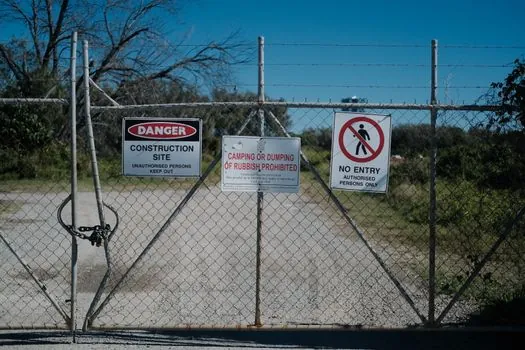
Confirm the signal word: DANGER for atmospheric, engulfment, or entrapment hazards; CAUTION for non-permit or LOTO-paired spaces; NOTICE for administrative access [S1][S3][S7]. Confirm the message payload: literal text "CONFINED SPACE" + "PERMIT REQUIRED" or "ENTER BY PERMIT ONLY" + "DO NOT ENTER" or "AUTHORIZED PERSONNEL ONLY," with ANSI Z535 panel layout (header, message, optional symbol) [S1][S3][S5].
Confirm substrate: aluminum 0.063" minimum for outdoor tank farms and manholes; rigid plastic 0.04" to 0.06" for indoor walls; adhesive vinyl only for short-term or curved-pipe applications; photoluminescent per ASTM E2072 for low-light or post-power-loss rescue visibility [S1][S5]. Confirm language: bilingual English/Spanish where the crew language profile or federal contract requires it (SKUs E1301BI, E1319BI, E1351BI at $8.24) [S3]. Confirm placement: one at the immediate portal, one at the approach path, one at the permit station, and one LOTO-paired label at the isolation point; for context on adjacent hazardous-area process tags, the industrial valve and pressure transmitter reference pages map the next-layer instruments typically co-located at the same permit station.