
Construction site warning signs must be selected by hazard severity first, signal-word panel second, and substrate last, because OSHA 29 CFR 1926 Subpart G ties each sign category to a color and use case that an inspector reads in seconds [S2][S5].
For U.S. sites the working stack is OSHA 1926 Subpart G plus ANSI Z535 for design; for U.K. and Australian sites the equivalent reference is the AS 1319 six-color family, with the same red-yellow-blue-green logic translated to local wording [S1][S4]. A typical large commercial build will run 8 to 12 distinct sign types in parallel, from perimeter Heras fencing banners down to PPE pictograms and traffic-control devices.
Reading the Color Code Before You Read the Wording
OSHA and ANSI classify construction signs by signal-word panel, not by free-text label: red top panel with white "DANGER" is reserved for immediate, life-threatening hazards, while a yellow "CAUTION" panel with a black triangle flags potential or moderate hazards [S2][S4]. Mandatory-action signs use a blue circle with a white pictogram (hard hat, hi-vis, eye protection), prohibition signs use a red circle with diagonal slash, and emergency-information signs use a green background with white pictogram for first aid and assembly points [S4][S5].
ANSI Z535.2 sets the geometry: a safety-alert symbol, a signal-word panel, a word-message panel, and an optional symbol panel, and that layout is the format inspectors check first on a compliance walk [S2][S5]. AS 1319 in Australia mirrors this logic across six color families (red, yellow, blue, green, fire-red, and prohibition-red), so a multi-national contractor can train crews on one mental model and translate the local language on the panel itself [S4].
Mapping Hazard Class to Sign Type
Excavation and trench hazards are Danger-class and must use red, while overhead hazards step down to Caution yellow when worker exposure is intermittent rather than continuous, a distinction OSHA inspectors apply directly to citation severity [S2]. High-voltage panels and exposed wiring are Danger-red, posted at the panel face and at the approach path so the message is read before contact is possible [S2].
Fall hazards at leading edges, floor openings, and unguarded roof work are Danger-class because the consequence is fatality, not injury, and the sign must remain visible from the access route, not from the edge itself [S2][S5]. Crane swing areas need a "Danger - Crane Swing Area Keep Clear" sign defining the operational radius, because the radius changes as the boom slews and a static barricade alone is not sufficient [S7]. Demolition zones pair a Warning panel with an "Authorised Personnel Only" access restriction at every approach, so the two messages reinforce each other across the perimeter [S7].
Placement Rules That Decide Whether the Sign Works
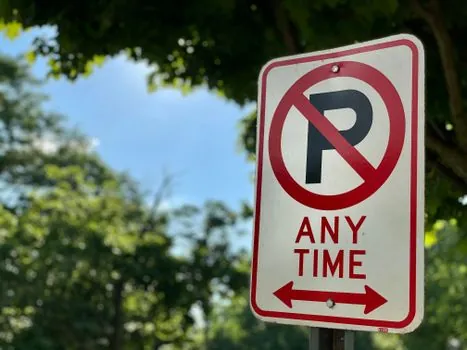
OSHA's placement rule is "as close to the hazard as safely possible, oriented so the worker, visitor, or driver reads it before entering the danger area," and that wording is the literal text AlphaGraphics' compliance guide lifts from the standard [S5]. Site-entry NOTICE signs (visitor check-in, PPE requirements, no-trespassing) must be posted at every active access point, not just the main gate, because secondary access points are the ones inspectors check second [S3].
For traffic-control devices the MUTCD requires fluorescent orange background with retroreflective sheeting, ordered from a dedicated safety-sign specialist, with most orders shipping within 2 to 5 business days once sheeting grade and custom text are confirmed [S6]. Project name, general contractor contact, and emergency phone numbers belong on the primary-entry sign, not on a back-of-cab door, so a first responder can read the project identifier in under 10 seconds on arrival [S3][S10].
Substrate and Sheeting: Where Most Field Failures Start
For UK perimeter applications the working substrate is 340 gsm mesh PVC with 25% airflow for wind load reduction, or 440 gsm solid PVC for hoardings where print density matters more than wind load, both rated fade-resistant under UV and available in fire-rated M1/B1 grades for inner-London sites [S1]. Mesh banners are specified for exposed, high-rise, and coastal sites where a solid PVC would act as a sail and tear within a season, and a 25 to 35% airflow perforation range is the band most UK suppliers stock [S1].
For U.S. traffic-control work the substrate is aluminum or composite with retroreflective sheeting, and the sheeting grade (engineer, high-intensity, diamond) is selected by the posted speed limit and the duration of the work zone, a decision MUTCD leaves to the engineer of record [S6]. On demolition and crane zones, a UV-stable rigid panel survives diesel fume and abrasive dust better than a self-adhesive vinyl, which is why most AS 1319-compliant Australian sites move to metal or composite once the project passes the 6-month mark [S4][S7].
Comparison: Sign Class by Decision Criteria
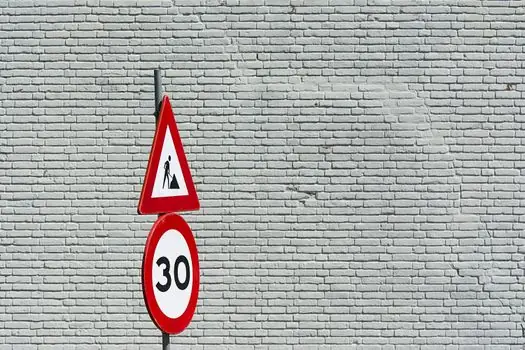
Across the four main classes the trade-off space is hazard severity, color, pictogram requirement, and typical substrate, and reading these four criteria side by side is the fastest way to spec a new site [S2][S4][S5]:
Danger (red top panel, white text): immediate, life-threatening hazards; pictogram required by ANSI Z535; substrate typically rigid aluminum or composite; typical locations are excavations, energized electrical panels, fall edges, crane swing radii [S2][S5][S7].
Caution (yellow background, black triangle): potential or moderate hazards; pictogram optional but recommended; substrate can be self-adhesive vinyl or corflute; typical locations are uneven ground, tripping hazards, and intermittent overhead work [S2][S4].
Mandatory (blue circle, white symbol): required PPE or actions; pictogram mandatory; substrate matches surrounding sign program; typical locations are site entry, hard-hat zones, eye-protection zones, hi-vis zones [S4][S5].
Emergency (green background, white pictogram): first aid, eyewash, evacuation routes, assembly points; pictogram mandatory; substrate typically photoluminescent for low-light legibility; typical locations are muster points and escape-route junctions [S4][S5].
Use Cases: What a Working Sign Plan Actually Looks Like
A pre-construction checklist from FASTSIGNS runs through each category before breaking ground, then revisits the list every time site conditions, crew composition, or active hazard zones change, because sign inventory is a living document, not a one-time purchase order [S3]. On demolition work, AS 1319 requires the warning to communicate both the nature of the activity and the access restriction, and that two-message pattern is what gets the sign past both the safety officer and the local council inspector [S7].
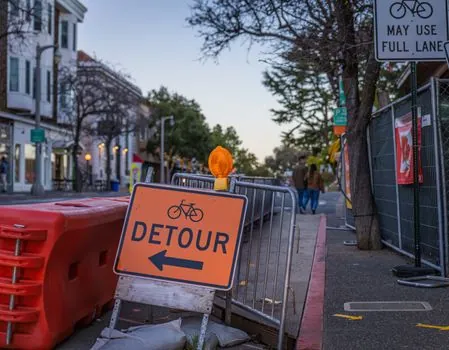
For traffic interfaces, the practical set is "Prepare to Stop," "Lane Closed/Ends," "No Entry," "Caution - Heavy Vehicles Turning," and "Pedestrian Detour," with each message tied to a specific MUTCD chapter and a specific retroreflective sheeting grade [S6][S10]. On a multilingual crew, English/Spanish panels with clear pictograms are the default best practice on U.S. sites because the pictogram carries the meaning when the wording does not [S5].
Limitations, Failure Modes, and What Inspectors Actually Cite
The most common field failure is using the wrong signal-word panel for the hazard severity, for example a yellow Caution sign at the edge of a 9 m fall, which OSHA reads as a misclassification rather than a missing sign and cites at the higher penalty tier [S2][S5]. The second is placement too far from the hazard, where a worker can physically enter the danger area before reading the message, and that is a placement defect, not a sign defect, and it carries the same citation weight [S5].
Substrate failures cluster around UV fade on south-facing hoardings (typically 12 to 24 months before legibility drops below ANSI contrast ratios) and around sheeting delamination on traffic-control signs that were specified at engineer grade but used in a high-speed environment where diamond grade is the correct call [S1][S6]. Repeating the sign audit on the same cycle as the toolbox talk, rather than once at project start, is the cheapest way to keep the inspection defect rate at zero across a 12 to 18 month build [S3][S5].
Standards and Sourcing Map
U.S. federal sites are governed by 29 CFR 1926 Subpart G for signs, signals, and barricades, with ANSI Z535.2 governing the design elements and MUTCD governing any device that interacts with public traffic [S2][S5][S8]. UK sites use the Health and Safety (Safety Signs and Signals) Regulations 1996 alongside the Heras-fence-banner conventions documented in the print trade, and Australian sites use AS 1319 as the master reference, with state-level overlays such as the NSW SafeWork guidance for site-specific placement [S1][S4].
Order specifications should always include the standard reference (1926 Subpart G, ANSI Z535.2, AS 1319, or MUTCD chapter), the sheeting grade, the substrate weight (gsm for PVC, mm for rigid panel), and a retroreflectivity class for any traffic-interface device, because that is the four-line spec a compliance auditor checks first [S2][S5][S6]. The next trackable signals to watch are any 2026 revisions to ANSI Z535.2 color-contrast ratios and the 2026 MUTCD update cycle, both of which will shift acceptable sheeting grades on traffic-control devices within the next 12 months [S2][S6].
Spec-level background on the components involved: warning sign, and warning tape.
Related analysis: Emergency Light Selection for Welding Operations: Zones, Watts, Battery Backup.