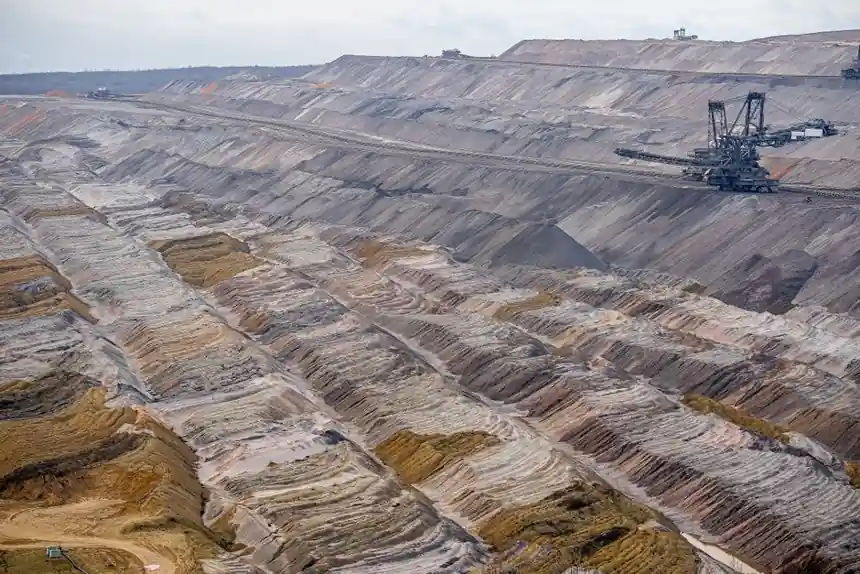
Selection of warning sign hardware for mining is governed less by aesthetics than by four hard gates: a regulatory design-and-posting rule, a substrate that survives the local duty cycle, a colour/symbol scheme aligned with AS 1319-1994 in Australia or equivalent national standards elsewhere, and a layout that puts the message at the decision point rather than at the hazard [S1][S3][S4].
For a typical surface coal, iron, or hard-rock operation, the practical consequence is that a "safety sign" is closer to a piece of infrastructure than a sticker: it is expected to remain legible for the life of the installation, not a single season, while taking continuous punishment from abrasive dust, water, UV, tyre scrub, and vibration [S4][S6][S8].
What the regulation actually says about sign design and posting
Under 62 Ill. Admin. Code 300.230 (a), signs and markers at a surface mine "shall be of uniform design that can be easily seen and read" and "made of durable material", and the mine operator is responsible for posting and maintaining them for the duration of the activity to which they pertain (Section 300.230(b)) [S1]. This is a baseline, not a ceiling: it sets three discrete obligations (uniform, visible, durable) and one temporal one (maintained while the activity runs), and it is broadly consistent with MSHA expectations under the 1977 Mine Act for sign standardisation across US mineral operations [S5].
For blasting specifically, the same Section 300.230(c) requires blasting signs to be displayed along the perimeter of any blasting zone at intervals of 500 feet or less, plus at every point where another road provides access; conspicuous signs at all public-road entrances must list the audible warning and all-clear signals in use; and a current blasting-zone map must be on file with the regulator and available for on-site review [S1]. The post spacing is the only hard numeric in the rule and is the one an inspector will measure with a measuring wheel.
Substrate and durability gates: matching the sign to the duty cycle
Conventional paint floor markings fail in a single season on haul routes because abrasive dust acts as sandpaper under tyres and tracks; conventional tape lifts at the edges when grit packs the adhesive boundary, then becomes a trip/lift hazard in its own right [S2]. For a haul road or workshop floor in a dust- and water-exposed mine, three substrate classes dominate selection: UV-stable, fade-proof printed aluminium or composite panels for fixed locations; reflective or photoluminescent weather-resistant labels for low-light and underground headings; and, where re-marking cost is high, projected light markings from an IP65-sealed, fanless projector that is unaffected by floor dust or water and has no consumable to reapply [S2][S8].
Spec gates on a fixed-panel sign in this duty cycle are: minimum 0.6–1.0 mm aluminium or equivalent composite; UV-resistant inks rated for the site's solar exposure band; high-contrast colour scheme aligned to AS 1319-1994 red-on-white (Danger), yellow-on-black (Warning), blue (Mandatory), green (Emergency/Egress) [S3][S7]; and, for headings in underground workings, a reflective or photoluminescent face so the message remains visible during a power failure [S8]. A panel that passes these four gates is considered fit for a 5–10 year in-service life before re-print; anything below that band is a candidate for the projected alternative where the projector is the only consumable-bearing part.
Sign type, colour and placement under AS 1319-1994
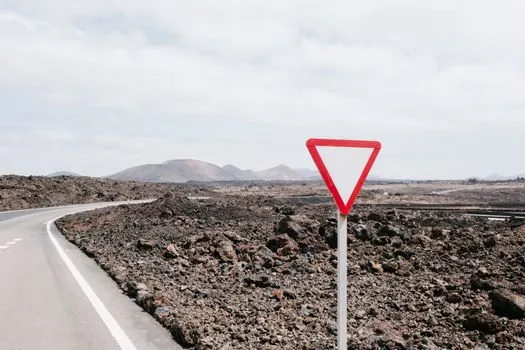
AS 1319-1994 is the standard that gives Australian mine signs a shared colour and shape grammar: red oval with the word DANGER over a black-on-white message panel for life-threatening hazards; yellow-on-black WARNING for hazards that can cause injury but are not immediately fatal; blue circular MANDATORY signs for required actions (PPE, isolations); green rectangular signs for emergency egress and first aid [S3][S7]. The four classes are not interchangeable, and misusing DANGER on a minor hazard is a documented dilution problem, because workers learn to ignore the highest signal if it is used too widely [S3].
Placement follows the "decision point" rule: signs belong where a person or vehicle can still choose a safe action, not at the hazard itself. Common high-risk placements on a mine site include: high-voltage switch rooms and substations; confined-space entries (tanks, sumps, process vessels); blasting zones and explosive magazines during loading and firing; unprotected edges, open stopes, and ground-collapse risk areas; and live plant during maintenance, isolation, or testing [S3]. On the traffic side, postings include 10–15 km/h speed limits indoors, 25 km/h on internal roads, height restrictions, one-way arrows, and haul-road right-of-way markers, with radio call channel signs and specific plant-interaction protocol panels layered on top at the working face [S4].
Comparison: sign technology options against four decision criteria
For haul-road and workshop-floor hazard demarcation in a dusty, wet, high-impact environment, four options line up as follows. (1) Painted markings: lowest material cost, highest re-application cost, service life measured in months under haul-truck traffic, fails in wet/dust conditions within one season. (2) Adhesive hazard tape: moderate upfront cost, very short service life because grit packs the edges and lifts the adhesive, then becomes a snag/lift hazard, which is the opposite of the safety intent [S2]. (3) Rigid printed aluminium or composite panels with UV-stable inks: highest upfront cost, multi-year service life, fixed message, best for decision-point postings on walls, gates, and posts. (4) Projected light markings from an IP65-sealed fanless projector: moderate hardware cost, no consumable, message is unaffected by floor dust, water, or uneven rock, but requires a power run and a clear mounting location, and is best for floor zones, intersection markings, and dynamic warnings [S2].
Decision rule of thumb from the source material: if the message is a fixed rule at a decision point (DANGER, speed limit, mandatory PPE), use a rigid panel; if the message is a transient floor or intersection marking in a high-destruction zone, project it. The same logic is reflected in industrial signage practice, where the goal is "signage as part of the site's physical infrastructure" rather than a seasonal consumable [S4].
Common failure modes and inspection triggers
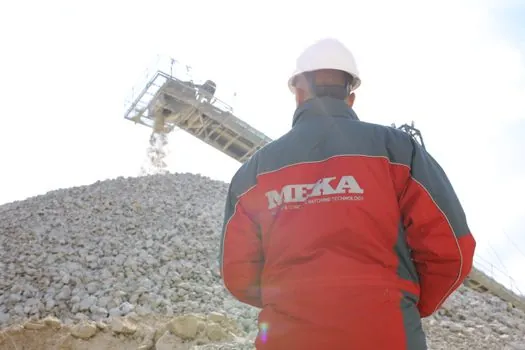
Three failure modes account for most real-world sign problems on mine sites. First, contrast loss: UV and abrasive dust together reduce the red-on-white or yellow-on-black contrast below the legibility threshold long before the substrate physically fails, so inspection cycles need to measure contrast, not just check that the sign is still bolted up [S8]. Second, message dilution: DANGER signs posted at low-hazard locations train workers to ignore the highest signal, which then fails to stop them at a real blasting-zone or energised electrical boundary; the fix is a usage audit against AS 1319-1994 categories and a cull of out-of-scope DANGER panels [S3][S7]. Third, drift from the documented WHS management system: a 20-year-old mine typically has dozens of hazard zones, traffic routes, exclusion zones, and muster points, and a sign that no longer reflects the current blasting-zone map or current haul-road layout is itself a compliance failure, even if the panel is in good condition [S1][S4].
Cross-applicability: how this maps to adjacent industrial sites
The same four gates translate well to chemical plants, where dust and corrosion are swapped for chemical splash and UV, and the comparison logic is laid out in the related Warning Sign Selection for Chemical Plants: 2026 Spec Map piece. The traffic-management and exclusion-zone sub-rules also overlap with port and warehouse logistics, where haul-truck and forklift interactions are the dominant hazard and signage is part of the same permanent-infrastructure logic described in the Truck Scale Selection for Port Logistics: 2026 Spec Map write-up. Selection signals worth tracking over the next planning cycle: the publication of updated AS 1319 guidance, more widespread substitution of projected markings in high-destruction floor zones, and a tightening of MSHA/state-level inspection focus on blasting-zone posting intervals and map currency. [S4]
For component-level specifications, see mining dump truck, and warning tape.