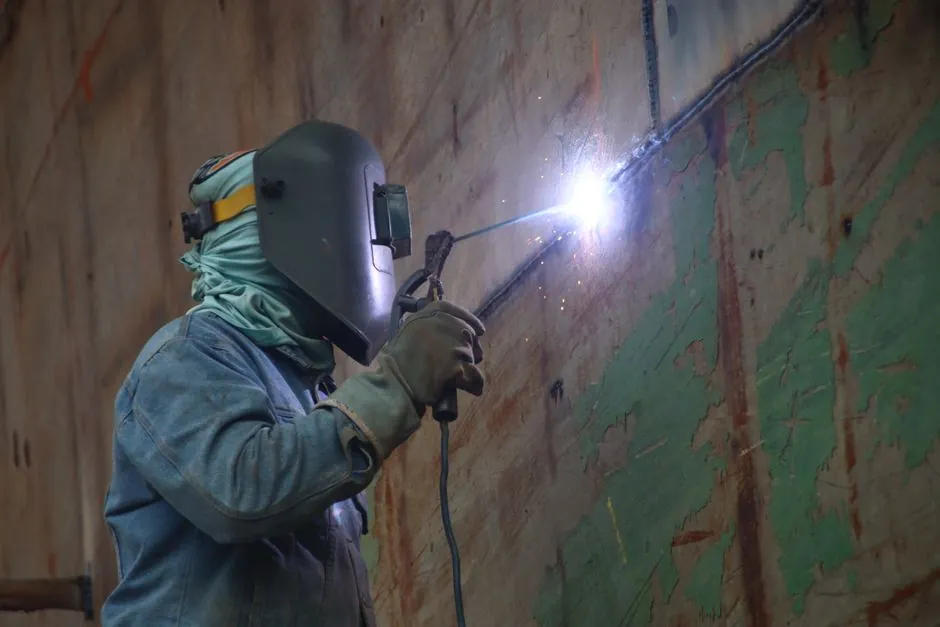
Welding bays are unusual hazardous-area spaces because the hazard is twofold: flammable gas or dust that may classify the location under ATEX/IECEx, and intense visible/IR radiation from the arc that overwhelms any general-purpose luminaire [S1].
Specifiers therefore need a fixture that is explosion-protected to the right zone, runs cool enough not to act as an ignition source, and delivers enough luminous flux plus battery runtime to evacuate welders and nearby operators through arc-glare conditions [S3][S5].
Why welding bays are a separate spec problem from generic hazardous areas
Welding generates UV, visible blue-light, and IR radiation strong enough to require lens shade numbers between 7 and 13 depending on process and current, per the standard shade-number table for SMAW, GMAW, and GTAW [S1]. That same radiation blinds conventional emergency luminaires if they sit near the work envelope, so spacing and photometric direction matter as much as the hazardous-area rating [S1][S3]. A second concern is that welding bays often also hold shielding gas cylinders (argon, Ar/CO2, acetylene) or solvent residues, which is why many sites classify at least part of the bay as Zone 1 or Zone 2 under IEC 60079-10-1, requiring Ex d flameproof or Ex e increased-safety luminaires rather than ordinary industrial fixtures [S4][S5].
Because welding combines an optical hazard, a thermal hazard, and frequently a flammable-atmosphere hazard, the emergency light spec has to clear three gates simultaneously: the right Ex rating for the zone, enough luminous flux and beam control to overcome arc glare, and a self-contained battery that holds 60 minutes minimum so egress is not dependent on a UPS that may itself be compromised by the incident [S3][S5].
Decoding the zone classification around a welding bay
Zone 0 means an explosive gas or vapour atmosphere is present continuously during normal operation, Zone 1 means it is likely to occur occasionally in normal operation, and Zone 2 means it is not likely and would only appear for short periods; equivalent dust zones 20, 21, 22 follow the same logic [S4]. In practice, the immediate vicinity of an open shielding-gas cylinder manifold or a solvent-cleaning bench tends to draw a Zone 1 call, while the wider bay with general ventilation usually drops to Zone 2, which is where most general-area emergency luminaires end up specified [S4][S5].
For dust-handling plants (grain elevators, flour mills, fertilizer lines) that also do maintenance welding, the comparable call uses Zone 21 or Zone 22 dust classifications under AS/NZS 60079.31, and the luminaire marking must explicitly include the dust group, not just the gas group [S4]. Specifiers who skip this step and order a gas-only Ex d IIB T4 unit into a starch or aluminium dust area commonly fail the inspection on first audit [S4][S5].
Wattage, lumen output, and the arc-glare reality
Common explosion-proof emergency luminaires on the market cluster into three wattage bands: compact 18W tubelights for corridors and stairways, 30W to 60W portable or wall-mount units for localised coverage, and 100W heavy-duty floodlights for large fabrication halls [S2]. LED efficacy now runs high enough that even an 18W maintained unit can deliver a usable escape-route illuminance of 1 lux on the floor along the egress path, while a 100W unit is reserved for open-bay fabrication where the mounting height is 6 m or more and the lux demand is closer to the general industrial 100 lux target for safe shutdown tasks [S2][S3].
Beam angle is the second lever: 120° wide-beam units suit low-bay welding cells, whereas a narrower 60° or 40° beam aimed down the egress corridor concentrates lumens where the evacuee is actually walking rather than wasting them on the back wall [S2]. Where welding sparks or spatter are a real risk, a prismatic or frosted lens cover is preferred to a clear lens, because clear polycarbonate yellows quickly under UV and loses 20 to 30 percent of its transmission within a year in a busy MIG bay [S2][S6].
Battery backup, charging time, and self-test behaviour
Sixty minutes is the de facto baseline runtime across the explosion-proof emergency category, from the 18W tubelight to the 100W flood, and 8 hours is the matching charge time on most LM6 aluminium or cast-aluminium housings using an external charger [S2]. Self-test options, including periodic automatic function tests with visual status indicators and integration with BMS or centralised emergency monitoring, are now routinely available on Zone 1 and Zone 2 LED emergency units and are the easiest way to keep the monthly and annual test logs from becoming a paperwork burden [S3][S5].
Two practical points: maintained versus non-maintained operation is a real choice in welding bays. Maintained units double as the normal ambient light when arc work is not happening, which suits cells used intermittently; non-maintained units stay dark until mains loss, which suits continuously occupied production cells where the welder works off task lighting and only needs the emergency layer for evacuation [S5]. Lithium-Ion packs at 2000 mAh are the typical self-contained battery for the 18W class, while the 100W class more often uses higher-capacity NiCd or LiFePO4 packs to support the extra load [S2].
Housing, ingress protection, and ambient temperature
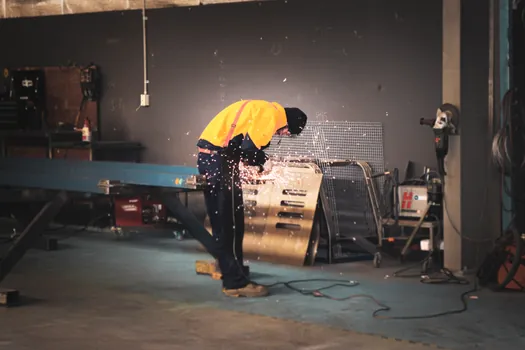
IP65 is the common enclosure rating for hazardous-area LED emergency lights in this category, which covers dust-tight and low-pressure water-jet exposure, and is enough for most indoor welding bays and sheltered outdoor platforms [S2][S3]. Cable entry options cluster around M20, 3/4" NPT, and 1/2" NPT, with the flameproof LED emergency tubelight class typically accepting up to two 3/4" ET entries for through-wiring on a corridor run [S2]. Maximum ambient temperature is usually 50°C for the portable 30W to 100W family and 55°C for the 18W tubelight, which is well above a typical welding-bay ambient of 35 to 40°C but leaves headroom for the radiant load from a hot workpiece [S2].
For sites where the luminaire sits within reach of spatter, an IK08 or higher impact-rated lens and a powder-coated aluminium body are the practical minimum; stainless-steel upgrade paths exist but are rarely needed inside a building [S2][S3]. Explosion-protection technique matters too. Ex d flameproof enclosures contain any internal ignition, Ex e increased-safety versions keep surface temperatures below the gas ignition threshold, and Ex tb dust-protected units are required for combustible-dust zones, so the marking string on the nameplate has to match both zone and gas/dust group, not just one of them [S4][S5].
Comparison of typical emergency-light classes for welding operations
Side by side, the 18W flameproof tubelight fits narrow corridors and stairwells, the 30W to 60W portable unit fits movable maintenance welding, and the 100W wall or pendant unit fits large fabrication halls. On wattage the 18W is lowest and the 100W is highest, on battery runtime all three sit at 60 minutes, on enclosure material LM6 aluminium dominates, on ingress IP65 is standard, and on zone coverage all three are rated for Zone 1 and Zone 2 in the gas group, with dust variants available on order [S2][S3]. The decision is therefore driven by mounting height, lux demand, and whether the fixture must be moved between jobs [S2].
Selection workflow for a welding-bay retrofit
A defensible spec starts with the hazardous-area drawing and a confirmation of the gas group (IIA, IIB, IIC) and temperature class (T4 to T6), then layers the photometric requirement: at least 1 lux on the egress path, higher where operators must close isolation valves in the dark, and adequate vertical illuminance on exit signs [S3][S5]. From there, the specifier picks maintained or non-maintained, self-contained or central-battery, fixed or portable, and confirms the cable entry thread matches the conduit run already in the bay [S2][S5]. A reviewer's checklist should verify ATEX 2014/34/EU or IECEx certificate scope, IP65 minimum, 60-minute runtime, ambient temperature rating at least 50°C, and lens material rated for UV exposure near welding [S3][S4][S5].
Two cross-references are useful while drafting the spec. For deeper hazardous-area coverage, the flameproof emergency light spec for chemical plants walkthrough lines up the same wattage bands against Zone 1/Zone 2 duty; for the broader jobsite lighting layer outside classified areas, the construction-site emergency-light selection guide covers the photometric floors and battery-gate logic that often apply to the non-classified perimeter of a welding project. For a wider view of how emergency light fixtures fit into an overall plant safety system alongside welding and cutting tool controls, the linked encyclopedia entries provide the surrounding context.
Common failure modes and what to avoid
Three spec errors show up repeatedly. First, ordering a Zone 2 gas-only unit into a Zone 21 dust area because the gas group letter matches; dust zone marking has to be on the nameplate or the install fails the audit [S4][S5]. Second, using a non-maintained maintained-equivalent fixture in a cell that is rarely occupied, so the unit never gets its monthly discharge test under real load and the battery sulphates within 18 months [S5]. Third, mounting the emergency unit directly above the welding arc so spatter pits the lens and UV degrades the polycarbonate within a year; the right mounting is offset 2 m to 3 m from the work envelope, on the egress side, with the beam aimed along the escape path rather than at the arc [S2][S6].
A fourth, quieter failure mode is mixing 4-hour fast-charge and 8-hour standard-charge units on the same circuit. The 8-hour unit never reaches full state of charge if the site tests monthly by leaving the unit off mains for the full rated duration, and within two years the 60-minute runtime claim has quietly dropped to 30 minutes. Trackable signals to watch in the next reporting window include: ATEX/IECEx certificate revisions covering LED emergency families, IEC 60079-0 standard updates that affect enclosure testing, and any change in the IECEx Scheme rules around self-test reporting on Zone 1 maintained luminaires [S3][S4][S5].
The underlying component specifications are covered under emergency rescue.