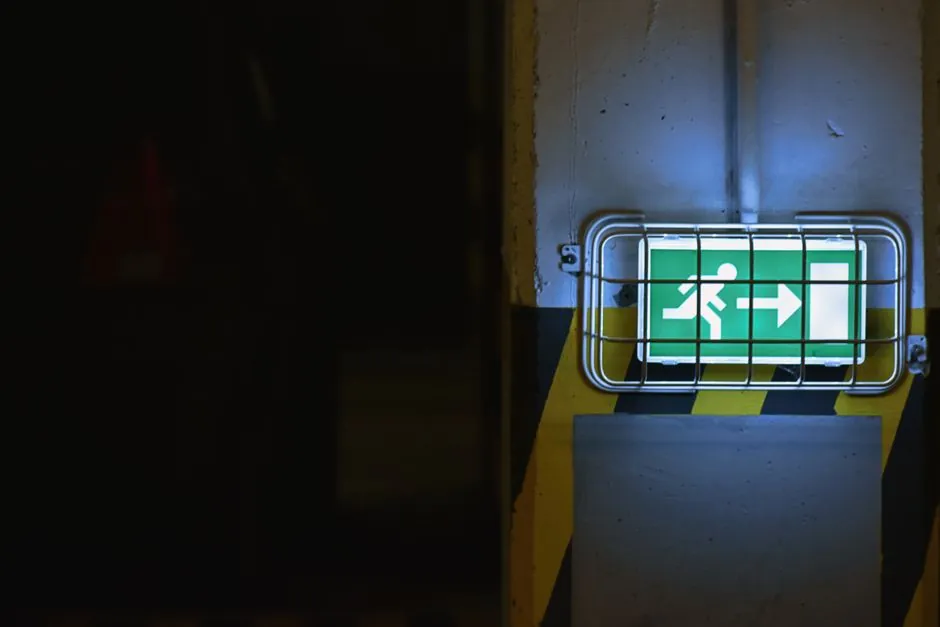
Emergency luminaires in food processing facilities must clear four spec gates simultaneously: IP65 minimum ingress protection, shatterproof construction, corrosion resistance to caustic washdown chemicals, and battery backup that survives ambient swings from cold stores to boiler-adjacent zones [S3][S5].
The decision binds food-safety regulators, electrical codes, and zone-classification rules together. A luminaire that passes UL 924 for emergency egress but fails HACCP on glass breakage, or passes NSF/ANSI 2 on cleanability but cannot handle a 5 °C cold store, gets rejected at commissioning [S1][S5].
Ingress, Cleaning, and the IP65/IP66/IP69K Stack
Thorlux's high-risk processing guidance sets IP55 minimum for luminaire enclosures near open product, with smooth profiles that prevent dust, fluid, and contaminant accumulation [S3]. The Australasian food-processing guide raises the floor to IP65 as the general default for luminaires "easy to clean, non-toxic, with reduced contamination risk and a shatterproof cover and body" [S5].
Washdown zones need higher ratings. A 2026-01-13 Hyperlite guide on washdown environments names IP66 as the practical minimum for high-pressure cleaning, with IP69K reserved for the most aggressive sanitation routines, such as daily high-pressure hot-water jetting at close range [S9]. Tigerlight's IP69K food-grade emergency batten targets exactly that washdown-and-food-grade intersection, with HACCP-compliant housing and high-pressure tolerance [S6]. The selection rule: IP65 for dry production and packaging, IP66 for hose-down zones, IP69K for the daily hot-jet zones adjacent to open product.
Materials, Shatterproofing, and Food-Contact Safety
Glass failure is the single most common audit finding in food-grade luminaire reviews. Thorlux's high-risk processing page specifies that the luminaire "should be housed in an enclosure which prevents the lamp or any part of the luminaire accidentally falling into the product," with shatterproof covers as a baseline, not an upgrade [S3]. The Australasian Thorlux page repeats the requirement and ties it to HACCP, IFS, and BRC food-safety frameworks [S5].
Material selection runs beyond the cover. Cleaning agents used in meat, dairy, and beverage plants are frequently corrosive (caustic, acidic, chlorinated), so the housing, gaskets, and fasteners all need compatibility statements. Stainless steel (typically 304, upgraded to 316 in salt or chloride exposure) and high-impact polycarbonate are the workhorses; aluminum housings require documented coating systems to survive the chemical atmosphere [S3][S4][S5]. NSF/ANSI 2 food equipment and USDA/FDA sanitary design are the two compliance regimes cited by LBC Lighting's 2017-09-26 food-processing overview that the emergency luminaire must satisfy alongside UL 924 [S1].
Battery Backup, Cold-Store Duty, and Maintained vs. Non-Maintained
Battery chemistry is the variable that determines whether an emergency luminaire works on a food-processing site at all. Self-contained and maintained emergency luminaires depend on batteries that lose usable capacity in cold storage, and self-discharge rates rise with ambient heat near cooking lines or pasteurizers [S5].
For ambient temperatures below 0 °C, specify low-temperature LiFePO4 or NiCd packs with documented -20 °C discharge ratings, not the standard NiMH packs used in office emergency lights. For 5 °C to 35 °C ambient, NiMH or LiFePO4 are both acceptable, with NiCd as the legacy option. The 90-minute minimum runtime on UL 924 is the floor; many food processors specify 120 minutes to cover cold-room evacuation plus muster [S5]. A useful cross-reference for adjacent industrial emergency-lighting selection logic is the Emergency Light Selection for Electrical Work spec map, which uses the same maintained-vs-non-maintained decision tree.
Zone Classification: When Explosion-Proof Becomes Mandatory
Most food-processing areas are non-classified, but dust zones appear in grain milling, sugar handling, starch, and powdered-dairy operations, where combustible dust clouds can persist. SUREALL's grain-silo application note names Class II Div 1 dust explosion-proof emergency luminaires (its SEG series) for storage and elevator lighting, with the broader Ex-proof range covering flour, feed, and powder lines [S4]. The Amasly 2025-03-19 article on explosion-proof LEDs in food factories reinforces that explosion-proof gear is becoming a "fundamental cornerstone" of food-factory lighting as health-and-safety enforcement tightens [S8].
Selection rule by zone: non-classified production rooms use IP65+ food-grade standard emergency luminaires; grain/sugar/starch zones with combustible dust require Class II Div 1 or Zone 21 rated explosion-proof emergency luminaires; ethanol-handling or solvent-cleaning rooms require Class I Div 1 or Zone 1 fixtures. For zone-mapping logic shared with oil-and-gas and chemical plants, see the flameproof emergency lights for chemical plants spec map and the oil-and-gas emergency light spec gates.
Illuminance, Color, and Escape-Route Geometry
Escape-route geometry drives most of the layout work. Thorlux's emergency-lighting checklist requires direct light on stairs, changes in floor level, changes in escape-route direction, corridor intersections, first-aid posts, fire-alarm call points, and the area outside the final exit door to a place of safety [S5]. The minimum 1 lux on the floor of escape routes is the standard floor; food processors frequently upgrade to 2 lux on stairs and ramps.
Color temperature and CRI matter for safety. In meat and produce inspection areas, 4000 K to 5000 K with CRI ≥ 80 lets QC staff see discoloration, off-color product, and foreign matter; the same luminaire can serve as the emergency source if maintained operation is specified. Glamox's food-processing application guide notes that vertical illuminance on control panels and computer screens, not just horizontal floor illuminance, is required to keep line operators able to read displays during a power loss [S2].
Comparison: Luminaire Tier by Application
Across the four typical food-processing applications, the spec stack looks like this: [S3]
Dry packaging and warehouse: IP65, non-maintained NiMH or LiFePO4, 90 min runtime, polycarbonate cover, 4000 K LED, no zone rating needed. Washdown processing (meat, dairy, beverage bottling): IP66 minimum, IP69K for daily hot-jet zones, maintained or sustained operation, LiFePO4 battery rated to -20 °C in cold rooms, stainless or coated-aluminum housing, HACCP/IFS/BRC documentation [S3][S5][S6][S9]. Cold store (-25 °C to 5 °C): IP65 vapor-tight housing, low-temp battery pack, ceiling-mount maintained, shatterproof cover, emergency mode triggered by power loss plus monitored by SmartScan or equivalent [S4][S5]. Dust zone (grain, sugar, starch, milk powder): Class II Div 1 or Zone 21 explosion-proof emergency luminaire, IP66 housing, dust-ingress certified, Ex d or Ex tb marked, LiFePO4 battery, and ATEX/IECEx documentation [S4][S8].
Standards Stack to Verify at Spec-In
The minimum compliance stack to confirm in a submittal: UL 924 (emergency egress, North America) or IEC 60598-2-22 (international equivalent), NSF/ANSI 2 for food equipment, HACCP/IFS/BRC for the manufacturer's food-safety management system, IP65 minimum with documented test report (IEC 60529), UL 1598 or IEC 60598-1 for the luminaire safety baseline, and DLC or Energy Star listing for utility rebate eligibility [S1][S3][S5]. For classified zones, add ATEX 2014/34/EU (EU), IECEx (international), or NEC Class II Div 1 (North America) [S4][S8].
Two trackable signals for the next spec cycle: NSF/ANSI 2 revisions on shatter-resistance thresholds for luminaires within splash zones, and the convergence of IP69K and emergency-battery testing in the major food-grade product launches. LBC's 2017-09-26 overview remains a useful primer on which agencies hold jurisdiction in the United States, while Thorlux's high-risk and Australasian pages, the Hyperlite 2026-01-13 washdown guide, and the Tigerlight 2026 IP69K food-grade emergency batten page together define the current 2026 product reality [S1][S3][S5][S6][S9]. For an adjacent industrial-lighting angle in a different hazard class, the Electromagnetic Brake Selection for Food and Beverage spec map walks through the parallel hygienic-design rules for motion-control components in the same washdown environments.
Detailed specification references: emergency light, emergency rescue, and emergency stop.