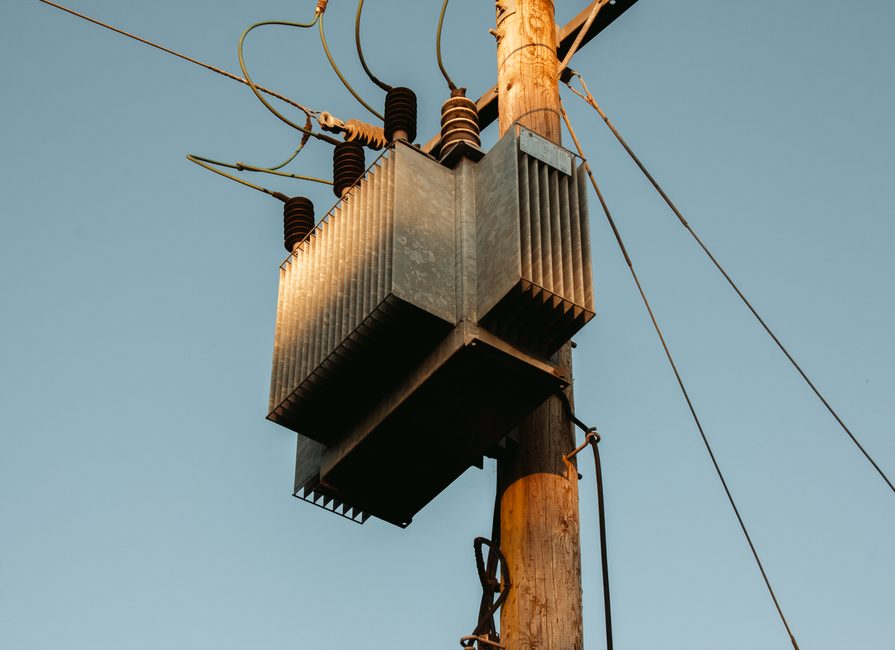
For electrical energy hardware, pure copper and copper-chromium grades remain the default choice where resistivity must stay below 1.7×10⁻⁸ Ω·m and operating temperature stays under 200 °C; for thermal-energy storage above 1000 °C, encapsulated copper phase-change capsules with Cr–Ni bilayer shells are documented to survive 1000 charge–discharge cycles between 1050 °C and 1150 °C [S3].
The selection problem is therefore not "which copper alloy is best" but "which energy domain the copper is serving" — conductive vs contact vs latent-heat — because each domain pulls the spec sheet in a different direction on conductivity, hardness, oxidation, and melting behaviour.
Conductive Domain: Busbars, Transformer Windings, Battery Tabs
ETP copper (C11000) at IACS 101% minimum conductivity and OFE copper (C10100) at IACS 101% are the two workhorses for low-voltage energy distribution where resistivity, not strength, sets the design [S5]. For ultra-thin battery-tab applications, fiber-laser lap-joint welding studies on pure copper (reported in the Chosun University work on lithium secondary battery interconnects) confirm that pure-cu foils can be welded without filler when joint geometry and laser pulse profile are tuned to the high thermal diffusivity of copper (~400 W/m·K) [S5].
Where busbar operating temperature exceeds 150 °C continuously, copper-chromium (C18200, CuCr1) is preferred because Cr precipitation raises the softening temperature while keeping conductivity above 80% IACS; this is the same material class used in resistance-welding electrodes, where hardness matters as much as conductivity.
Contact and Switching Domain: Where Hardness Outranks Conductivity
For pluggable connectors, slip rings, and spring contacts in energy-meter terminals, Cu-Be (C17200, typically 1.8–2.0% Be) and Cu-Ni-Si (C64710) deliver 350–400 HV after age-hardening, an order of magnitude above annealed pure copper's 40–50 HV, while still retaining 20–60% IACS conductivity [S5].
Cu-Sn (phosphor bronze, C51000) and Cu-Zn (cartridge brass, C26000) remain the cost-driven choice for low-current spring contacts in energy meter terminal blocks, where the spec is bend-cycle endurance above 10⁵ cycles at 0.5–1.0 mm strip thickness, not raw conductivity. Designers pick brass for stamped parts below 0.3 mm, phosphor bronze where fatigue life is the binding gate, and beryllium copper only where the contact normal force or arcing duty makes a softer alloy unacceptable.
Thermal Storage Domain: Encapsulated Cu Capsules Above 1000 °C
Molten salts dominate current high-temperature PCM deployments, but their thermal conductivity stays below 1 W/m·K, which throttles charge/discharge rate; copper as a metallic PCM delivers thermal conductivity above 300 W/m·K, an improvement of more than two orders of magnitude, with a melting point of 1077 °C suited to solar thermal and industrial waste-heat recovery [S3].
The Zhang et al. study demonstrates copper spheres encapsulated with a chromium–nickel bilayer via periodic-barrel electroplating, achieving 75% of theoretical latent heat density (~71 J/g at the 1077 °C melt) and a Cr–Ni shell thermal resistance of 8.27×10⁻⁶ m²·K/W; the capsules endured 1000 thermal cycles from 1050 °C to 1150 °C with no leakage [S3]. Designers working on concentrated solar receivers or steel-mill waste-heat recovery can read these numbers as a feasibility envelope — not as a commercial product datasheet, because capsule geometry, diameter, and Cr/Ni layer thickness all shift the latent-heat yield.
Material Comparison: Four Copper Alloys Against Four Decision Criteria
The four-way comparison below lines the principal copper grades against the binding gates that show up in an energy-equipment spec review. Use it as a triage table, not as a substitution chart — busbar and contact duties are not interchangeable. [S2]
ETP Cu (C11000) — conductivity ≥101% IACS, hardness ~40–50 HV annealed, max continuous service ~200 °C, cost baseline 1.0×; best for busbar, transformer winding, ground strap.
CuCr (C18200) — conductivity 80–85% IACS, hardness 140–180 HV, max continuous service ~350 °C, cost 1.5–2.0×; best for resistance-welding electrode, high-temp busbar, vacuum interrupter contact.
CuBe (C17200) — conductivity 20–60% IACS (age-hardened), hardness 350–400 HV, max continuous service ~200 °C, cost 5–8×; best for spring contact, slip ring, hazardous-area connector where mechanical duty is binding.
CuSn (C51000, phosphor bronze) — conductivity ~15–20% IACS, hardness 100–150 HV, max continuous service ~150 °C, cost 2–3×; best for low-current spring, battery-cell connector, instrument terminal [S5].
Failure Modes and Selection Traps

For the phase change material reference architecture, oxidation of bare copper above 400 °C is the binding failure mode; this is precisely why the high-temperature PCM literature pairs copper with a refractory Cr–Ni shell rather than relying on the copper substrate alone [S3].
Standards and Sourcing Anchors
Wrought copper and copper-alloy rod, bar, and shapes are covered by ASTM B49, B133, B301 and the UNS designations used in this article (C11000, C10100, C17200, C18200, C51000, C64710); electrical conductor hard-drawn and medium-hard copper follows ASTM B1 and B2, while oxygen-free copper in electronic applications traces to ASTM F68. For European specifications, EN 1652 (plate, sheet, strip) and EN 12163 (rod) are the equivalent call-outs, and IEC 60288 covers conductors in cables. [S2]
Scrap and secondary-copper sourcing has tightened in 2026 as North American yards re-quote basis on copper material grades, with regional recyclers advertising separate price lists for bare bright, #1, #2, and insulated copper — buyers specifying C11000 or C10100 should confirm mill test reports rather than rely on yard-grade labels when the application is energy meter or busbar [S4].
Spec Selection Workflow
Step 1: classify the duty as conductive, contact, or latent-heat; this alone rules out roughly half the candidate grades. Step 2: lock the binding constraint — for busbar it is IACS × cross-section, for contact it is hardness × cycle life, for PCM it is melt point × thermal-cycle count. Step 3: apply the environmental filter (reducing atmosphere, ammonia, salt fog, temperature ceiling) before any cost optimisation, because re-rating after a field failure costs more than the original premium for CuCr or CuBe. Step 4: confirm ASTM/EN grade and UNS number on the mill cert; the same alloy name from different mills can differ in impurity ceiling and grain size, both of which move resistivity and creep behaviour. [S1]
Trackable signals for the next review window: ASTM B49 revisions on oxygen-free copper purity ceilings, EN 1652 amendments on CuCr strip tolerances for resistance-welding electrode stock, and field data on encapsulated copper PCM capsules moving from lab demonstration toward pilot-scale solar-thermal receiver retrofits [S3]. Copper busbar and contact hardware is mature, so the spec map is stable — the moving edge in 2026 is the high-temperature thermal-storage side, where capsule geometry and shell chemistry remain the open variables.
Background reading: Quarry Road Roller Selection: 12-26 t Single-Drum Spec Map.