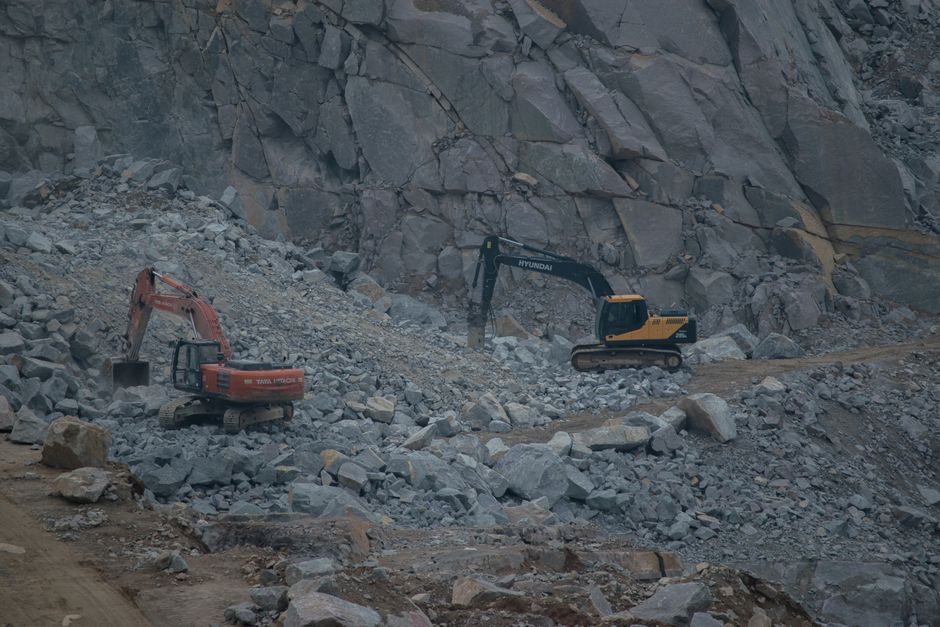
Fully hydraulic single-drum vibratory rollers in the 12-26 t operating-weight class (LTd210H/212H/214H/216H pattern) are the dominant configuration supplied to aggregate quarries and mine haul-road contractors, with 8-18 t mechanical-drive variants handling sub-base lift work [S1].
Quarry duty is distinct from highway compaction: lift thickness runs 300-600 mm of crushed rock rather than 150-200 mm of granular sub-base, and the compactor must push through AASHTO A-1/A-2 material with high particle friction; vibratory single-drum machines are engineered for this load case [S1][S2].
Operating-Weight Class and Why It Matters for Quarry Fill
Quarry haul roads and ROM pad compaction require 12-26 t static operating weight to deliver 30-65 kN linear drum load at the impact zone; below 8 t, machines cannot reach 95% Modified Proctor density on 300+ mm rock lifts in a reasonable pass count [S1].
The 8-18 t single-drum mechanical-drive vibration roller bracket covers the 8 t class for trench reinstatement around pit edges and the 18 t upper end for primary fill; above 18 t, fully hydraulic single-drum (LTd210H-216H) takes over, delivering higher amplitude at lower frequency for thick-lift quarry fill [S1].
For tandem-roller applications (asphalt cap layers on quarry access roads), the LTc6 / LTc6D mechanical-drive hydraulic-vibration tandem and LTc208/210/212/214 full-hydraulic tandem family cover 6-14 t, with front-drum / rear-tyre combinations (LTc203P/204P) used where surface finish matters more than rock-fill density [S1].
Drum Type: Smooth vs Padfoot vs Sheepsfoot Selection
Smooth single-drum rollers are specified for crushed-stone base courses and ROM pad finishing; padfoot (sheepsfoot) drums are mandatory for cohesive clay-rich quarry overburden where kneading action is required to break down lumps [S1][S6].
Padfoot drum contact pressure at 30-60 bar is the engineering reason clay-bound quarry haul-road layers consolidate; smooth drums skate on the same material, leaving uncompacted lenses that fail under haul-truck loading [S6].
Luoyang Lutong (LYTOP) and Jiangsu Junma both list dedicated padfoot single-drum variants in the 14-22 t class for mining/quarry duty, distinguishing them from highway-grade smooth-drum SKDs exported to Southeast Asia and Africa [S3][S6].
Drive System: Mechanical vs Full Hydraulic Trade-Off
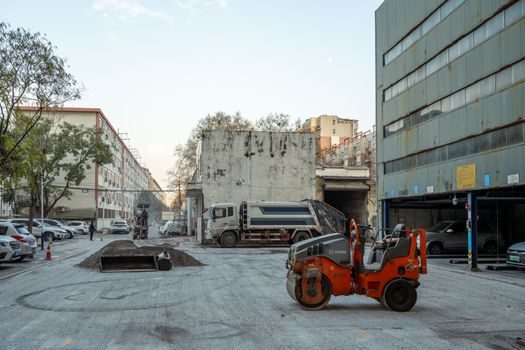
Mechanical-drive vibration rollers (LTd208-216 mechanical variants, LTc6/LTc6D tandems) are lower purchase cost and simpler to field-repair in remote pit locations; full-hydraulic drive variants add 15-25% to unit price but eliminate clutch-pack wear on start-stop cycle duty [S1].
Quarry operations with continuous 8-10 hour shifts on uneven ROM pad terrain benefit from full-hydrostatic travel drive because torque to the drum is not interrupted by gear shifts under load; mechanical-drive machines are typically specified for batch sub-base work and intermittent paving [S1].
Vibration drive is separately specified as mechanical-eccentric or hydraulic-eccentric even on mechanical-drive chassis; the LTc6/LTc6D tandem is mechanical-drive travel with hydraulic vibration, illustrating that the two drive trains are decoupled [S1].
Vibration Parameters: Frequency, Amplitude, and Centrifugal Force
Quarry single-drum rollers typically operate at 28-35 Hz low frequency with 1.6-2.2 mm high amplitude for thick rock lifts (300-600 mm); highway tandem rollers shift to 40-50 Hz with 0.4-0.8 mm amplitude for thin asphalt layers [S1].
Centrifugal force output in the 250-400 kN range is common on 18-26 t class machines; lower-amplitude / higher-frequency settings on the same drum are used for the final 50-100 mm surface pass to avoid aggregate fracture [S1][S6].
Two-amplitude / two-frequency vibration motors (a standard spec on LTd210H-216H family) let the operator switch between deep-lift and finish-pass modes without shutting down, which directly improves quarry cycle time [S1].
Quarry-Specific Hazards: Dust, Grade, and Abrasive Wear
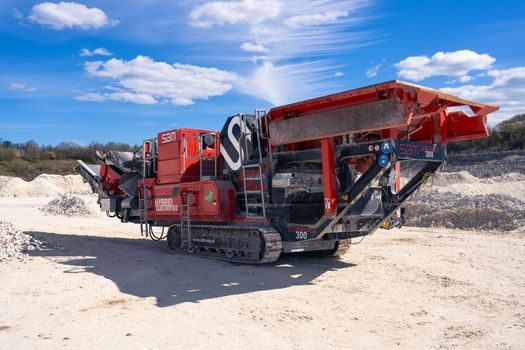
Drum bearing life in quarry dust is the primary maintenance cost driver; enclosure sealing to IP65 on the vibration motor housing is now standard on export-grade single-drum models, with roller bearing greasing intervals cut to 250 hours versus 500 hours on highway machines [S1].
Continuous 15-20% grade operation (common on pit access ramps) demands dual-axle dynamic-braking rather than purely service brakes; full-hydraulic travel drive is preferred because it provides retardation through closed-loop hydrostatic circuit, not just friction braking [S1].
Abrasive wear on drum shells from silica-bearing crushed rock is mitigated by hardened-steel drum wrap (400-500 HB) on quarry-spec machines; standard highway drum shells at 250-300 HB wear through in 3,000-4,000 hours of quarry duty versus 8,000+ hours on construction-grade material [S6].
Manufacturer Landscape and Export Channels
Jiangsu Junma Road Roller Co., Ltd. (Jingjiang, registered 2010) supplies the road roller / vibratory roller / road compactor range through Made-in-China.com, with main products listed as road roller, vibratory roller, road construction machinery, road compactor, and self-propelled variants [S3].
Luoyang Lutong (LYTOP) is the dedicated Luoyang Airport Industrial Zone roller specialist; the company develops, designs and produces road rollers as its core product, with mining/quarry variants in the 14-22 t padfoot class [S6].
Jining Dingcheng (Shandong) lists vibratory road roller, walking-behind vibratory roller, vibratory plate compactor and concrete troweling machine as main products, with ISO 9001 and CE certification and primary export markets in North America, South America, and Eastern Europe; this supplier covers the small-machinery end of quarry support compaction rather than primary fill [S2].
For procurement teams sourcing through trading houses rather than direct manufacturers, Luoyang JOOMACH (established 2021) lists the LTd210H-216H family and the LTc tandem range alongside spare-parts, OEM service and GNSS ADAS for agricultural machinery in its product matrix [S1].
Two adjacent procurement reference categories that quarry engineering teams frequently bundle with compactor purchases are Power Cable Selection: Voltage Class, Insulation, and Installation Duty for on-site crusher feed and Wiring Duct Selection Criteria for Conveyor Cells: A 2026 Spec Map for the conveyor-side MCC rooms that supply the same crushing line.
Selection Checklist for Quarry Procurement
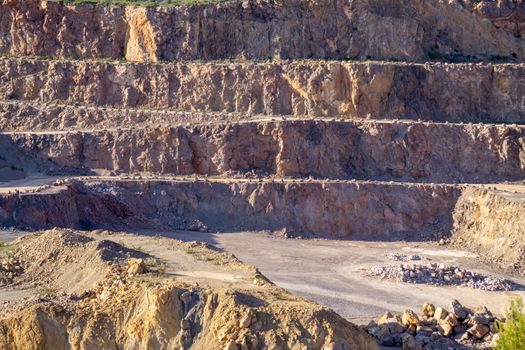
Specify static operating weight 12-26 t with 30-65 kN linear drum load; drum type matched to fill (smooth for crushed stone, padfoot for cohesive overburden); drive system matched to duty cycle (full-hydraulic for continuous shift, mechanical for batch); vibration motor 28-35 Hz / 1.6-2.2 mm amplitude with two-amplitude / two-frequency switchability; drum shell 400-500 HB; IP65 vibration-motor enclosure; and dual-axle dynamic braking for sustained grade work [S1][S6].
Confirm that the vibration motor and roller bearing service interval is documented for dust-laden quarry air rather than clean construction-site air, and that the supplier can deliver wear-shell replacement drums within the planned 3,000-4,000 hour overhaul cycle [S1][S6].
For haul-road shoulders and ROM pad edges, pair the primary single-drum with a 3-4 t mechanical-drive roller for trim work; for asphalt cap layers, specify the LTc208-214 full-hydraulic tandem with front-drum / rear-tyre configuration as the surfacing pass [S1].
Spec-level background on the components involved: road roller, and roller chain.