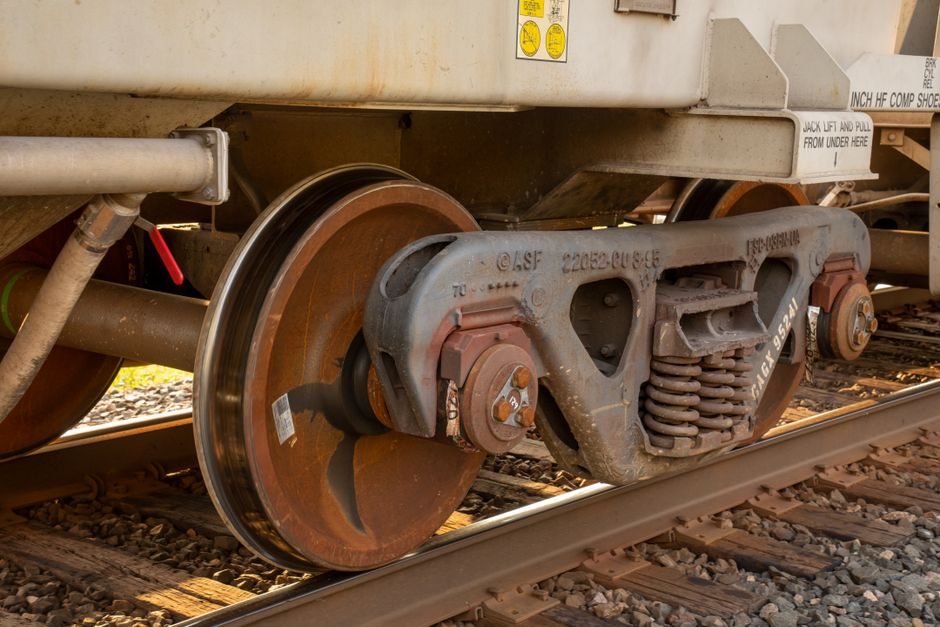
Knorr-Bremse Rail's published 2026 portfolio covers braking, entrance, climate, power-electrics, coupling, signaling and platform-screen-door subsystems delivered from ~40 locations worldwide with 10,000+ employees, confirming that copper-intensive subsystems (power electrics, signaling contacts, HVAC heat exchangers, coupler contacts) sit inside the procurement scope of every major rail OEM [S1].
For copper specifically, the rail supply chain draws on four alloy families — Cu-ETP (CW004A), Cu-DHP (CW024A), CuNiSi (CW109C) and CuCrZr (CW106C) — each governed by EN 1652, EN 12165 or EN 12167 for semi-finished product and by EN 50155 / IEC 61373 for in-service qualification of onboard equipment.
Alloy families and where each one is specified
Cu-DHP (CW024A, phosphorus-deoxidised, 99.9% Cu min) dominates refrigerant and HVAC heat-exchanger tube stock on rolling stock, where brazing operations demand a residual-phosphorus deoxidant; tubes to EN 12451 and EN 12452 are the typical call-out. CuNiSi (CW109C) and CuCrZr (CW106C) are the two precipitation-hardenable grades selected for contact wire, catenary droppers, and current-collector strips: typical tensile strength sits at 500–640 MPa for CuNiSi-TF00 and 450–550 MPa for CuCrZr-TF00, with electrical conductivity held at 45–55% IACS so that mechanical wear life and traction-current capacity are balanced. Procurement of the wider copper material family should always cross-check EN 1976 designation against the required temper (R200 / R260 / R350 / R460 for strip, TF00 / TH04 for rod).
Standards that govern the decision
EN 50155 is the binding standard for electronic equipment used on rolling stock, fixing operating-temperature windows (OT1 -25 to +55 °C with extended classes to +85 °C) and supply-voltage tolerances that drive the copper cross-section and connector choice. IEC 61373 defines the vibration and shock profiles (category 1, class A/B) that the same copper-bearing assemblies must survive, pushing designers away from Cu-ETP annealed and toward work-hardened or precipitation-hardened tempers. EN 45545-2 hazard level HL1–HL3 governs flammability, smoke and toxic-gas release of cable insulation, which in turn bounds the copper conductor temperature rise.
For overhead contact line (OCL) wire and messenger wire, EN 50149 specifies Cu-ETP, CuAg0.10, CuMg0.5, CuSn0.3, CuNi2Si and CuCrZr as the only acceptable materials; for rail and grooved contact wire the standard cross-sections run 80–150 mm² Cu-ETP and 100–120 mm² for high-strength variants. Pantograph collector strips, the wear part, are separately qualified to EN 50405 with Cu-CuCrZr sintered strips being the default for 250 km/h operation and above.
Selection criteria: conductivity vs strength vs wear
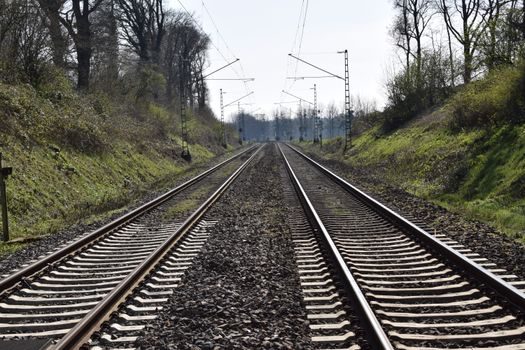
Three engineering variables drive the alloy pick and they trade off linearly: electrical conductivity (MS/m or %IACS), tensile strength (MPa), and softening temperature (°C). Cu-ETP sits at ~58 MS/m, ~220 MPa R200, with recrystallisation starting near 200 °C — fine for static busbar inside an equipment cabinet, marginal for anything bolted to a pantograph. CuCrZr sacrifices roughly 20% of the conductivity (45–50 MS/m after ageing) to gain 2.5× the strength (450–550 MPa) and a softening temperature above 500 °C, which is why it dominates 25 kV AC catenary hardware. [S3]
For third-rail systems (750 V DC metro), the wear pair is stainless-steel collector shoe on copper-alloy contact rail, with the rail typically specified as CuAg0.10 (CW013A) for its combination of conductivity and wear resistance, or aluminium–steel composite rail where weight matters more than conductivity. Traction-motor windings, transformers and inductors continue to use Cu-ETP round wire to EN 60317-0-1 with polyester-imide or polyamide-imide insulation to EN 45545-2 HL3; conductor temperature class is normally 180 °C (Class H) or 200 °C (Class C) for inverter-fed drives.
Application-to-alloy map for rail subsystems
Pantograph contact strips → sintered Cu-CuCrZr or Cu-CuNiSi; OCL contact wire → Cu-ETP, CuAg0.10, CuMg0.5, CuSn0.3 or CuCrZr per EN 50149; busbars and jumper cables → Cu-ETP R250/R350 to EN 13601; HVAC heat-exchanger tubes → Cu-DHP to EN 12451/12452; cable conductors → Cu-ETP Class 5/6 flexible to EN 60228; transformer and motor windings → Cu-ETP round wire to EN 60317 series; grounding straps and shunts → Cu-ETP braid or Cu-DHP flat bar; coupler and contactor contacts → CuNiSi or CuCrZr where arcing wear is expected. [S1]
This is also the point where the spec-by-spec thinking must align with the magnetic material selection on the same vehicle — the silicon steel laminations and the copper winding are co-engineered, and changing one without re-checking the other invalidates the thermal balance of the transformer or inductor.
Failure modes that drive redesign
Three field-failure mechanisms dominate copper components in service. (1) Stress relaxation at bolted joints: Cu-ETP loses ~10–15% of its initial clamping force within 1,000 h at 105 °C, forcing busbar designs to use Belleville washers or to step up to CuNiSi. (2) Fretting wear at stranded-cable terminations: tin- or silver-plated Cu-ETP strands exposed to vibration per IEC 61373 fail at the crimp barrel, solved by using nickel-plated Cu-DHP or by adding flexible silver-plated braids. (3) Spark-erosion of DC contactor tips: pure Cu-ETP tips erode within weeks on 750 V DC; AgSnO2 or AgC inlay on a CuCrZr base is the standard fix, governed by EN 50123 for traction DC switchgear. [S3]
Sourcing and supplier-evaluation signals
A 2026 procurement review of Cu-ETP rod, Cu-DHP strip and CuNiSi profile should track four verifiable signals: (1) EN 1976 / EN 12165 / EN 12167 / EN 13601 mill certificates with full O, P, S and trace-element data; (2) EN 50155 / IEC 61373 test reports for any pre-assembled copper component; (3) EN 45545-2 HL1–HL3 declarations for insulated conductors and busbar sleeving; (4) ISO 9001 + IRIS Silver or equivalent rail-sector QMS at the converter and the fabricator. Conversion cost and lead time remain volatile because copper concentrate complexity — higher gangue, higher impurity load — has been on a 15-year rising trend and smelter throughput has had to rise to compensate, with secondary slag and acid streams eating into operating margins [S3].
For new pantograph and OCL hardware, also confirm EN 50149 §6.2 lot acceptance tests (tensile, elongation, conductivity, torsion) and EN 50405 §6 for the collector-strip wear coupon test. The same procurement template should be carried into the wider flow meter and instrumentation scope on the vehicle, where copper alloy bodies (CW614N brass, CW510L dezincification-resistant brass) show up in cooling-system and compressed-air skids alongside the electrical copper.
For broader context on rail-component sourcing and adjacent cold chamber die casting work for rail hardware, the same EN 50155 / IEC 61373 envelope applies, and copper-alloy inserts are commonly cast in-place during moulding of those structural parts. Trackable near-term signals worth monitoring: EN 50155 amendment package A4 expected to clarify cyber-security and 5G-R coexistence, IEC 61373 revision 2 alignment work, and any EN 50149 amendment that opens CuNiSi-TF00 to higher-speed mainline catenary.