
That tolerance is suitable for many cutting, drilling, and forming operations, but it is not a finished-part tolerance; procurement must separate bar-supply accuracy from machining allowance, stress relief, and inspection requirements.
What tolerance applies to copper machining stock?
Another supplier lists material tolerance as ±0.125 in, while a cut-to-size service states a custom-cut tolerance of ±1/16 in, or 0.0625 in [S2][S6].
These figures are supplier conditions, not a universal ASTM B152 product tolerance. A machining buyer should state diameter, length, quantity, material condition, surface condition, and permitted cut length separately in the purchase order rather than treating “round bar” as a complete material specification.
For copper material used as raw stock, dimensional uncertainty is only one input. The machinist must also account for forming allowance, machining datum selection, heat-lot consistency, internal stress, and inspection after material removal.
How the main supply options compare
Mill-finish ASTM B152 C110 bar, standard saw-cut lengths, and precision cut-to-size stock occupy different positions on cost, accuracy, and lead-time risk. The comparison below uses only published supplier specifications [S1][S2][S6].
For a critical tolerance stack-up, standard saw-cut bar is the economical starting point only if the machining allowance can absorb its cut variation. Tighter cut service may reduce setup work, but it does not remove the need to control stress release or verify the finished geometry.
Selection criteria for a machining purchase
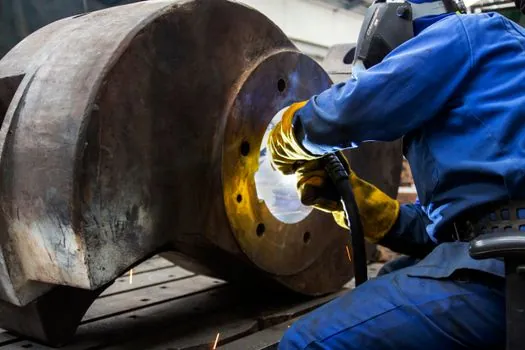
Three procurement checks define a usable machining tolerance package: the permitted stock variation, the condition of the bar, and the stability of the material lot. A supplier’s nominal diameter does not establish any of these by itself. [S5]
First, compare the supplier tolerance with the machining allowance. A bar cut to −0.000 in / +0.125 in can remain at or above nominal diameter, so a turning program written only for removing material from nominal stock may leave an undersize feature [S1]. The process engineer must either shift the machining datum, remove a defined skin, or buy tighter stock.
Second, define the surface condition. For a part with exposed surfaces, this is a cosmetic acceptance issue; for a bearing seat, shaft journal, or seal surface, it is a process-planning constraint.
Third, identify the material condition and lot requirement. For comparison, C110 round bar is described as ASTM B152 mill finish with 10–32 ksi tensile strength [S1]. These are separate requirements: heat-lot control manages consistency, while the ASTM designation identifies the product specification.
Stress relief can erase machining accuracy
Copper bar can move after machining because internal stress is released as material is removed.
The practical lesson is that stock tolerance alone cannot guarantee a 0.004 in flatness result. Dimensional stability depends on how much material is removed, where it is removed, the fixturing method, and whether residual stress has already been relieved before final machining. The example is dated February 2013, so it should be treated as an engineering case rather than a current tolerance standard.
The defensible interpretation is process control, not a guaranteed purchased-bar tolerance: a stable setup, suitable tooling, and controlled material removal can preserve accuracy better than a program that assumes rigid stock.
Which users fit each stock condition?
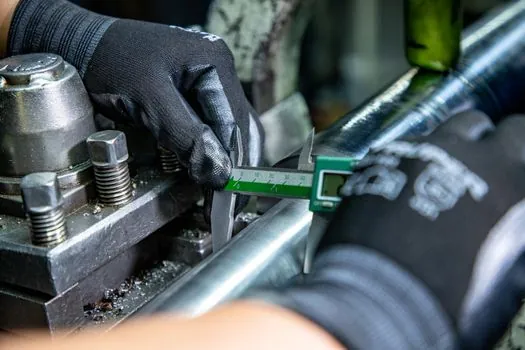
Those applications justify copper’s thermal and electrical conductivity, while machining applications benefit from its hot- and cold-forming capability [S1].
Standard mill-finish bar is not the first choice when a drawing already requires an exceptionally accurate as-received diameter, a cosmetic surface, or a finish machined directly from the skin. In those cases, cut-to-size stock, an agreed preprocessing allowance, or a precision blanking route is more appropriate. The supplier’s standard cutting tolerance, heat-lot condition, and surface disclaimer must be transferred into the drawing or purchase specification.
For comparison, alloy steel can offer higher strength and different machining behavior, while aluminum alloy generally provides a lighter material option. Neither substitutes directly for C110 where electrical or thermal conductivity is the functional requirement; material selection should follow service conditions, not machining convenience alone.
Copper machining behavior and tooling constraints
Copper is machinable, but it is less easy to machine than many common metals and requires appropriate tools and processes for cutting, drilling, and forming [S3]. Its ductility can produce burrs, smear, and tool loading, while lower stiffness than steel can increase chatter under weak setups.
A published 2026 guide for CNC machining copper uses C110 round bar as its reference stock and treats machining design as more than tool selection [S5]. The practical risk is dimensional movement from stress release, especially when pocketing or drilling follows roughing. A machining sequence should therefore minimize unsupported clamping, retain cutting support until the feature set is balanced, and inspect the part after the operations most likely to remove internal stress.
For shops comparing alternate bar products, forged versus rolled alloy steel bar provides a useful structural comparison, but copper remains the proper choice when conductivity and formability dominate. Copper does not gain steel-like stiffness simply by accepting a wider initial diameter tolerance.
Standards, inspection, and purchase requirements
ASTM B152 is the cited specification for 110 copper bar and flats in mill finish, and the listed C110 round bar has a 10–32 ksi tensile-strength range [S1]. The purchase record should also identify the supplier condition, cut tolerance, length, diameter, surface acceptance, heat-lot requirement, and any machining allowance [S1][S2].
Do not collapse the supplier’s −0.000 in / +0.125 in cut condition into an ASTM B152 dimensional class without documentary confirmation. The research identifies ASTM B152 and the commercial tolerances, but it does not establish that every listed tolerance is generated by one standard. Inspection at receipt should record actual diameter at multiple positions, cut length, surface condition, and material identity before the bar enters production [S1][S2].
For finished parts, inspect after stress-sensitive operations rather than assuming the first machined profile will remain flat. The 0.25 by 0.75 by 6.0 in example and its 0.004 in flatness callout show why final geometry can diverge after pockets, slots, and holes are machined [S4]. A tolerance plan that includes as-received stock size, machining allowance, fixture design, and post-machining inspection is more reliable than specifying a single nominal bar diameter.
Track two procurement signals before releasing a machining buy: the supplier’s actual diameter and length condition, and the documented effect of stress-relief or cut processing on the finished feature. If those values are unresolved, request a sample or one-piece machining trial before committing the full order.