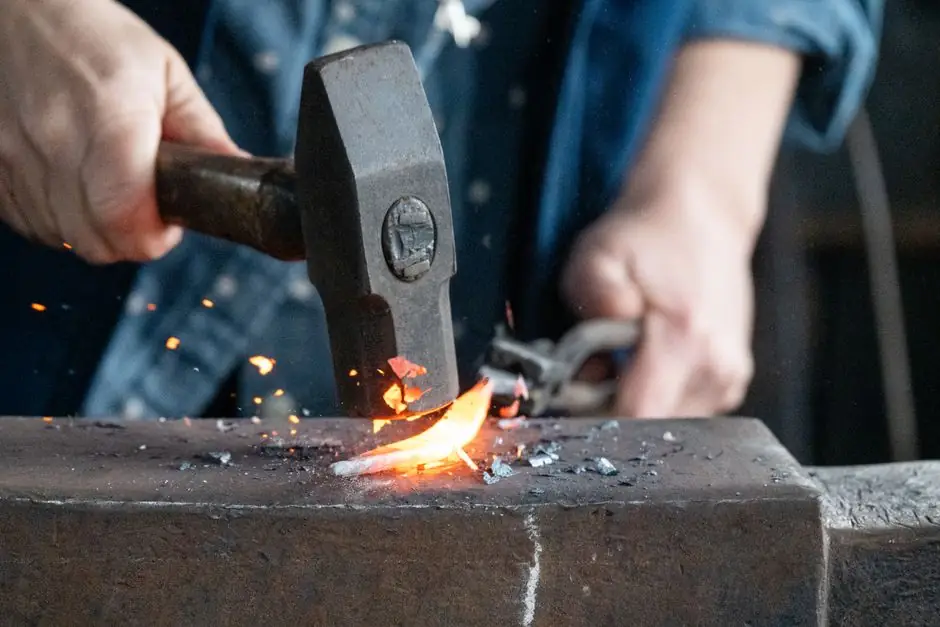
Forged alloy steel bar carries a 20% to 50% price premium over equivalent rolled stock, justified only when the component demands grain-flow alignment, internal soundness, and a documented reduction ratio, not when the spec merely lists "forging quality" as a buzzword [S5].
Procurement and design engineers sourcing round, square, or hex stock for shafts, valve bodies, flanges, landing-gear pins, and offshore fittings face a deceptively simple decision: cut from a rolled bar, or pay for forged bar. The route chosen changes grain structure, ultrasonic acceptance, fatigue behaviour, and total cost of ownership, not just the unit price on a quote [S2]. This article lays out the metallurgical, dimensional, cost, and standards differences a process engineer needs to specify correctly the first time.
Process Routes: Compression Pattern and Reduction Ratio
Rolled bar is produced by passing a heated billet (typically above 1,000 °F, the recrystallisation range) through successive grooved rolls that progressively reduce the cross-section; rolling elongates the grain structure along the rolling direction and is faster, more continuous, and cheaper per ton than forging, which is why rolled bar remains the default commodity product [S2][S3].
Forged bar, by contrast, is shaped by localised compressive deformation in a hammer or press while the billet is held above its recrystallisation temperature (commonly 1,050–1,250 °C for alloy steels); a properly executed forging operation delivers a minimum 3:1 reduction ratio, refining the as-cast dendritic structure into a worked, more uniform grain network with directional flow following the part geometry [S3][S4]. Open-die forging is the standard route for round, square, and flat forged bars in larger sizes, while closed-die forging is reserved for near-net-shape components and is not normally how long bar stock is produced [S2]. For an overview of how these grades fit into the broader family, see the alloy steel reference page.
Mechanical Properties: What Forging Actually Buys You
Forging aligns internal grain flow with stress paths, eliminates voids, and develops more uniform mechanical properties throughout the cross-section; this is the structural advantage that matters in safety-critical applications such as aerospace drive shafts, landing-gear pins, and high-pressure oil and gas valves [S4][S5].
However, the claim that "forged is always stronger" is not supported by the data: a forged bar of a given grade and a rolled bar of the same nominal grade, in the same heat-treatment condition, can meet equal or higher stated tensile requirements depending on section size and test location; forging alone does not guarantee higher values, and "forging quality" is not a substitute for measurable acceptance criteria [S1]. The practical rule is: forging delivers fatigue and impact gains primarily when the bar is large (typically above ~200–250 mm round), the reduction ratio is at least 3:1, the heat treatment is correctly specified, and the test location reflects the most heavily loaded fibre of the finished part [S1][S3][S4]. Common forged grades cited for aerospace, defence, and power generation include 4140 (chromoly) and 4340 (nickel-chromoly), with carbon typically held in the 0.20–0.55% range to balance strength after quench-and-temper against forgeability [S4]. For the complementary commodity-grade family, see carbon steel.
Section Size, Tolerances, and Machining Allowance

Rolled bar is supplied in standard mill rounds, squares, hexagons, and flats, with hot-rolled, peeled/turned, ground, or cold-finished conditions available; tolerances depend on the ordered standard, and warping, scale, and thickness variation on hot-rolled product often mean additional machining is required if dimensional precision or surface finish matters [S1][S3].
Forged bar is generally supplied with explicit machining allowance because the surface scale and dimensional tolerance of an as-forged round are looser than a comparable rolled bar; in return, the route spans a much broader diameter range than rolling can deliver, and it accommodates low-volume, non-standard sizes that no rolling mill will run economically [S1][S3]. Cold-finished bar is a commercial description that may include drawing, turning, grinding, or polishing, and buyers should not assume that every cold-finished bar was literally cold rolled [S1]. For applications that demand light, high-strength sections, the titanium alloy family is sometimes evaluated alongside alloy steel where the duty cycle permits.
Decision Matrix: Forged vs Rolled for Critical Components
For a procurement engineer, the four decision criteria that consistently drive the choice are (1) section size, (2) fatigue/impact duty, (3) inspection regime, and (4) cost premium tolerance; the matrix below condenses the research into a directly comparable view. [S1]
On section size, rolled bar is generally economical and technically suitable up to roughly 8–12 in. round in standard mill grades, while forged bar is the only practical route for very large diameters, one-off or low-volume sizes, and non-standard sections [S1][S3]. On fatigue/impact duty, forged bar with documented 3:1 minimum reduction and aligned grain flow is preferred for cyclically loaded shafts, landing-gear pins, and pressure-containing bodies, whereas rolled bar is acceptable for static or lightly loaded brackets, spacers, and general machined hardware [S1][S4][S5]. On inspection, critical forgings typically carry defined ultrasonic testing (UT) acceptance criteria, test location, and traceability, while rolled bar is usually accepted on MTC plus dimensional inspection with UT or other NDT specified only when technically required [S1][S5]. On cost, forged bar runs 20% to 50% above comparable rolled bar per ton, with the exact delta depending on alloy, size, heat treatment, and NDT scope; the premium is justified by reduced warranty exposure, longer component life, and lower risk of catastrophic failure in heavy industry [S5]. For engineers who need a deeper dive into form-factor trade-offs, the related piece Alloy Steel Bar vs Plate for Forged Components: Spec-Level Selection extends this matrix to the bar-versus-plate question.
Standards, Inspection, and Acceptance Criteria
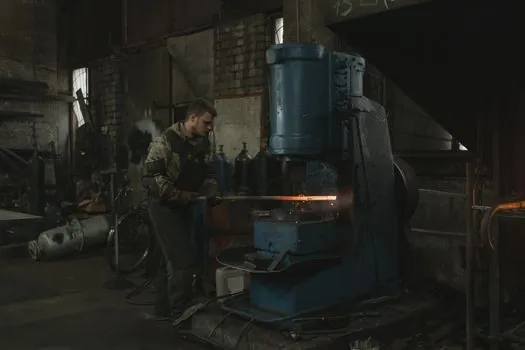
Reliable procurement of either route relies on a verifiable Mill Test Report (MTR) and, for critical service, mandatory ultrasonic testing (UT) to confirm internal soundness; UT acceptance criteria, test location, and traceability are part of the forging specification, not an add-on, and they are what convert a generic "forged" callout into an auditable requirement [S5].
The governing material specification (commonly ASTM/SAE-grade based, with explicit heat-treatment condition, reduction ratio, and NDT scope) is what controls acceptance, not the word "forged" in the purchase order; rolled product that meets the same specification and acceptance tests should not be rejected merely because it was not forged [S1]. For sour-service or corrosive-duty applications, the material standard and NDT regime must be cross-checked against requirements such as NACE MR0175 for sour H₂S environments, and against any project-specific procurement documentation; for sour-service or chloride-rich duties, nickel alloy families are often evaluated as alternatives when alloy steel alone cannot meet the corrosion allowance.
Use Cases: When Forged Is Mandatory, When Rolled Is Fine
Forged alloy steel bar is the correct call for aerospace drive shafts and landing-gear pins (40,000-cycle fatigue design lives, 8-in. cross-sections, weight-capped designs around 250 lb per part), heavy-machinery axles under massive cyclic loading, high-pressure oil and gas valve bodies, and any safety-class component where a casting-related discontinuity near the core of a large rolled bar would be unacceptable [S4][S5].
Rolled bar is the correct call for general machined brackets, spacers, hydraulic-cylinder heads in non-sour service, and standard round-bar diameters up to roughly 8–12 in. where the MTC, specified heat-treatment condition, and required NDT cover the design loads without forcing a 20–50% cost penalty [S1][S5]. A useful sanity check before signing the PO: if the drawing calls for a straight bar and the only reason listed for forging is "critical service," confirm whether the actual duty cycle, size, and NDT scope justify the premium, or whether a properly specified rolled bar with explicit UT acceptance would meet the design intent at lower cost [S1][S5]. For duty cycles that cross into corrosion-led failure modes, also review the stainless steel family entry; the silicon steel page covers the related electrical-steel context where grain orientation, rather than fatigue, is the controlling property.
Limitations, Failure Modes, and Common Mis-Specifications
The most common mis-specification is calling out "forged" or "forging quality" without quantifying reduction ratio, test location, UT acceptance thresholds, or heat-treatment condition, which leaves the order open to interpretation and the delivered product to the lowest-cost interpretation of those words [S1][S5].
Another recurring failure mode is assuming a rolled bar of large diameter has been worked all the way through its core; in larger diameters, rolling primarily elongates the grain structure along the rolling direction, and any casting-related discontinuities near the core are less thoroughly broken down than in a forged bar with documented reduction [S2]. A third pitfall is specifying closed-die forging for what is actually a straight bar requirement; closed-die forging normally produces near-net-shape components, not ordinary straight bar stock, and the purchase requirement should be confirmed against the drawing before the quote is released [S1]. Track the next decision nodes: (1) require the MTR to list reduction ratio, forging temperature range, and heat-treatment condition explicitly, and (2) require UT acceptance criteria, test location, and acceptance class by reference to a recognised standard, not by narrative description, on every critical-component PO issued after 2026-10-11.