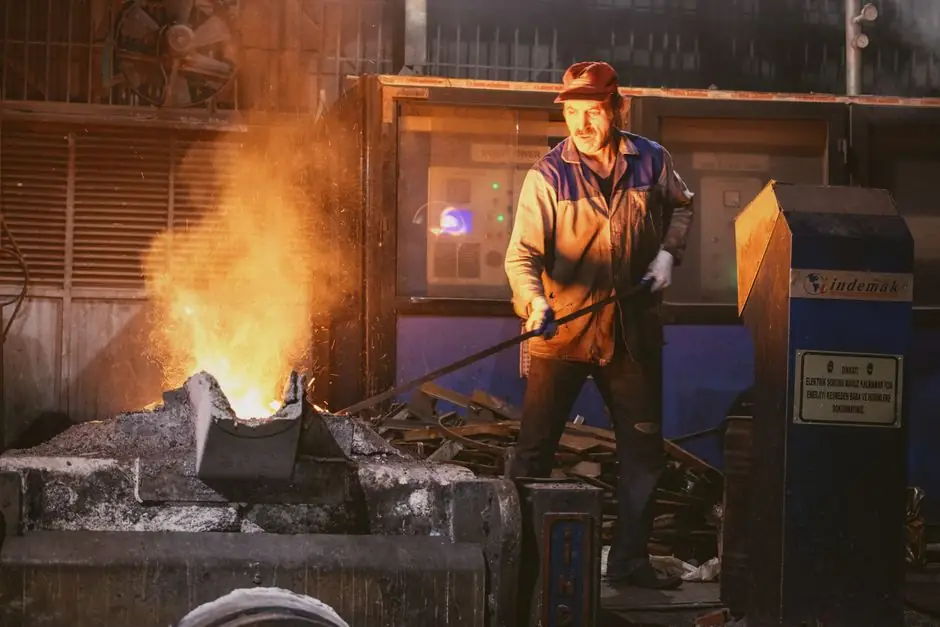
Coreless induction furnaces reach melt rates of roughly 0.5–2 tonnes per hour in mid-size foundry ratings and handle cold starts in any alloy, while channel induction furnaces run 10–15 percentage points more efficiently on a single dedicated alloy but cannot start from solid [S1][S2][S6].
Both are grid-powered, refractory-lined, water-cooled-copper-coil melters, yet the two designs diverge in coil geometry, startup behavior, and stirring mechanism, which in turn sets the melting rate ceiling for each unit. For a foundry specifier, the choice is less about which is "better" and more about matching furnace architecture to duty cycle [S4].
How the Two Architectures Set the Melting Rate Ceiling
The coreless furnace has no iron core; an alternating current in the water-cooled copper coil drives a reversing magnetic field straight into the entire crucible charge, which induces eddy currents through the full cross-section of the metal. Direct field coupling across the whole bath is what gives the coreless design its high power density and fast cold-start melt rates, typically expressed in tonnes per hour for a given kW rating [S3][S4]. Inherent electromagnetic stirring from the same coil keeps the bath homogeneous in temperature and chemistry, which matters when charge mix changes batch to batch [S3].
The channel furnace works as a transformer: a primary coil on a laminated iron core induces current into a single-turn secondary loop of molten metal contained in a refractory "channel" through the core. Heating is therefore concentrated in a small molten loop at the bottom of the bath, and the channel must stay molten for the secondary circuit to close, which means a channel furnace cannot start from cold solid charge and operates best on a continuous, single-alloy heel [S1][S4]. This transformer-like construction is also what delivers the 10–15 percentage point efficiency edge over the coreless principle during holding, per a 2024 practical-measures analysis [S6].
Melting Rate, Holding Efficiency, and Energy: A Criteria Comparison
Across four decision criteria drawn from OEM and engineering sources, the two architectures behave as opposing specialists. (1) Melting rate from cold: the coreless design wins because direct induction through the whole crucible charge transfers power into the metal across its full cross-section, not just a narrow channel; documented coreless advantages include rapid melting and short cycle times for steel, iron, and non-ferrous alloys [S2][S3]. (2) Holding efficiency: the channel design wins by 10–15 percentage points in electrical efficiency because the laminated-core transformer geometry concentrates flux into a low-loss molten loop and the bath acts as thermal mass rather than the heating element [S6]. (3) Alloy flexibility: coreless furnaces are preferred for foundries that swap alloys frequently and need to drain the bath fully between pours, while channel furnaces are described as "rigid" and "best suited to a single dedicated alloy" because changing the molten heel is difficult [S4][S5]. (4) Startup: coreless can start from a solid cold charge, channel cannot and requires a permanent heel [S1][S4].
For pour-and-cast operations with one alloy, channel furnaces deliver lower kWh per tonne held. For job shops that change alloy every shift and need fast turnaround from a cold furnace, the coreless design is the engineering default, and the wider process economics (scrap charging, empty-bath drain, refractory wear per cycle) tip the decision further toward coreless [S2][S4][S5].
Alloy Fit: Where Each Type Earns Its Slot

Channel induction furnaces are commonly specified for lower-melting-point non-ferrous work, including aluminum and copper alloys, where the transformer loop stays in a low-resistivity molten zone and the bath can be held at pour temperature for long shifts [S1][S5]. The coreless induction furnace, in contrast, is documented as the right tool for higher-melting-point and metallurgically demanding alloys such as cast iron, carbon steel, and stainless steel, where the bath needs to be heated throughout its full depth and stirred to avoid cold skulls or alloy segregation [S1][S3].
For a typical mid-size iron foundry melting 1–5 t batches from a cold start each morning, a coreless medium-frequency unit is the standard reference configuration. For a die-cast aluminum plant running three shifts on a fixed 6xxx-series alloy, a vertical-channel holding furnace fed by a smaller coreless melter (a duplex arrangement) is a common pattern, with the channel unit trimming holding kWh while the coreless unit handles cold-charge melting [S2][S4]. The coreless unit also handles ferrous scrap and returns cleanly, with a documented low-emission profile relative to combustion furnaces [S7].
Limitations and Failure Modes Engineers Should Plan For
Coreless furnaces carry higher refractory wear per melt cycle because the entire bath goes through cold-to-melt and back, and the bath surface radiates more heat than a channel design. Power factor correction capacitor banks, water cooling, and coil insulation are continuous maintenance items, and a coreless unit left empty between shifts loses the heel advantage that a channel unit retains by design [S3][S4].
Channel furnaces, conversely, cannot survive a frozen channel: if power is lost or the loop is allowed to solidify, the secondary winding opens and the unit must be re-melted from a separate source, which is one of the most-cited operational risks in foundry practice [S1][S4]. Channel units are also harder to drain completely, so alloy changeover requires careful heel management and is rarely done on production lines running narrow-margin chemistries [S4]. For spec sheets, the trade is real: channel units give higher steady-state efficiency and excellent thermal homogeneity for long holds, coreless units give higher melting throughput and alloy agility, and any attempt to use one for the other's job typically shows up as a kWh-per-tonne penalty or a heel-management headache within weeks [S2][S4][S6].
Selection Signals and What to Track Next
A specifier should fix three numbers before choosing: the cold-start melt rate required (t/h), the planned alloy count per week, and the target kWh per tonne held at temperature. If the cold-start rate and alloy count are both high, specify a coreless medium-frequency induction furnace and accept the higher holding kWh; if a single alloy dominates and the duty is mostly holding and pouring, specify a channel melting furnace in duplex with a smaller coreless melter. For aluminum-only plants, a gas- or channel-style aluminum gas aluminum melting furnace line is a separate comparison and is covered in the linked reference. Trackable signals to watch: medium-frequency IGBT converter prices per kW, refractory life ratings per campaign, and tightening EU Stage V-style foundry emissions rules, all of which push the next 12–24 months of furnace-refresh decisions toward higher-efficiency coreless power supplies paired with channel-style holders. For a broader process-side comparison, the EN-GJL-250 vs EN-GJS-500-7 grade map and the EN ISO 374-1 glove marking piece both show how the same criterion-by-criterion logic applies outside the furnace room, and the EN-GJL-250 vs EN-GJS-500-7 grade map is a useful template for documenting the alloy-side decision in parallel. [S1]