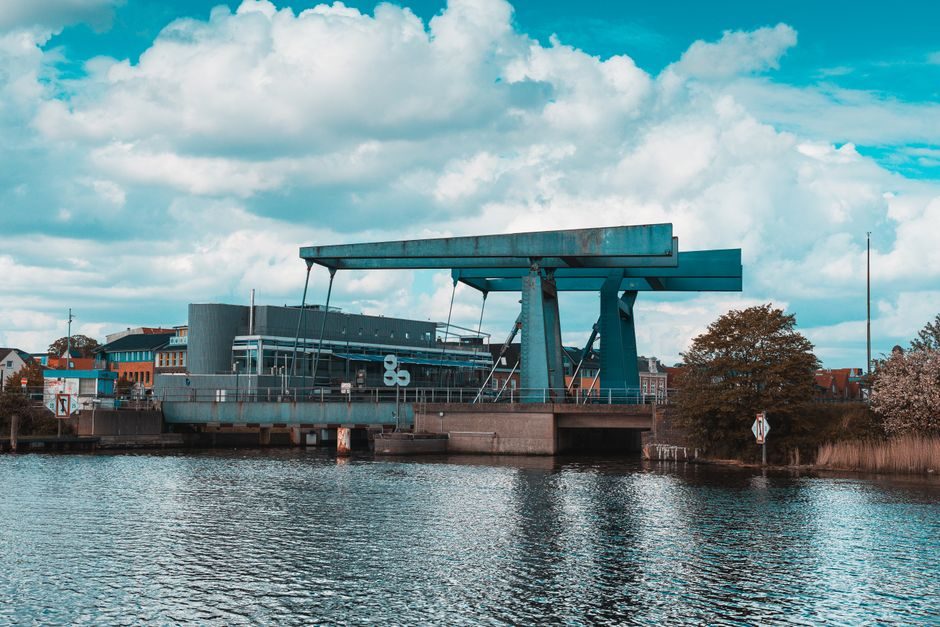
Coriolis mass flowmeters and open channel flowmeters solve fundamentally different measurement problems: one measures mass flow through a closed, pressurized pipe, the other infers volumetric flow from a liquid level in a gravity-driven open channel.
The two technologies share almost no field overlap. Process plants that custody-transfer hydrocarbons, batch reactor feeds, or chemical dosing lines rely on Coriolis flowmeters for direct mass measurement with typical accuracy better than ±0.1% of rate. Municipal wastewater, irrigation canals, and stormwater systems rely on open channel flowmeters paired with primary devices such as flumes or weirs to calculate flow from a measured head.
Measurement Principle and Sensing Domain
A Coriolis flowmeter uses one or more vibrating tubes driven at resonance; mass flow is derived from the phase shift of the tube vibration caused by the Coriolis force acting on the fluid [S1]. The same instrument simultaneously outputs density and (by calculation) temperature-corrected volumetric flow, which is why Coriolis is the default choice for batch control, two-phase flow, and custody transfer of liquids and slurries.
An open channel flowmeter does not measure flow directly. It measures liquid level in a channel of known geometry using a non-contacting sensor (ultrasonic, radar, or submersible hydrostatic), then applies a flow equation bound to a flume, weir, or calculated channel cross-section to convert level into flow rate. Because the primary element is the channel itself, the flowmeter is only one half of the measurement loop.
Accuracy, Turndown, and Process Conditions
Coriolis accuracy is commonly specified at ±0.05% to ±0.1% of reading for mass flow, with turndown ratios of 100:1 or better across a wide viscosity range, and is largely unaffected by fluid conductivity, viscosity changes, or flow profile distortion. Density resolution on the order of 0.001 g/cm³ or finer supports concentration and net-oil-computation applications. For high-pressure gas and high-viscosity crudes, Coriolis is also one of the few technologies that can deliver mass-flow accuracy without upstream straight-pipe conditioning. [S1]
Open channel systems are typically specified at ±2% to ±5% of reading for calculated flow, with accuracy driven primarily by primary-device geometry, level-sensor error, and approach-channel hydraulics. Repeatability on level alone can be sub-millimeter with a modern radar or ultrasonic sensor, but the converted flow uncertainty compounds because the level-to-flow relationship is often non-linear, especially in weirs.
Installation Geometry and Site Constraints
Coriolis meters require a fully filled, closed piping section and proper support to keep the vibrating tubes within their stress and vibration limits. They add measurable pressure drop, are heavy on large line sizes, and need careful mounting away from pump pulsation or excessive pipe vibration that can couple into the tubes. Sensor orientation and drainability matter for hygienic service, while hazardous-area certification (e.g. ATEX/IECEx zones) drives model selection for oil and gas or chemical sites. [S2]
Open channel flowmeters install above, beside, or within an existing gravity channel and do not contact the flow when an ultrasonic or radar level sensor is used. This non-contacting architecture means no pressure drop, no obstruction in the flow path, and minimal maintenance in dirty or corrosive water — the same properties that make them the dominant technology for raw sewage, stormwater, and agricultural irrigation. Their hard constraint is hydraulic: the channel must have a free surface, a stable approach velocity profile, and a primary device engineered for the expected flow range.
Process Application Fit: A Criteria Comparison
Four decision criteria separate these technologies cleanly. Closed, pressurized lines with high-value or multi-phase fluids almost always favor Coriolis; gravity channels with variable surface level and debris-laden water almost always favor open channel. There is rarely a credible third option in between. [S3]
For engineers sizing new projects, the Coriolis flowmeter buying guide 2026 walks through tube count, line size, and communication protocols, while the underlying Coriolis flowmeter technology page documents the physics in detail. For level-sensor-based systems in channels, the open channel flowmeter reference catalogues the flume and weir primaries most often paired with ultrasonic or radar heads.
A short quotation from a current product page sets the tone: the VersaFlow Coriolis is described as "a market leading process measurement device" that "focuses on providing precise" mass-flow measurement [S1] — language that signals the closed-pipe, high-accuracy positioning Coriolis vendors emphasize in their 2026-line documentation. No equivalent single-vendor claim can be made for open channel systems, because performance is dominated by the civil/primary device rather than the electronics.
Fluid Compatibility and Maintenance Profile
Coriolis meters handle a very wide fluid envelope: clean liquids, viscous oils, aggressive chemicals, slurries up to a few percent solids, and even two-phase gas-liquid mixtures in the right configuration. They are largely immune to changes in electrical conductivity, temperature (within the sensor rating), or viscosity, but they do not tolerate large gas pockets in liquid service, which can stop the tubes or zero the reading until cleared. [S4]
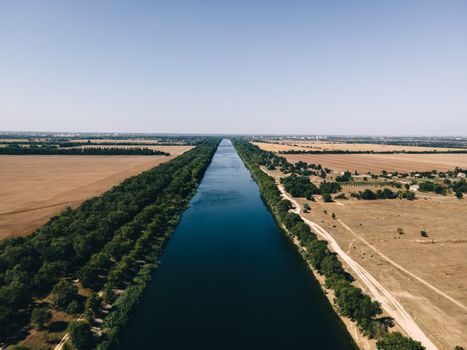
Open channel systems handle whatever the channel carries — including rags, grit, and grease in raw sewage — because the sensor never touches the flow. Maintenance is concentrated on the primary device: flume surfaces need periodic cleaning, weir crests need to stay sharp and level, and sediment must not build up in the approach channel. The level sensor itself is usually low-maintenance, especially when a non-contacting radar or ultrasonic model is used.
Output, Integration, and Cost Envelope
Coriolis meters offer 4-20 mA with HART, Foundation Fieldbus, PROFIBUS PA, and increasingly Ethernet-APL outputs, plus on-board density and temperature diagnostics used for advanced process control. Per-line cost is high — a small-line Coriolis with transmitter can run into five-figure USD territory, and cost scales with line size because the flow tubes themselves grow. [S5]
Open channel flowmeters are typically a flow computer plus a level sensor plus a civil primary, with cost dominated by the flume or weir construction rather than the electronics. Output is a 4-20 mA or digital flow signal that feeds a SCADA or RTU, and modern radar/ultrasonic sensors expose diagnostics such as echo confidence and surface tracking, useful for spotting foam, turbulence, or sensor fouling before they corrupt the flow reading.
Who Each Technology Is For — and Who It Is Not
Coriolis is the right answer for custody transfer, batch and blend control, reactor feed, chemical injection, and any application that needs density or net-mass reporting. It is the wrong answer for large gravity sewers, irrigation canals, and stormwater outfalls, where installing a closed vibrating tube in a large-diameter gravity line is mechanically and economically infeasible. [S1]
Open channel is the right answer for raw wastewater, effluent monitoring, irrigation distribution, dam spillways, and any site where the flow is gravity-driven and the channel already exists. It is the wrong answer for any closed, pressurized line, for high-accuracy chemical or hydrocarbon metering, and for any application where the fluid must not be exposed to a free surface, such as cryogenic liquids or high-pressure gas service.
Standards, Calibration, and Sourcing Discipline
Coriolis performance claims should be checked against documented test reports covering zero stability, density accuracy, and the effect of process pressure on flow coefficient. Hazardous-area installations should be matched to the actual zone classification and the prevailing certification scheme on the project — ATEX (2014/34/EU) for EU sites, IECEx for international projects, and UL/CSA for North America. Open channel installations should be cross-checked against ISO 1438/1 and related hydraulic standards governing flume and weir geometry, and the level sensor should carry an independent IP rating appropriate for the installation environment. [S2]
Sourcing should follow the same discipline used in the temperature transmitter selection criteria coverage — model code, not brochure adjectives, drives the spec. On the Coriolis side, the 2026 product lines documented by Honeywell (VersaFlow) [S1] and the CX-CMFI coriolis mass flow meter line carried by Shanghai Cixi Instrument [S4] illustrate how different vendors package the same physics for different markets. On the open channel side, sourcing concentrates on the primary device, the level sensor vendor, and the flow computer's algorithm library.
Track these signals over the next two quarters: how Ethernet-APL adoption progresses in Coriolis transmitter firmware updates, and how radar level sensors continue to displace ultrasonic units in stormwater and wastewater retrofits. Both shifts are visible in 2026 product launches and will reshape the cost and reliability of each option.
Related: electromagnetic flowmeter.