
An onsite solar PPA is a 15-25 year contract where a third-party developer designs, finances, and owns a PV array on the host's property, and the host pays a fixed per-kWh rate that is "almost always lower than the rate from a traditional utility" [S4].
A corporate (offsite) PPA delivers the same MWh to the buyer's grid account from a remote plant via the public network, and is administratively heavier but easier to scale to multi-site industrial portfolios [S2]. For most single-site manufacturers, the choice reduces to roof area, balance-sheet capex appetite, and whether Guarantees of Origin matter for Scope 2 reporting [S2].
Contract Structure: Who Owns What Behind the Meter
Behind the meter, the onsite PPA flows through a private direct line, and the developer's array is treated as part of the host's electrical balance; the host's utility meter only registers the net import or export to the public grid [S2]. A corporate (offsite) PPA uses the public grid as the delivery medium, so the off-taker's load is matched to remote generation only on a contractual and accounting basis, not on real-time electrical balance [S2].
Typical onsite PPA terms run 15-25 years, with the asset commonly transferring to the host at expiry for a nominal fee (Wewise publishes a €1 buyout) [S4]. Offsite corporate PPAs commonly run 10-20 years and rarely include a transfer clause, since the array sits on third-party land and the offtaker only buys the kWh stream [S3][S5].
Onsite vs Offsite vs Virtual: Comparison on Four Decision Criteria
On a capex axis, onsite PPA wins for buyers with thin capex budgets because the developer carries design, permitting, financing, and O&M; the host pays only a per-kWh rate, often with CPI indexation, and the "PPA provider only gets paid when the solar installation produces energy" [S5]. A direct capital purchase of the same array unlocks the Federal Investment Tax Credit (the older 26% basis deduction cited in industry guidance, though current rate should be confirmed with counsel) [S1]. An offsite or virtual PPA is a pure financial hedge plus a GoO certificate, with no host-side construction interface at all [S2].
On a site-fit axis, onsite requires usable roof, carport, or ground area on or immediately adjacent to the load; Alight lists "roofs, carports, the ground and even near-site areas" as standard siting options [S5]. Offsite removes that constraint and lets a single, large, optimally-sited project serve a multi-site industrial buyer, which is the main reason corporate offtakers choose it over onsite [S2].
On a sustainability-reporting axis, both routes can support Scope 2 claims, but only physical (onsite or offsite) deliveries inherently tie kWh to a specific generator; a virtual PPA requires a separate Guarantees of Origin purchase to legitimately claim the underlying MWh as renewable [S2].
On an exit/transfer axis, onsite PPAs routinely end with a €1-to-symbolic asset transfer to the host [S4]; offsite and virtual PPAs end with the contract, not with a physical asset, which is a clean exit for the buyer but leaves no long-lived hardware on the books.
Who Each Model Is For (and Who It Is Not)

Onsite PPA is for industrial operators with usable roof or ground area, a single dominant site, and a 10+ year horizon who want predictable kWh cost without owning or maintaining the array [S1][S5]. It is not for tenants without roof control, sites shaded or structurally unfit, or buyers who need renewable MWh allocated to multiple legal entities from a single contract.
Corporate (offsite/virtual) PPA is for multi-site industrial buyers, data-center and hyperscale-class loads, and any offtaker whose Scope 2 footprint exceeds what the local roof can host; it is the route used by Google, Amazon, and Apple for their renewable procurement, per Alight's industry summary [S5]. It is not a good fit for a single mid-sized plant with no in-house energy procurement team, because contract administration, settlement, and GoO tracking are heavier than an onsite deal [S2].
Payment Mechanics, Escalation, and 100% Pay-as-Produced
In both onsite and offsite PPAs the buyer pays per kWh produced, and the "rate is typically fixed for the length of the contract and is usually lower than the market rate for electricity today"; CPI-linked and fixed-with-zero-escalator variants both exist [S5]. The most common volume commitment on an onsite deal is 100% pay-as-produced, which Alight flags as "the lowest PPA rate" because the developer can fully amortize production and shoulder no volume risk [S5].
Surplus onsite kWh (when instantaneous PV output exceeds the host load) is exported to the public grid and typically sold merchant at spot price, which is upside for the developer; when PV falls short, the host tops up from the grid at the prevailing utility tariff, which means the host carries commodity exposure on the residual slice, not on the PPA slice [S2][S4].
Risk Allocation: Performance, Maintenance, and Decommissioning
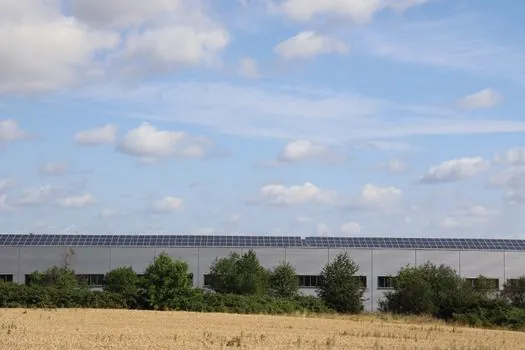
Under an onsite PPA, the developer assumes system-performance and maintenance risk for the full contract term; the host's exposure is limited to the fixed kWh price and the obligation to buy what the array actually produces [S4]. Typical developer scope explicitly includes "predictive and reactive maintenance and re-investments" plus optional storage upgrades over the contract life [S5].
Under an offsite/corporate PPA, generator performance risk sits with the project owner, and the offtaker's only direct lever is the contract-for-difference settlement; a virtual PPA "merely provides for a financial settlement arrangement in the form of a 'Contract for Difference' (CfD)'," so it functions primarily as a price hedge rather than a delivery guarantee [S2].
Onsite PPA as a Hedge Inside a Broader Energy Strategy
Pairing an onsite PPA with battery storage is a common industrial-site pattern: storage lets the host "protect against demand charges, provide a flexible tool when utility rate structures change, and in certain cases, protect against blackouts and brownouts" [S1]. For plants on time-of-use tariffs, shifting midday PV into the evening peak materially improves the avoided-cost math of the fixed PPA rate.
For a multi-site industrial buyer, the cleanest architecture is often a hybrid: an onsite PPA on the largest, most roof-rich plant for behind-the-meter cost certainty, plus a corporate (offsite or virtual) PPA to sweep up the residual Scope 2 footprint and allocate renewable attributes across smaller sites via GoOs [S2][S4]. Buyers who need airtight CAPEX control on the host balance sheet, or who already have an industrial coating capex line and cannot stack new asset categories, will lean onsite; buyers chasing Scope 2 numbers across a portfolio will lean corporate.
Trackable signals for the next planning cycle: (1) confirm current U.S. Federal ITC basis percentage with tax counsel before sizing a capital-purchase comparison against the PPA rate, since the 26% figure in the source material is from mid-2024 guidance and the live rate may differ [S1]; (2) verify state-level net-metering successor tariffs at each host site, because they govern the value of onsite export and directly affect the developer's willingness to quote the lowest 100% pay-as-produced rate [S5]; (3) for European sites, validate national transposition of the Renewable Energy Directive (RED) for what counts as a "renewable" MWh on a virtual PPA without paired GoOs [S2].
Component reference pages worth checking: industrial adhesive, and industrial borescope.
Background reading: 201 vs 304 Stainless Steel: Nickel Cut, Corrosion Lost.