Specifying the wrong climate-control device for a control cabinet is one of the most common field-level causes of PLC I/O drift, contactor coil failure, and unplanned line stoppages. The correct path is a two-step calculation: total internal heat dissipation in watts, plus external heat transfer through the six cabinet surfaces, summed and converted to Btu/hr [S3][S4].
Industrial practice uses a single conversion factor, watts x 3.41 = Btu/hr, and reads a sealed-enclosure temperature-rise curve at watts per square foot of unpainted/painted surface to pick fan, heat-exchanger, or air-conditioner capacity [S3][S4]. Most engineers add a 20-30% safety margin to handle summer ambient peaks, solar load, and component derating as cabinets age [S5][S6].
Two-Part Heat Load: Internal Watts Plus External Surface Transfer
Internal heat load is the sum of every heat-generating device inside the enclosure: PLCs, VFDs, power supplies, transformers, contactors, and resistors. The first numerical step is watts x 3.41 = Btu/hr, applied to each component nameplate value, then totaled [S3]. External heat transfer is the second term: surface area in square feet (ignoring the top when the cabinet is wall-mounted) multiplied by a Btu/hr/ft^2 value that depends on the delta-T between ambient air and the desired internal temperature [S3]. A 48 x 36 x 16 in. painted steel cabinet has a calculated surface area of about 42 ft^2, and a 300 W internal load gives roughly 7.1 W/ft^2 input power on the standard sealed-enclosure curve [S4].
For gasketed, unventilated cabinets, surface area drives the passive dissipation ceiling. Larger surface area per watt of internal load means a lower temperature rise, and the relevant figure is watts/ft^2, not cabinet volume [S4].
Why Sealed-Cabinet Curves Drive the Component Reliability Story
For every 10 deg C (18 deg F) rise above a 22-24 deg C room baseline, the reliability of electronic components is cut in half, the standard "Arrhenius-style" rule referenced across enclosure thermal papers [S4]. Painted metallic and non-metallic enclosures share one temperature-rise curve; unfinished aluminum and unfinished stainless steel sit on a higher curve because their lower emissivity reduces radiant transfer [S4]. For a 7.1 W/ft^2 input on a painted cabinet, the sealed-cabinet graph returns roughly 11 deg C (20 deg F) of internal rise, meaning a 40 deg C ambient already pushes internal air above the 55 deg C limit many PLC vendors publish in their derating tables [S4].
Heat-load transfer from solar gain on outdoor cabinets is the easy miss. A dark-painted south-facing wall in summer can add the equivalent of several watts per square foot of absorbed radiation, which is why outdoor sizing tools ask for orientation, paint color, and altitude [S2][S5].
Decision Matrix: Fan vs. Heat Exchanger vs. Air Conditioner vs. Vortex
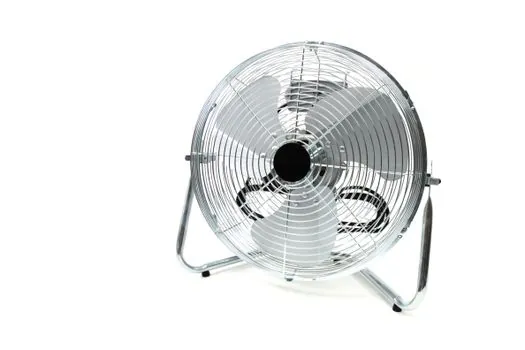
Four cooling families cover almost every industrial cabinet. The choice hinges on ambient-to-internal delta-T, contamination level, and the need for a closed (sealed) loop. [S1]
Filter fans are the lowest-cost option and work when the cabinet ambient is at least 5-10 deg F below the desired internal temperature and the air is reasonably clean. They fail in dirty, oily, or high-humidity rooms because they exchange inside and outside air [S5]. Air-to-air heat exchangers keep the cabinet sealed, transfer heat through a closed core, and handle ambient temperatures close to internal target with a 10-20 deg C lift. Enclosure air conditioners are the only practical option when ambient exceeds internal target (positive delta-T) or when humidity must be held below the 65% RH threshold to suppress corrosion and condensation [S5]. Vortex coolers use compressed air, generate no electricity, hit 1,000-2,000 Btu/hr capacities, and tolerate very dirty environments, but they consume shop-air and add noise. The decision table lines up as: filter fan where delta-T is negative and air is clean; heat exchanger where delta-T is small and dust is present; A/C where delta-T is positive or humidity must be controlled; vortex where compressed air is already plumbed and electricity is undesired [S5][S6].
Reliability Targets and the 65% RH Threshold
The thermal design target is not just temperature, it is condensation control. Keeping internal relative humidity below 65% prevents corrosion on terminals, busbars, and PCB creepage paths; in outdoor or washdown cabinets this is achieved by combining a small enclosure heater (typically a silicone strip heater, 10-50 W) with a hygrostat, so internal air stays a few degrees above the outside dew point [S5].
Enclosure heaters are also used to prevent electronics from operating below their published low-temperature limit, typically 0 deg C for most PLCs and -10 deg C for outdoor-rated HMIs [S5]. For cabinets that see day-night swings above and below 0 deg C, the correct setup is a heater with a thermostat plus a cooler with its own thermostat, sharing a common return-air sensor so they never fight each other.
Sizing Math: Worked Example for a 300 W Painted-Steel Cabinet
Take a 48 x 36 x 16 in. painted steel cabinet, 300 W internal dissipation, 35 deg C maximum ambient, 25 deg C internal target. Surface area calculates to 42 ft^2, and input power is 7.1 W/ft^2 [S4]. The sealed-cabinet graph for painted metal at 7.1 W/ft^2 gives roughly 11 deg C rise, which means passive dissipation alone produces an internal temperature of about 46 deg C at 35 deg C ambient, well above the 25 deg C target [S4].
The required cooler capacity is 300 W plus whatever external heat leaks through the walls at the new internal-external delta-T. Converted to Btu/hr, 300 W equals 1,023 Btu/hr, plus conduction through 42 ft^2 of painted steel with a 11 deg C delta-T. A correctly sized closed-loop cooling solution for this cabinet lands in the 1,500-2,000 Btu/hr range, which is where most 600-1,000 W-rated enclosure air conditioners sit after the 20-30% engineering margin is applied [S3][S5]. Online calculator flows from Kooltronic and 1-ACT follow the same logic and ask for the same inputs: cabinet dimensions, total internal watts, ambient temperature, target internal temperature, and NEMA/IP rating [S1][S2].
Field Failure Modes and Common Sizing Errors
A second cluster of failures is contamination: filter fans pull oil mist, dust, and water through the enclosure when cabinets are placed near a washdown zone, even with MERV-rated filters in place.
For hazardous-area cabinets, cooling choices narrow further. A heat detector inside the cabinet plus a sealed enclosure air conditioner preserves the NEMA 4 or 4X rating that explosion-proof or Class I Division 2 installations require, and it avoids pulling dirty plant air across live terminals. Closed-loop cooling in this context means the heat exchanger core transfers to ambient without ever equalizing internal and external air, which is the only way to keep the cabinet positively pressurized and the ingress rating intact [S5].
Standards, Compliance, and the Selection-Tool Shortlist
Specifying the right thermal management device comes down to four inputs: total internal watts, ambient maximum, target internal temperature, and enclosure NEMA/IP rating. Add solar gain, altitude, and contamination profile for outdoor cabinets, and the answer typically points to one of the four families in the matrix above [S2][S5]. For more on related panel-building work and structural limits that affect cabinet mounting, see the tower-crane free-standing height and tied-in rules piece, since the same wind and seismic forces acting on a tall steel structure show up in outdoor cabinet anchoring.
Trackable signals for the next design cycle: NFPA 70 (NEC) article 409 on industrial machinery panels continues to govern short-circuit current ratings and may interact with cooler wiring derating on future revisions, and UL 508A remains the panel-builder standard of reference for many U.S. control cabinets. Watch vendor datasheets for published sensible-cooling capacities in Btu/hr at a stated ambient, not nominal compressor tonnage, because that is the only number that maps back to the watts-per-square-foot curve.