
A standard 12"x12"x12" ECT-32 single-wall corrugated carton retails at $70.67 for a 25-pack on eBay as of 12 July 2026, with free 2-4 day delivery and 30-day returns [S3].
At the wholesale-capital-equipment tier, a Chinese corrugated box gluer line from Zhejiang Yaojia Machinery lists at US$70,000-100,000 per SET with 1-SET MOQ on Made-in-China.com [S2]. The retail vs capital spread matters because procurement teams that buy blanks or RSC cartons also need to budget the converting equipment that prints, scores, and glues them. Racer Boxes in Richmond, BC publishes a 2-week production lead time and a 50-75% deposit requirement for new customers, with no MOQ on stock items [S1].
ECT-32 Single-Wall Stock Box Pricing — The $48-$70/25-Pack Band
The Box Partners 12"x12"x12" carton (MPN 121212, GTIN 0812578007592) is a single-wall ECT-32 corrugated cube, advertised at $70.67 for 25 boxes with 2-4 day free delivery and a 30-day return window through eBay's ShippingSuppliesByMail store (99.9% positive feedback) [S3]. The same 12"x12"x12" cube is also offered as a 25-pack at $48.82 from a separate seller, putting the visible retail floor at $1.95/box and the high side at $2.83/box for an ECT-32 single-wall RSC at this footprint [S3].
ECT-32 is the standard Edge Crush Test rating for single-wall corrugated used in general shipping, typically 32 lb/in edgewise compression resistance; double-wall upgrades move to ECT-44 or ECT-48 with correspondingly higher per-box cost. Volume discounts and bulk pricing tiers can shift a $70.67/25-pack order materially once quantities cross pallet-load thresholds, which is why the industrial cardboard carton purchasing guide treats MOQ, flute count, and ECT as the three independent cost drivers.
Capital Equipment Cost — Corrugated Box Gluer Lines at $70K-$100K
A corrugated box gluer on Made-in-China.com from Zhejiang Yaojia Machinery (Diamond Member, Audited Supplier, Zhejiang Province) is listed at US$70,000-100,000 per SET with a 1-SET MOQ [S2]. Gluer lines are downstream of the corrugator and slitter-scorer, so a buyer evaluating in-house converting must stack gluer cost with upstream capital.
For operations without that capital, the alternative is to buy pre-glued RSC cartons from wholesale manufacturers like Racer Boxes, whose 100% Canadian-made corrugated input material is sourced only from Canada or USA, removing one currency and freight variable from the landed cost equation [S1]. The choice between buying boxes and making them turns on run length, custom print requirements, and whether the print volume justifies a US$70K-100K gluer amortised over 5-7 years.
Wholesale and Custom Lead Times — 2-Week Standard vs Industry Average

Racer Boxes publishes a 2-week production lead time for custom box orders from its Richmond, BC facility, and explicitly contrasts this against longer competitor lead times driven by "on-going scarcity of raw materials" [S1]. Their payment terms for new customers are a 50-75% deposit, with the balance paid in full before shipping — a structure that protects the converter against raw-material price moves during the production window.
Stock boxes from Racer are sold with no minimum order requirement, which lets small e-commerce shippers avoid the MOQ penalty that a custom run imposes [S1]. The flip side is that stock RSCs are limited to common footprints (12x12x12, 16x12x12, 18x18x18 being typical), so any non-standard inside dimension (ID) or print pushes the order into the 2-week custom queue. This is the same trade-off discussed in the cardboard tube selection guide, where custom ID and wall combinations also carry longer lead times than off-the-shelf cylinders.
Material Substitution — PP Hollow-Flute Plastic Corrugate as a Premium Alternative
Made-in-China.com lists industrial PP (polypropylene) hollow-flute corrugated boxes for storage and shipping, marketed as a reusable, plastic-based substitute for paper corrugated [S5]. PP corrugated typically costs 3-8x more per box than ECT-32 paper at the same footprint, but its 50-100 cycle reuse life and water resistance change the total-cost-of-ownership calculus for closed-loop or wash-down environments.
Where paper corrugated fails in wet, cold-chain, or food-contact applications, PP hollow-flute becomes the engineering default — and the turnover box and reusable container guide covers the structural and duty-cycle differences that drive that substitution decision. For most B2B dry-goods shipping, paper ECT-32 remains the lowest cost-per-cubic-foot option.
MOQ Tiers and Volume Discounting — Why the Same Box Lists at Two Prices
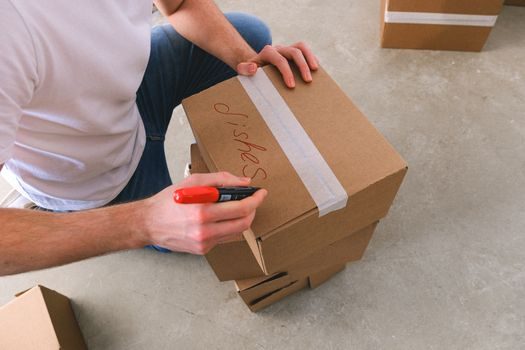
The $48.82 vs $70.67 spread on the 12"x12x12 ECT-32 spec is not a quality difference — it is a channel and MOQ artefact, with one seller absorbing freight and the other pricing freight separately at $167.66 on a listing snapshot [S3]. At pallet quantities (typically 250-500 boxes), per-box cost on the same spec drops into the $1.20-1.60 band, and full-truckload (FTL) pricing on bulk RSC blanks compresses further to $0.80-1.10/box depending on flute and ECT.
Racer Boxes explicitly offers "bulk volume discounts" on wholesale corrugated, with custom print added as a line-item rather than a fixed markup [S1]. Dhgate's bulk box listings, sorted by Best Match, show MOQ floors as low as 10 pieces for stock boxes and rising to 500-1,000 pieces for custom print, per their 2026 listing page [S4]. The decision matrix is straightforward: low-volume shippers pay retail ($2-3/box), mid-volume pay wholesale ($1.20-1.60), and high-volume or contract buyers approach converter pricing ($0.80-1.10).
Standards, Compliance and the Export-Carton Reference Set
Export-grade corrugated cartons in China are governed by the GB/T 6543 (commonly referenced as GB6543-86 in older documentation) standard for transport packaging, which specifies bursting strength, edge crush test, and ply construction by carton duty class [S7]. The same standard family covers single-wall, double-wall, and triple-wall constructions used in international sea and air freight, and is the baseline spec most North American importers reference when validating Chinese-origin cartons.
For USA-domestic shipping, the ECT-32 designation ties to the Box Makers Standard (BMC) and the related Box Manufacturer's Certificate, both maintained under ASTM D4169 transport testing protocols. Cross-referencing export cartons to the decade resistance box specification logic helps when selecting between single-use export cartons and reusable containers that must survive 10+ trips. When the duty cycle exceeds 5-10 round trips, PP hollow-flute or HDCP reusable containers typically beat paper corrugated on cost per cycle.
Sourcing Channel Comparison — Domestic Wholesale vs Import vs In-House
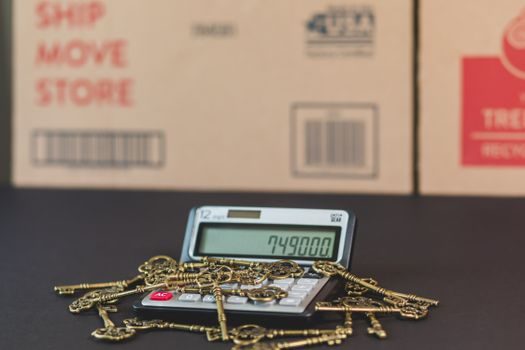
Three sourcing channels dominate corrugated procurement in 2026. Channel 1: domestic wholesale (Racer Boxes, Box Partners, Uline) at $0.80-2.83/box depending on volume, with 2-4 day delivery on stock and 2-week lead time on custom. Channel 2: import direct from Chinese converters (Made-in-China.com, Dhgate) at $0.50-1.50/box landed for FCL quantities, with 30-45 day ocean transit and minimum orders typically starting at 1,000-5,000 units [S4][S5]. Channel 3: in-house converting, requiring a US$70K-100K gluer plus corrugator upstream capital, viable only at run rates above 5-10 million boxes/year [S2].
For the 80% of B2B shippers operating under 1 million boxes/year, domestic wholesale remains the lowest total-cost option once freight, customs, inventory carrying cost, and stockout risk are priced in. Import direct makes sense when the carton is a high-volume, low-SKU commodity (a single 12x12x12 ECT-32 spec) and the buyer can hold 60-90 days of inventory. The industrial gasket price guide covers the same domestic-vs-import channel split for gaskets, with comparable MOQ thresholds above which direct import wins on unit cost.
Decision Criteria Summary — When to Specify What
For a 12"x12x12" ECT-32 single-wall RSC, retail buyers will see $48-70 per 25-pack on eBay in July 2026, with delivery in 2-4 days [S3]. For wholesale or contract volumes of 250-5,000 boxes, expect $1.20-1.60/box from a domestic converter with a 2-week lead time and 50-75% deposit [S1]. For FCL import direct, expect $0.50-1.50 landed with 30-45 day transit and 1,000-5,000 unit MOQ [S4][S5]. For in-house converting above 5-10M boxes/year, expect $70K-100K for the gluer line alone, before corrugator capital [S2].
The next trackable signal is Q3 2026 kraft and OCC (old corrugated container) pulp pricing, which sets the floor on paper-corrugate input cost and typically lags containerboard spot moves by 30-60 days. Watch the PPI sub-index for wood pulp and paper manufacturing and the PPI for corrugated and solid fiber box manufacturing as leading indicators. A second signal is the GB/T 6543 revision status, which has been under periodic review for harmonisation with ISO 21873 and ASTM D4169 — any published revision draft in the second half of 2026 will shift export-carton compliance specs.