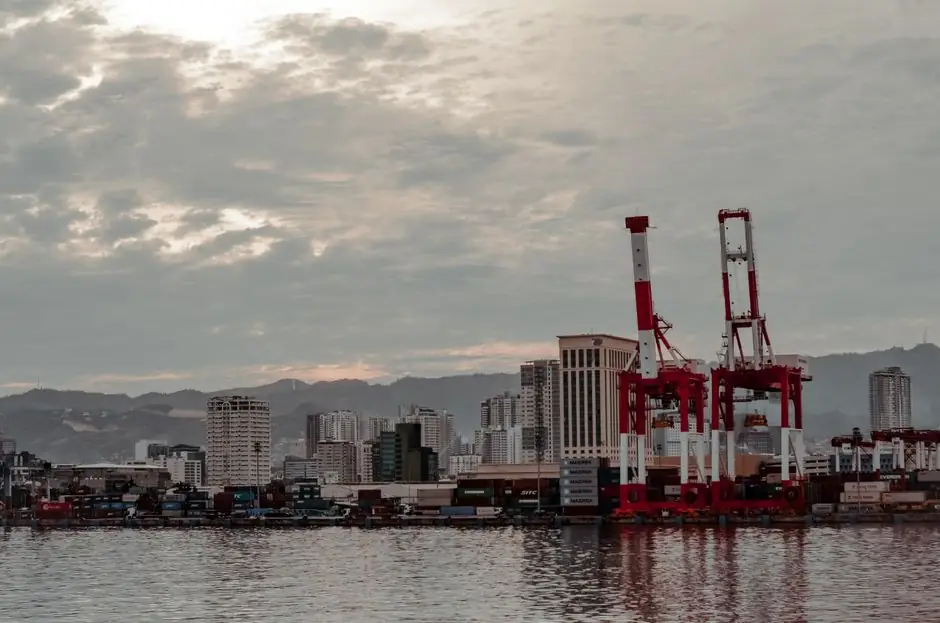
Port-terminal stacker cranes are rail-mounted or rubber-tyred AS/RS machines rated typically 1,000-5,000 kg payload, 6-40 m lift, and aisle widths as tight as 1,500-1,800 mm, with throughput driven by single-cycle or dual-cycle (SGL/DGL) operating modes [S1][S3].
Selection in 2026 is driven by container/pallet mix, terminal duty cycle, and integration with WMS/WCS rather than by a single vendor name; the engineering decision is which combination of mast, travel drive, and shuttle interface matches the berth-to-gate cargo flow [S1].
Aisle Width, Lift Height, and Payload Class Form the First Filter
Minimum aisle width for a single-mast stacker crane in a port-block AS/RS is typically 1,500-1,800 mm, with very-narrow-aisle (VNA) variants operating below 1,500 mm when rail guidance is fixed to the rack base [S1]. Lift height ranges from 6 m in low-rise consolidation yards to 40 m in fully automated container-stacking blocks, with mast sections sized for seismic zone and wind class per the terminal's geographic code [S1]. Standard payload classes cluster at 1,000 kg, 1,500 kg, 2,000 kg, 3,000 kg, and 5,000 kg, and the wrong class selection typically causes trolley-rail deflection and encoder drift within 18 months of service [S3].
For port logistics specifically, a stacker crane is normally specified when storage depth exceeds 12 pallets per lane and throughput targets more than 40 cycles/hour per aisle, conditions that rule out walkie or rider-type pallet stackers which top out around 1,500 kg and 4.5 m lift [S1].
Travel Drive, Mast Type, and Shuttle Interface Comparison
Four physical configurations dominate port-side AS/RS bids: rail-mounted single-mast, rail-mounted double-mast, cantilever, and mobile (rubber-tyred on slab). Rail-mounted single-mast units achieve the tightest aisle, rail-mounted double-mast units carry the highest payload (up to 5,000 kg at 40 m), cantilever units allow non-uniform pallet footprints, and mobile units trade aisle width for cross-aisle flexibility [S1][S3].
The shuttle interface is the second decision gate: a four-way shuttle, a radio shuttle, or a pallet-runner carrier bolted to the crane's telescopic fork. EBILTECH's stacker-crane-plus-pallet-runner system layers a radio shuttle inside each lane so the crane only handles the lane-end transfer, which typically lifts effective lane throughput by 20-30% versus a stacker-only design [S1]. Mitsubishi Electric's e-F@ctory stacker-crane package targets cycle-time reduction and shorter startup through MELSEC iQ-R motion control with servo-driven hoist and travel, an architecture now standard in most greenfield port AS/RS builds [S3].
Duty Cycle, SGL/DGL Mode, and Throughput Math
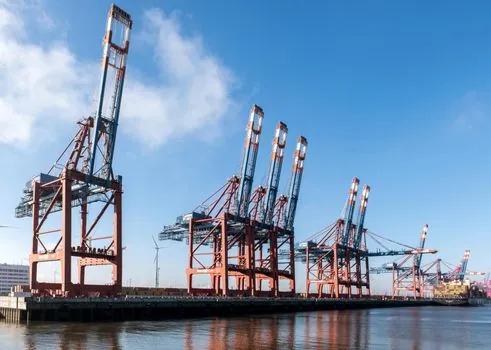
Stacker cranes run in single-cycle (one inbound or outbound per traverse) or dual-cycle (combined inbound plus outbound in one traverse) modes; dual-cycle cuts travel per storage event roughly in half but requires balanced lane loading to avoid dead-head returns [S3]. A typical 40 m aisle traversed at 120-180 m/min with 30 m/min hoist yields 60-90 SGL cycles/hour or 80-120 DGL cycles/hour, before queue and WMS latency drag [S3].
For port-logistics duty, peak-to-average throughput ratios of 3:1 are common during vessel-calls, and the crane's motion controller must sustain SGL mode under that load without encoder slip; servo-driven MELSERVO-J5 or equivalent drives are now the default for new builds, replacing older inverter-driven hoist systems [S3].
Seismic, Wind, and Corrosion Constraints at Port Sites
Port-side installations are exposed to marine salt atmosphere, which mandates hot-dip galvanised mast sections, 316L stainless tie-rods, and IP54 or higher control-cabinet ratings, with coastal-zone terminals often moving to IP65 for the drive cabinet [S1]. Seismic zone classification drives base-anchor bolt count and rail-clip spacing; for Zone 3 or higher, rail joints are welded rather than bolted, and the crane's anti-derailment shoes are upgraded from single-flange to dual-flange [S1].
Wind loading is a separate, often under-specified constraint: a 40 m mast with 2,000 kg payload at 30 m/s gusts will exceed the trolley-rail's lateral stability margin unless the crane carries an anemometer-triggered parking routine that drives the mast to a low-rest at 20 m/s and parks below 15 m/s [S1]. Port operators have learned the hard way that omitting this routine costs the trolley-rail within the first named storm.
Integration with WMS/WCS, Safety, and Predictive Maintenance
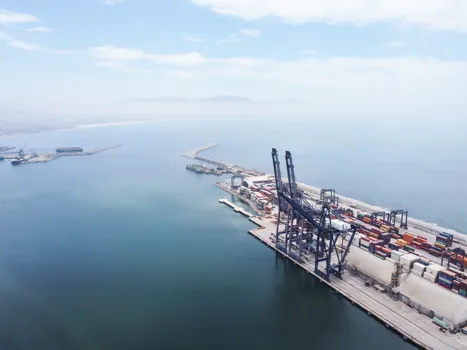
Modern port stacker cranes ship with Ethernet-based WMS/WCS links, safety PLCs compliant with ISO 13849-1 Performance Level d or e, and laser/light-curtain perimeter guarding around the aisle ends [S3]. Mitsubishi's e-F@ctory stacker-crane reference architecture layers edge-compute (MELIPC) on top of the safety PLC so that cycle-time, hoist-current, and travel-encoder data feed a predictive-maintenance model, a pattern EBILTECH mirrors in its storage-software stack [S1][S3].
For ports, the practical question is whether the WMS exposes a RESTful or OPC-UA interface to the crane's motion controller; legacy terminals running proprietary Modbus or PROFIBUS stacks are paying 10-15% in latent throughput because every cycle must handshake twice, and that handshake is the single biggest retrofit driver in 2026 [S3].
Misuse Boundaries: When Not to Specify a Stacker Crane
For heavy container handling above 5,000 kg, the correct machine class is a gantry crane or mobile crane, not a stacker crane, and the engineering line is drawn at the telescopic-fork's rated load, not at the mast's structural limit [S1].
Two adjacent reference points sharpen the decision: the Stacker Crane Selection for Automotive Parts Logistics case study shows single-mast units topping out at 24 m for tier-1 auto lanes, while the Bucket Elevator vs Conveyor Chain: Selection Map for Vertical and Horizontal Bulk Handling piece covers the bulk-handling branch that sits upstream of the stacker-crane block. Steel framing around the AS/RS block is its own decision, and the Steel Section Selection for Warehouses: Grades, Profiles, and Failure Modes article covers the grade-and-profile logic that ports typically inherit from a warehouse spec book.
Track these two signals through the rest of 2026: (1) whether the IEC 60204-1 safety and ISO 13849-1 PL d/e baseline is being written into new port-tender specs as mandatory rather than optional, and (2) whether dual-cycle mode is moving from a vendor option to a default in mid-rise (18-24 m) port-block bids.