
Co-packaged optics crossed from demonstration to shipping product in mid-2026, with named 1.6T CPO platforms now available while pluggable transceivers continue to dominate the installed base [S3]. The decision is no longer whether CPO works, but where it earns its keep against an entrenched pluggable supply chain that has just answered back with a denser liquid-cooled form factor.
Three architectures are now evaluated side by side: pluggable optics at the front-panel cage, near-package optics (NPO) on the PCB adjacent to the ASIC, and CPO with the optical engine inside the ASIC package [S5]. For AI clusters pushing past 100 Tb/s per node, the electrical path between switch ASIC and faceplate cage, typically 15 to 30 cm, is the binding constraint, not the optics module itself [S1][S2].
What CPO actually changes inside a switch
CPO relocates the optical engine from the front-panel cage onto the switch ASIC's own package, collapsing the electrical path from inches to millimeters and removing the per-module digital signal processor (DSP) [S3]. The laser is kept in a separate front-panel module called an external laser source (ELS), so the most heat-sensitive and failure-prone part remains field-replaceable without opening the chassis [S3]. A fiber shuffle then routes from the on-package engines out to the faceplate connectors.
The result is a credible path to sub-pJ/bit energy per bit, with NVIDIA's published 1.6T figure showing link power falling from 30 W per pluggable to 9 W per CPO link [S1]. SemiAnalysis cites a broader envelope, with energy required to transmit data reduced by more than 50% versus DSP transceivers, and a full transition to CPO cutting transceiver power by as much as 84% versus DSP-based pluggable optics [S2]. Roughly 60% of data center energy is spent on data movement rather than compute, so even a partial cut compounds across a cluster [S1].
Pluggable optics in 2026: still the default, now denser
Pluggable transceivers remain the de facto choice in data center communication because they offer field serviceability, multi-vendor interoperability through standardized form factors, and a mature supply chain [S5][S8]. Support for co-packaged optics grew through 2025 and into 2026, but pluggable modules are still the path of least resistance for most operators [S8].
The pluggable camp's answer to CPO's faceplate-density argument arrived in March 2026 as the XPO (eXtra-dense Pluggable Optics) MSA, a liquid-cooled pluggable form factor with 64 electrical lanes, 12.8 Tb/s per module, and a cold plate inside the module rated to 400 W [S3]. XPO keeps the module-swappable service model that data center operations teams already run, while matching the bandwidth density that previously required moving the optics on-package.
Scale-up vs scale-out: where each architecture wins
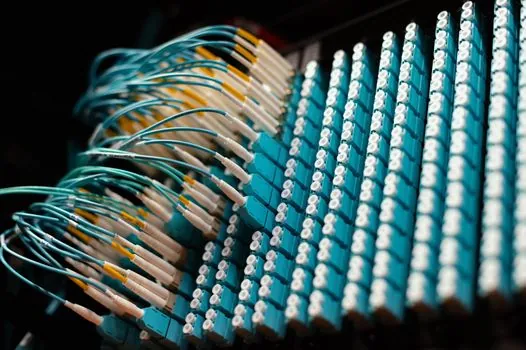
CPO's strongest case is scale-up, the tightly coupled domain inside a rack or two where copper links like NVLink already push bandwidth limits. NVLink delivers 7.2 Tb/s per GPU today, doubling to 14.4 Tb/s per GPU in the Rubin generation, but copper range is capped near two meters, which caps the scale-up domain at one or two racks [S2]. CPO removes that ceiling by replacing the longest copper stretches with optical links, while still allowing bandwidth to scale.
Scale-out CPO solutions from NVIDIA and Broadcom are also attracting hyperscaler attention, but the broader scale-out fabric, top-of-rack to spine, where the optical interface already lives at the faceplate, continues to favour pluggable optics for serviceability and multi-vendor sourcing [S2][S7]. For comparison, see how Optical vs Digital Theodolite Reading Methods shows a similar pattern: legacy readout survives because field serviceability and familiarity outweigh marginal precision gains for most users.
Decision matrix: CPO, NPO, and pluggable compared
The three architectures line up against the criteria that actually drive a build-versus-buy call. CPO delivers the shortest electrical path and the lowest energy per bit, but the optical engine is integrated into the ASIC package, which raises packaging complexity and complicates field service [S5]. NPO mounts optical engines on the PCB near the compute device, keeping the electrical path short while using established PCB assembly and supporting system-level serviceability, a middle ground with many of CPO's power benefits and fewer packaging risks [S5]. Pluggable optics keep the longest electrical path and the highest per-link power, but offer the simplest service model, the broadest multi-vendor supply, and the lowest qualification cost for new builds.
On density, CPO and XPO-class pluggables are now in the same ballpark per faceplate, with 3.2T ports projected to exceed 10 million units by 2029 [S1]. On power per bit, CPO leads, with the 1.6T 30 W-to-9 W delta as the cleanest published number [S1]. On supply-chain risk, pluggable optics still win by a wide margin; interoperability across CPO vendors remains a key challenge, and the standards and supply chain are still evolving [S1].
When CPO is the right call in 2026

Specify CPO for new scale-up domains where the rack topology already constrains copper reach, where the operator can absorb a single-vendor switch-and-optics stack, and where the build has a power budget tight enough that the 9 W-per-link target materially shifts the cluster's energy-per-training-step number [S1][S2]. Hyperscalers are already committing to suppliers, with Celestial AI estimating a $1B revenue run rate by the end of calendar year 2028, driven primarily by a CPO scale-up solution shipping with Amazon's Trainium 4 [S2].
For everything that is not a new build at the leading edge, pluggable optics remain the correct answer, with XPO now offering a path to higher faceplate density for operators who refuse to give up the module-swap model. Near-package optics sits in the middle for teams that want a meaningful power cut without the packaging and serviceability penalty of full CPO [S5]. For a related procurement-side trade-off where lifetime cost dominates the decision, the Mechanical Pull-Chain vs Hydraulic Dock Leveler comparison shows the same logic: the lower-power option only wins when lifetime operating cost is large enough to absorb the higher first cost.
Failure modes and constraints to flag in a spec
CPO's known weak points in 2026 are packaging complexity, the still-evolving multi-vendor interoperability story, and the fact that the optical engine is no longer a hot-swap spare [S1][S3]. The ELS is the only field-replaceable optical component, so the spec should call out ELS module count, hot-swap behaviour, and the laser source's MTBF explicitly, not just the link's. For NPO, the constraint is PCB-level signal integrity at the new shorter reach, which trades the pluggable connector's forgiving margin for shorter, more controlled routes.
For XPO-class pluggables, the headline spec numbers (12.8 Tb/s per module, 400 W cold plate) imply a facility-side coolant loop that a conventional QSFP-DD cage never needed, so the cooling distribution unit and the rack-level manifold become part of the optics qualification, not just the switch [S3]. The CPO-versus-pluggable debate is, in 2026, also a coolant-versus-air debate.
What to track next

Two signals will determine whether CPO moves from scale-up to broad scale-out by 2027: the first is a multi-vendor CPO interoperability demonstration at 1.6T with mixed switch ASICs and optical engines, since the supply chain and standards are still evolving [S1]; the second is whether the XPO liquid-cooled pluggable MSA publishes a second-generation roadmap with a credible path past 12.8 Tb/s per module, which would extend pluggable optics' runway further into the late-decade bandwidth curve [S3].
For the relevant spec sheets and selection criteria, see power supply, dc power supply, and switching power supply.