
OSHA office first aid kits include a CPR barrier and biohazard bag, while other workplace guidance requires at least two pairs of medical exam gloves [S1][S7].
The practical scope is respiratory and contact protection during CPR, not a substitute for rapid response, training, chest compressions, or emergency medical services [S1][S4].
Barrier and Glove Selection by CPR Device
OSHA office first aid kits are specified to contain a “CPR Barrier and biohazard bag,” directly establishing both a barrier device and a waste-containment component [S1]. The USACE medical and first aid guidance likewise lists a breathing barrier and latex-free gloves among the PPE that first aid personnel must be provided and use when handling casualties [S5].
Pocket masks and flat face shields are the two principal CPR barrier formats. A pocket mask generally supports more effective rescue breaths, while both types reduce direct mouth-to-mouth contact; a flat shield is easier to pack into a compact kit, whereas a pocket mask offers greater functional separation in a vehicle, guide pack, or larger medical bag [S4].
How Many Gloves and Barriers to Stock
Two or more pairs of medical exam gloves are specified in one institutional first aid supply requirement, with latex and non-latex options identified [S7]. The Red Cross kit specification is more concrete for its stated configuration: it lists two pairs of nonlatex gloves in size large, alongside one breathing barrier with a one-way valve [S2].
Gloves and barriers serve different functions. Gloves are worn to reduce contamination of the rescuer's hands and to protect the responder from contact with blood or other bodily fluids, while a CPR barrier protects the mouth and airway area during rescue breaths [S5][S6]. The Connecticut Office of Early Childhood specification combines disposable, nonporous gloves with a CPR mouth barrier, treating them as separate supplies [S3].
One CPR barrier can meet the minimum content requirement for many kits, but one barrier cannot be used simultaneously by multiple responders. For multi-person response teams, additional barriers and gloves provide a practical reserve, especially where a workplace policy requires ventilation PPE or more than one responder may need immediate access [S4][S5].
Where the Equipment Belongs in the Kit
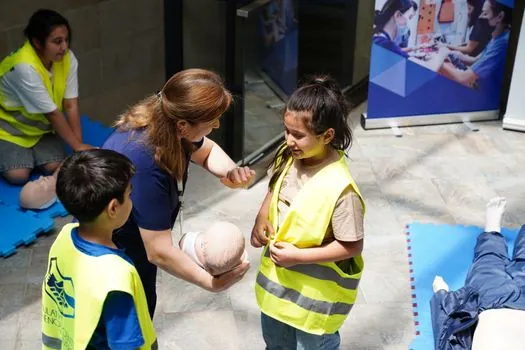
A barrier buried beneath clothing or sealed inside a pack can take too long to retrieve, so CPR protection should be placed where the designated responder can identify it without opening unrelated compartments [S4].
The barrier must not become the first step in care. The recommended sequence is to assess responsiveness, summon emergency help, begin chest compressions when indicated, and locate the nearest AED if one can be brought in; searching for a mask, unfolding a shield, or reading unfamiliar packaging must not delay compressions or the emergency call [S4].
OSHA assigns first aid and CPR training to designated responders, requires training certificates to remain current, and requires kit contents to be replenished and maintained in a serviceable condition [S1]. That maintenance duty includes checking that the barrier valve is unobstructed, gloves remain sealed within their shelf life, and the biohazard bag is present [S1][S4].
Purpose, Users, and Non-Users of Barrier PPE
CPR barrier PPE is intended for responders who provide rescue breathing and for people exposed to blood during first aid, not as general-purpose personal protective equipment for unrelated tasks [S5]. USACE guidance requires personnel handling casualties to be provided with and use a breathing barrier, latex-free gloves, and other PPE as the exposure requires [S5].
It is also not intended for personnel who lack CPR training or for sites without a designated response process. USACE requires hands-on training that cannot be completed entirely online and calls for first aid and CPR attendants to be retrained every 2 years (2014-11) [S5]. OSHA similarly limits first aid duties to designated first aid responders and includes AED references as reserved until further notice [S1].
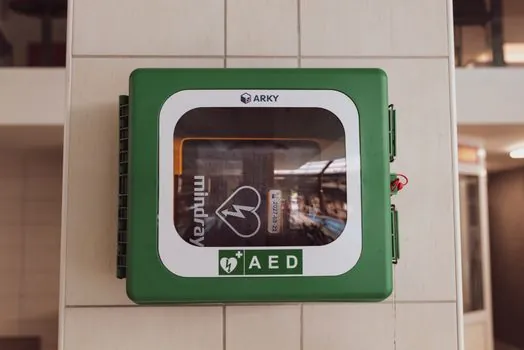
Facilities without an AED should not treat a CPR barrier as a substitute for one. OSHA defines an AED as a medical device that analyzes heart rhythm and can deliver an electric shock to victims of ventricular fibrillation to restore normal rhythm, while the SHMS manual reserves references to AEDs until further notice [S1].
Operational Limits and Failure Modes
The central operating limit is delay: a barrier device must not postpone the emergency call, responsiveness check, or indicated chest compressions [S4]. Major guidance treats barrier devices as optional protective aids for rescue breathing rather than prerequisites for starting CPR, and a compact plastic shield does not guarantee complete protection [S4].
Storage and condition can determine whether the equipment works as intended. A one-way valve should remain unblocked, the face shield or pocket mask should be clean, intact, and readily deployable, and gloves should remain packaged until needed [S2][S4][S9]. The 2026 field guidance identifies one-way airflow, filtration without excessive resistance, and field-friendly construction as selection features [S4].
Kits also need an adequate waste-control layer. OSHA pairs the CPR barrier with a biohazard bag, while the gloves create an additional contamination-control need if they are opened during an emergency [S1]. The kit should therefore be stocked as a coordinated response set: barrier, gloves, containment bag, and access instructions, not as disconnected plastic items.
Standards, Training, and Procurement Checks
Procurement should verify quantities, material choice, storage condition, and intended user, using the applicable workplace or institutional specification. OSHA’s SHMS manual identifies a CPR barrier and biohazard bag for office kits; the Red Cross configuration specifies one one-way-valve breathing barrier and two pairs of large nonlatex gloves; and UCSB requires at least two pairs of medical exam gloves [S1][S2][S7].
Several usable examples combine a one-way-valve face shield with nitrile examination gloves, showing that barrier and glove protection can be supplied as one responder-focused package [S9]. For a broader comparison of minimum kit fills, see ANSI Z308.1 vs OSHA 1910.151: Class A/B Kit Fill Compared.
The strongest selection rule is straightforward: specify at least one CPR barrier with a one-way valve, at least two pairs of gloves, and a biohazard bag, then position the barrier and gloves for immediate access while preserving the priority sequence for emergency response [S1][S2][S4][S7].
Track three conditions during each kit check: barrier-valve integrity, glove package condition, and responder training currency [S1][S5]. These checks convert a nominal first aid inventory into a usable CPR response set.