
Industrial burn kits should combine task-matched dressings, hydrogel, burn gel, non-adherent pads, and nitrile gloves rather than rely on a generic cream packet.
The correct quantity depends on the hazard exposure, workforce size, workplace first aid classification, and the number of workers who may be injured in one event.
Define the industrial burn hazard before buying supplies
Industrial burn treatment covers more than flame. The same kit can be needed for welding spatter, steam contact, hot metal, chemical exposure, electrical burns, or friction heat, and the useful contents change with the mechanism. [S4]
For corporate and office settings, a Class A kit of type I or II is typically sufficient, while a Class B first aid kit may be necessary for higher-risk environments such as industrial settings. Industrial operations fall into the higher-risk side of that distinction in several cases [S10]. A welding-focused burn kit is specifically intended for burn injuries commonly encountered in industrial settings or sustained during welding [S7].
ANSI/ISEA Z308.1-2026 organizes workplace first aid kits by class and type, while the burn components must still be matched to the exposure profile and the workplace injury risk assessment [S1]. A kit suitable for an office is not automatically adequate for a furnace area, welding bay, chemical process unit, or high-voltage maintenance shop.
The base first aid kit should also cover ordinary injuries. Workplace kit examples include gauze pads, antiseptic wipes, nitrile gloves, bandages, and burn treatment items [S5], while burn-focused assortments can add large or small dressing bags, roll-top bags, and metal-case configurations [S4].
Match dressing format to exposure area
The RHINO RESCUE burn kit includes four 4 x 4-inch burn dressings, and the burn-treatment catalogue lists hydrogel burn dressings among its products. Commercial burn-treatment assortments include these sizes as distinct products rather than treating a small universal pad as a substitute [S2].
A 4 x 4 inch dressing is a baseline unit for many burn kits, but the burn area, body location, worker movement, and required coverage determine whether 2 x 6 inch or 8 x 8 inch stock is needed. For example, an industrial dressing assortment is sold separately in large and small configurations, demonstrating that burn coverage is managed as a range rather than a single package size [S4].
The burn-treatment catalogue lists hydrogel burn dressings, and the RHINO RESCUE burn kit includes non-adherent bandages. One listed industrial burn package combines four 4 x 4 inch burn dressings, eight 3.5 g burn gel packets, four non-adherent bandages, PBT bandages, adhesive tape, a bandage, burn ointment, gloves, and scissors [S8].
Compare the principal burn treatment formats

Hydrogel dressings, gel packets, burn cream, and non-adherent dressings perform different roles, so stocking only one format creates a predictable treatment gap. Product formats also differ in coverage, sterility claims, unit count, and storage format [S2][S8].
The main comparison is straightforward. Hydrogel burn dressings are listed among the products in the burn-treatment catalogue. The RHINO RESCUE burn kit includes eight 3.5 g burn-gel packets, and the burn-treatment catalogue lists unitized burn treatments. The burn-treatment catalogue lists topical burn treatments, and the RHINO RESCUE burn kit includes burn ointment. The RHINO RESCUE burn kit includes four non-adherent bandages. A multi-item kit gives the responder more than one treatment and protection option [S2][S3][S8].
Size and packaging complete the comparison. The RHINO RESCUE burn kit includes four 4 x 4-inch burn dressings and eight 3.5 g burn-gel packets, while the burn-treatment catalogue lists hydrogel burn dressings. Unitized products reduce handling of shared containers, but a workplace inventory still needs enough dressing area, gel, gloves, and barrier protection for the credible number of simultaneous casualties.
Build for burns that occur beyond a standard cabinet
Industrial burn assortments therefore appear as both compact treatment units and larger dedicated bags [S4].
Storage location is as important as product type. Welding areas, furnace floors, kitchens, maintenance shops, and vehicle workshops each need supplies reachable without crossing a hazardous process area. A central cabinet may satisfy storage rules but fail the response-time requirement when hot-work injury occurs at the far side of a production line.
The burn-treatment catalogue lists fabric, metal, bag, and plastic container types and separately lists emergency burn kits. Metal cases and roll-top bags are practical where supplies may be exposed to dirt, moisture, or mechanical damage, but protection alone does not validate the contents. The fill still has to match the hazard, and the stock has to remain accessible, complete, and within the employer’s inspection cycle.
Add protection and escalation equipment around the dressings
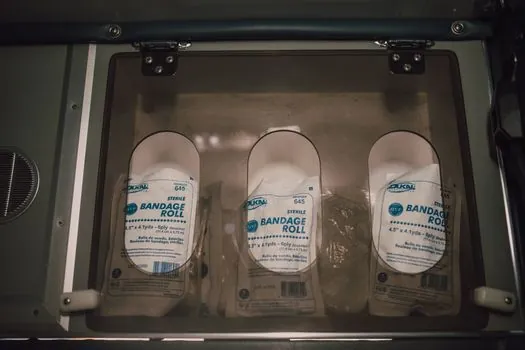
Burn response requires more than a topical product because the casualty may be contaminated, shocked, or unable to self-treat.
Nitrile gloves, adhesive tape, scissors, and bandages are practical cross-compatible additions to a burn kit. The same industrial package includes those components alongside four 4 x 4 inch burn dressings and eight 3.5 g gel packets [S8]. The gloves protect both responder and casualty, while scissors and tape support dressing changes and securement.
Escalation equipment must sit near, or be clearly linked to, the burn kit. An emergency light supports safe assessment in poorly lit areas, while an eye-wash station becomes relevant when a burn involves chemical contamination. If the burn casualty cannot be moved or is transported to definitive care, the response plan must connect the kit contents with evacuation and medical assistance procedures.
Separate routine burns from chemical and electrical emergencies
Hydrogel, gel, and dressing stock is suitable for the common burn-treatment pathway, but chemical and electrical burns require hazard-specific controls and medical escalation. A general first aid kit should not be treated as the complete response system for either hazard. [S2]
Chemical burns require contamination control, removal from exposure where safe, and use of an appropriate emergency eyewash or safety shower. Electrical burns can involve internal injury that is not visible at the skin, so treatment supplies do not replace de-energization, emergency response, and medical evaluation. The industrial dressing assortment provides general wound-care capability, but it does not alter the underlying hazard controls.
For hydrofluoric-acid work, a separate chemical-specific response protocol is needed, including the applicable emergency antidote and trained responders. The selection details for calcium gluconate 2.5% gel for HF first aid kits address that narrower hazard rather than ordinary thermal-burn stock.
Set quantities, inspection intervals, and replenishment controls
Workplace kit quantity should rise with workforce size and injury risk, but the number of kits must be set through the employer’s assessment rather than a single universal count. Kit listings cover low-risk offices, portable Class A configurations, and industrial Class B configurations, showing that classification and deployment are distinct decisions [S5][S10].
Within each location, quantity should reflect burn probability, response time, casualty severity, and the possibility of multiple casualties. A 16-unit poly burn-treatment kit, a roll-top bag, and an 18-unit metal kit demonstrate that even dedicated burn products vary in capacity and enclosure [S4]. A 23-item catalogue spanning emergency burn blankets, emergency burn kits, hydrogel dressings, and topical treatments shows how a supplier may split replenishment by use case rather than treat burn care as one SKU [S2].
Inspection should verify package integrity, sterility claims, remaining quantity, expiry status, accessibility, and whether the fill still matches the hazard. Items include sterile 4 x 4 inch burn dressings, 2 x 6 inch hydrogel dressings, and 8 x 8 inch hydrogel dressings [S2]. Replenishment is trackable through unit counts such as eight 3.5 g gel packets and four burn dressings in one package [S8], or the 10- and 25-unit topical gel boxes listed by the supplier [S2].
The next procurement check should compare the current cabinet fill against the site’s burn mechanisms, target casualty count, storage distance, and kit classification. A defensible industrial burn inventory combines 4 x 4 inch dressings with larger sizes where needed, maintains at least one usable cooling and dressing option, includes nitrile gloves and non-adherent pads, and links thermal burns to a separate chemical or electrical response plan [S1][S2][S9][S10].