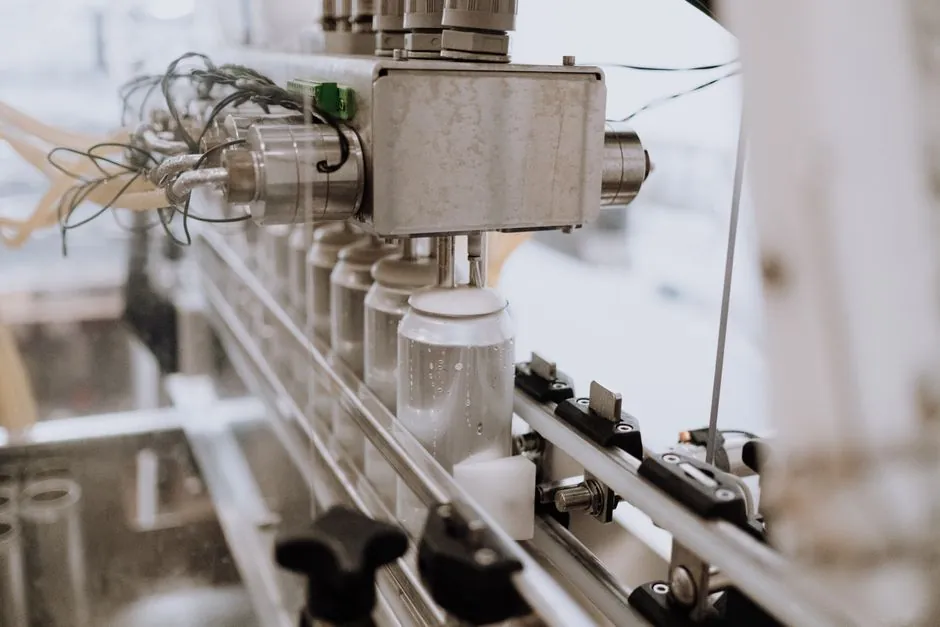
Crossed roller guides carry combined radial, axial, and moment loads in a compact envelope through cylindrical rollers set at 90° between flat raceways, giving line contact instead of the point contact of recirculating ball bearings [S1][S5].
For food and beverage automation, crossed roller bearings (CRBs) and stainless-steel linear guides are commonly specified in canning, bottling, conveyor, meat-cutting, mixing, and 3D-food-print heads where washdown corrosion and tight envelope constraints rule out standard ball-rail assemblies [S2].
Why Crossed Roller, Not Standard Ball, in a Washdown Line
Line contact from cylindrical rollers raises load capacity and stiffness versus the point contact of a ball raceway, and the absence of a recirculation path removes a vibration source present in ball-bearing slides [S1][S5]. In a canning or filling line running thousands of bearings at high cycle rates, that extra rigidity directly translates into repeatable indexing of containers and reduced pulsation at the capping head [S2].
Crossed roller guides are generally aimed at stroke lengths below about 1 m and at applications where the carriage can be built up from multiple short rails to constrain two axes, rather than buying a single long ball-rail assembly [S1]. Where travel exceeds that envelope, a linear roller rail or recirculating ball rail typically becomes the lower-friction, lower-wear choice [S3].
Load, Accuracy, and Rigidity Inputs to Lock Down First
Selection must start from radial load, axial load, and moment load values, with moment load flagged as the dominant variable in any compact CRB assembly [S4]. The buyer-side checklist in current crossed-roller selection guides also lists equipment position, duty cycle, speed profile, mounting interface, preload or clearance, starting torque, sealing, lubrication, temperature, corrosion, and required inspection documents before a quote is requested [S4].
Rigidity is governed by roller diameter, roller length, contact angle, and preload class; resin cages trade some load capacity for quieter running and lower mass, while metal cages give the higher contact stress needed for heavy or vibrating food-line equipment such as tumblers and grinders [S5]. For a meat-slicing or dough-cutting axis, the rigidity advantage of metal cages usually outweighs the noise penalty, especially when the line is already enclosed for hygiene.
Material and Sealing Choices for Washdown and Sanitation
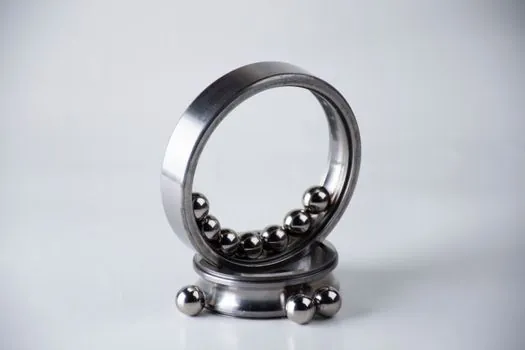
Stainless-steel linear guides and CRBs are the baseline for any food-zone axis exposed to high-pressure, high-temperature cleaning cycles and to chlorinated or acidic cleaning chemistries [S2]. End-effectors handling soft or irregular food items benefit from CRBs that carry loads from any direction at the same time, eliminating the need for stacked bearing arrangements in tight gripper geometries [S2].
Sealing compounds and lubricants must be food-grade where incidental contact is possible, and synthetic-resin seal designs (such as PTFE-based scraper seals) are widely used on cam followers and crossed roller slides to keep process water and particulate out of the raceway [S2]. For sub-zero or hot-fill zones, the seal elastomer and lubricant base oil have to be rated for the full operating temperature window, not just the steady-state value, because washdowns create thermal spikes.
Decision Map: Crossed Roller vs Linear Roller Rail vs Ball Rail
Across three decision criteria, the comparison reads as follows. Load capacity: crossed roller and linear roller rail both exceed standard ball rail thanks to line contact, with metal-cage crossed roller on top for combined moment + axial loading [S1][S3][S5]. Travel length: ball rail wins for unlimited stroke, linear roller rail for long stroke with high load, and crossed roller slide is constrained to roughly 1 m unless built from stacked short rails [S1][S3]. Vibration and pulsation: crossed roller is lowest because there is no recirculation, linear roller rail is moderate, ball rail is the highest because of cage-induced pulsation [S3][S5].
For a typical food-line axis under about 1 m of travel with a moment load, crossed roller is the default pick; for a long packaging conveyor run, a stainless linear roller rail or sealed ball rail is the better economic match [S1][S2][S3]. This is also why a related heavy-industry reference, Crossed Roller Guide Selection for Cement Plant Duty, reaches a similar rigidity-over-travel verdict for kiln and preheater axes.
Where Crossed Roller Fits, and Where It Does Not

It is a fit for: canning line indexing heads, bottle and container orientation mechanisms, meat and dough cutting slides, robotic pick-and-place end-effectors, and short-stroke filling-nozzle traverses on stainless frames [S2]. It is not a fit for: long over-1 m stroke conveyors, ultra-high-speed label applicators where ball-rail pulsation is acceptable, or any axis where the cleaning regime would attack standard chrome-steel raceways and a stainless option is not available [S1][S3].
For heavy-shock or heavy-contamination applications in adjacent process industries, a parallel selection reference, Crossed Roller Guide Selection for Steel Mill Duty, covers the higher-impact envelope and can be cross-checked against any food-line axis that borders a slag, dust, or pellet feed zone.
Specification Inputs to Put on the RFQ
Buyers should document radial/axial/moment loads with units, target L10 life in hours or km of travel, preload class, starting torque limit, maximum speed, stroke length, mounting hole pattern, and the cleaning chemistry plus temperature range the seal must survive [S4]. Inspection documents commonly requested on food-grade CRB orders include material certificates, dimensional reports, and traceability paperwork for the stainless components that contact the product zone [S4].
For washdown-rated lines, also specify the lubrication interval, the lubricant base (food-grade NSF H1 where contact is possible), and the replacement path for the slide so that preventive maintenance does not require breaking the hygienic enclosure [S2]. A neat rule of thumb: if the slide cannot be re-lubricated from outside the washdown zone, the grease reservoir and seal package are not sized for a food plant.
Track next: Q4 2026 releases of NSF H1-registered crossed-roller lubrication kits from major motion suppliers, and any new ISO 22000-aligned hygienic-design guidance for linear motion components in open food-zone axes. A useful adjacent spec reference for the gas side of food-line thermal processing is Industrial Gas Selection for Energy Equipment: 2026 Spec Gates.
For component-level specifications, see crossed roller guide, linear guide, and road roller.