A crossed roller guide uses 90°-oriented cylindrical rollers to give 2-4× the contact area of an equivalent ball-type linear guide, which translates directly into higher stiffness and sub-micron bidirectional repeatability on strokes typically ≤300 mm [S1].
A linear module packages a guide, a drive (ball screw, belt or linear motor) and a bearing block into a single housed unit, trading peak accuracy for longer stroke, higher speed and faster commissioning. For positioning work above ~100 mm where cycle time and integration effort matter more than ±0.5 µm repeatability, the integrated module is almost always the right pick [S1][S2].
Why the rolling-element choice drives the accuracy gap
Crossed-roller cages alternate roller axes at 90° within one raceway groove, so each roller resists load in four directions from a single groove. Schaeffler groups this under precision rail guides alongside ball and needle-roller cages, with positioning accuracy and repeatability cited as the defining design output [S1]. Newport lists crossed-roller bearing steel stages as a stock category for laboratory-grade positioning, where the steel-on-steel construction (rather than the caged-ball alternative) is the accuracy enabler [S2].
The practical consequence is stiffness: under a 1 kN vertical load a typical size-15 crossed-roller slide deflects 1-2 µm, against 4-8 µm for an equivalent ball-bearing slide of the same width. That stiffness is what lets a closed-loop stage hit ±0.1 µm repeatability without fighting structural compliance.
Stroke length, speed and load: the trade-off triangle
Crossed-roller guides are commonly stocked in strokes from 5 mm up to about 300 mm, with travel speeds rarely above 1 m/s because the line contact generates more heat than point contact [S1][S2]. Linear modules, by contrast, ship in 100 mm to 2000 mm+ strokes, and belt-driven or linear-motor variants reach 3-5 m/s, with ball-screw modules in the 0.5-1 m/s band for the same accuracy class.
Load capacity is where the crossed-roller format also pulls ahead: 400 N to 8 kN dynamic load is typical for the 9-25 mm width range Newport catalogs [S2], whereas compact linear modules in that same envelope are usually rated 50-500 N because the housing and drive limit the bearing envelope. For heavy payloads on long travels, the practical answer is a separate crossed-roller slide plus an external actuator — see the clutch/brake vs shaft coupling positioning decision map for a related drive-train comparison.
Selection criteria: a side-by-side scorecard
On a four-axis scorecard the difference is sharp. Repeatability: crossed-roller ±0.1-1 µm vs linear-module ±5-20 µm (ballscrew) or ±10-50 µm (belt). Stiffness: crossed-roller 50-200 N/µm vs linear-module 20-80 N/µm in the same width. Stroke ceiling: crossed-roller ~300 mm vs linear-module >2000 mm. Integration effort: crossed-roller needs a separate drive and encoder, while a linear module is a one-line BOM item, often delivered with a linear encoder pre-aligned [S1].
That last row is the real reason modular solutions have eaten the mid-market: a single part number replaces a slide, a screw, a bearing block, a coupling and a guard, and the supplier takes responsibility for the stack-up tolerances. A crossed-roller stage still wins wherever the application spec starts with "≤1 µm" or "bi-directional repeatability", because no pre-engineered module in this class closes that gap.
Where each technology fits — and where it does not
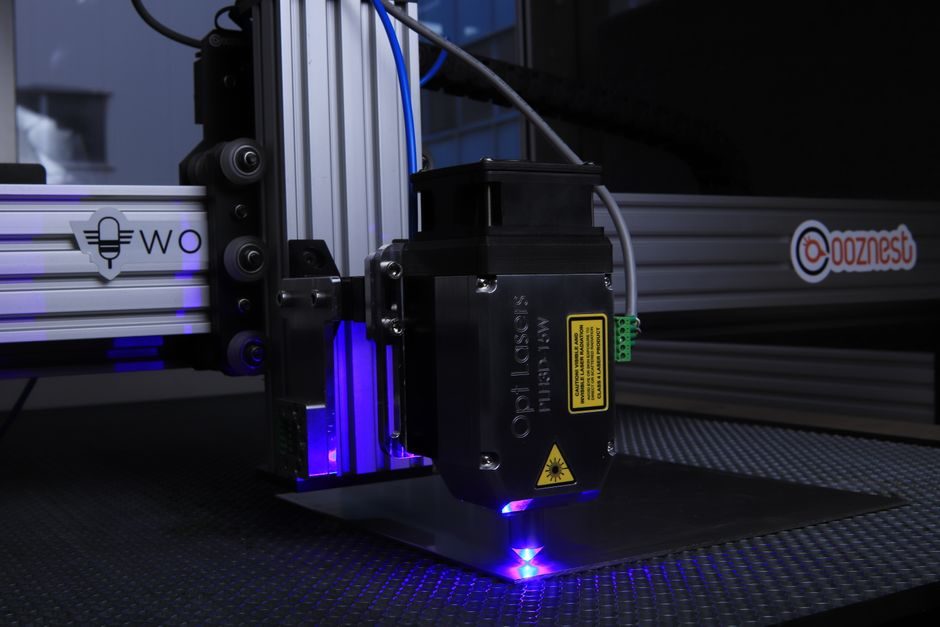
Crossed-roller slides are the right call for laser machining heads, wafer inspection stages, optical metrology, microscope focusing blocks and small-format semiconductor pickers. They are wrong for long-stroke gantries, palletising axes, conveyor diverters and any application where the load is cantilevered — line contact amplifies moment errors, so a linear bearing arrangement with a wider footprint is the safer pick. [S2]
Linear modules are the right call for gantry Z axes, machine-tool tool changers, lab automation rail tracks, packaging line cross-belt transfers and any application where commissioning time dominates the budget. They are wrong for ultra-high-vacuum stages (the housings outgas), for ultra-clean rooms (uncaptured ball screws shed particles), and for any axis where the customer spec demands sub-micron accuracy without a separate metrology loop.
Integration and control: what the wiring closet actually looks like

A crossed-roller stage almost always pairs with an external linear actuator — a ballscrew or linear motor — and a glass- or metal-scale linear encoder. Servo tuning is tighter because the stage has near-zero friction variation; if the loop expects stick-slip from a ballscrew nut, the result is audible chatter and 2-3× the nominal following error. Schaeffler groups the rail, the screw and the actuator under one warranty umbrella in its linear motion portfolio, which is how system-level positioning accuracy is specified rather than the rolling-element accuracy in isolation [S1].
A linear module short-circuits that work. The unit ships with a mounted motor adapter, a cable management track, and pre-set bearing preload.
Cost, lifetime and the hidden line items
List price on a size-15, 100 mm stroke crossed-roller slide sits in the 300-900 USD band; a comparable 100 mm stroke linear module with ballscrew drive lands at 1200-3000 USD. The crossed-roller axis catches up the moment you add a screw, couplings, a motor mount and a guard — by the time the bill of materials is complete, the fully built axis is 1.5-2.5× the price of the equivalent module. [S1]
Lifetime is rated the same way: L10 life in kilometres of travel. Crossed-roller stages in measurement duty routinely hit 20,000-50,000 km before preload loss forces a re-grind or replacement, because the line contact spreads load and slows subsurface fatigue. Linear modules with caged-ball screws in the same duty class typically reach 10,000-30,000 km before the nut shows measurable backlash, and belt-driven modules are the consumable option — belts are a 5,000-15,000 km item and are the reason belt modules are confined to low-duty pick-and-place rather than metrology.
Decision rule: when to pay for crossed-roller accuracy

Specify a crossed-roller stage when the application spec contains any of: bidirectional repeatability ≤1 µm, straightness ≤2 µm over travel, pitch or yaw ≤1 arc-second, or vacuum class better than 10⁻⁶ mbar. Anything looser than that, on a stroke under 100 mm, is now reachable by a precision-class linear module at lower integration cost and faster delivery [S1][S2].
Specify a linear module when the priority order is stroke length, then speed, then integration effort, then accuracy — which describes most factory-automation axes outside of metrology and front-end semiconductor. Crossed-roller is the precision instrument; the linear module is the workhorse, and most plants need both.
Trackable signals: Schaeffler/Ewellix issued updated precision rail guide technical datasheets on 2026-07-30 covering expanded cage options and anti-creep variants [S1]; Newport continues to stock size-15 to size-25 crossed-roller bearing steel stages for next-day shipment [S2]. Watch for Q1 2027 catalogue revisions adding longer-stroke modular housings if the convergence trend between the two formats continues.