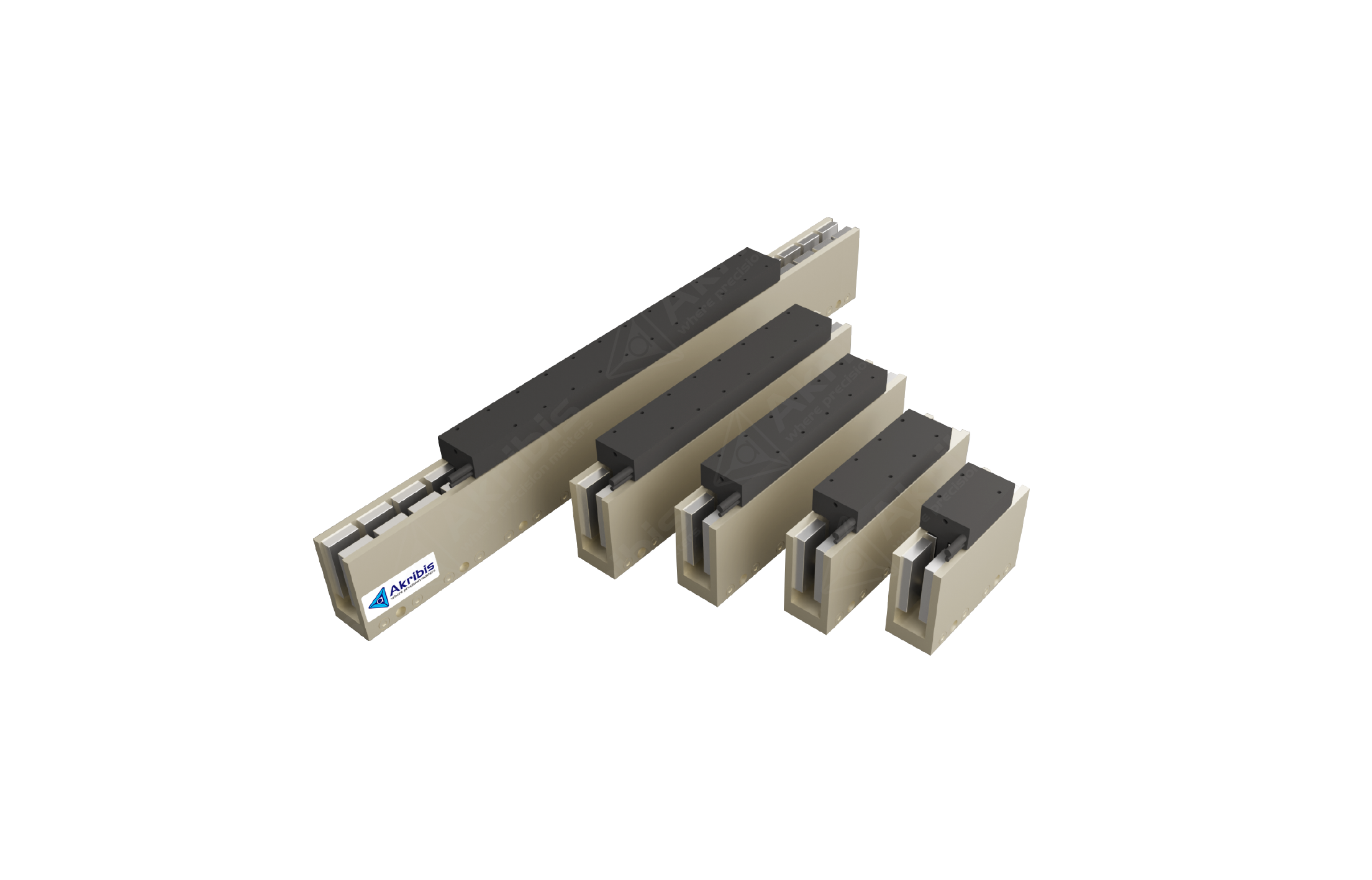
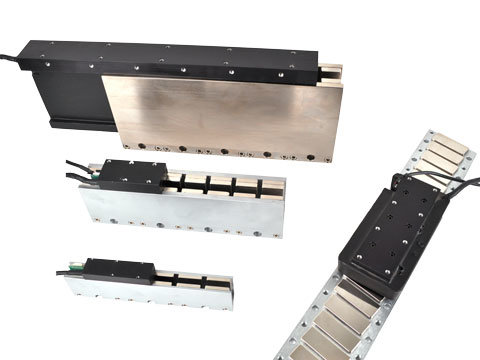
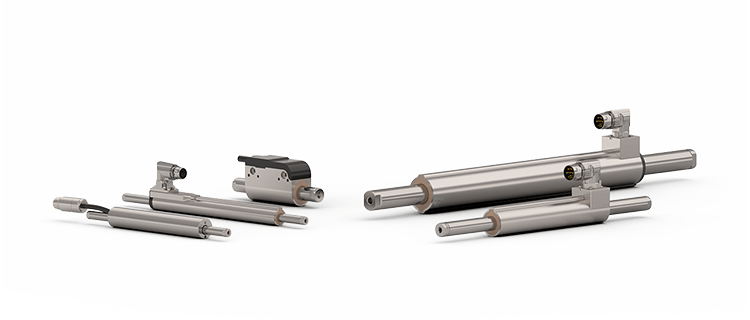
A linear motor is an electric motor that produces force in a straight line instead of a torque about a shaft. Conceptually it is a rotary motor that has been cut along its axis and unrolled flat: the stator becomes a track, the rotor becomes a moving carriage called the forcer, and the air gap that separated them is preserved as a flat or tubular gap. Because the load couples to the forcer directly, with no screw, belt, rack, or gearbox in between, the linear motor is the canonical direct-drive linear actuator, prized for high speed, high acceleration, and feedback-limited positioning accuracy in machine tools, semiconductor stages, and precision automation.
The two dominant families are the linear synchronous motor (LSM), which runs a forcer coil over a permanent-magnet track with no slip, and the linear induction motor (LIM), which drives a passive conductive reaction plate by induced eddy currents. This guide covers both, then drills into the iron-core versus ironless construction choice, the force and velocity specifications that drive sizing, and the selection sequence procurement engineers follow before a $10K to $1M motion-system purchase.
Photo: Smacmca, CC BY-SA 3.0, via Wikimedia Commons
This guide is written for industrial purchasing engineers and machine designers. It covers 6 chapters from working principle and history, motor type classification, iron-core versus ironless technology, secondary track materials and cooling, key specification parameters, to the selection decision sequence, with 7 selection FAQs and verified manufacturer references. Performance figures reference manufacturer datasheets from Aerotech, ETEL, Tecnotion, and Siemens, with the rotating-machine framework of IEC 60034 and the magnetic-circuit fundamentals shared with conventional servo drives.
Chapter 1 / 06
What is a Linear Motor
A linear motor is an electromagnetic machine that converts electrical energy directly into linear thrust. The physical principle is identical to that of a rotary motor: a traveling magnetic field, set up by three-phase currents in a set of coils, interacts with a magnetic field on the opposing member to produce force. The only structural difference is geometry. Where a rotary motor wraps its stator and rotor into concentric cylinders, a linear motor lays them out flat, so the same Lorentz interaction that would produce torque instead produces a straight-line force along the track. There is no crankshaft, no lead screw, and no gear reduction between the electromagnetic force and the moving load, which is why the linear motor is described as a direct-drive actuator.
A linear motor has two parts. The primary, also called the forcer or slider, carries the three-phase windings, the feedback wiring, and usually the cooling connection; it is the moving element in most machine configurations, though in some designs the primary is fixed and the magnet track moves. The secondary is the reaction member that runs the length of the travel. In a synchronous motor the secondary is a track of permanent magnets in alternating north-south polarity; in an induction motor the secondary is a passive conductive plate. The forcer hovers over the secondary across a controlled air gap, typically a fraction of a millimeter to a few millimeters, held by precision linear guides or air bearings.
Because the two parts never touch, the linear motor eliminates the wear, backlash, windup, and resonance that limit screw-driven and belt-driven axes. Position feedback comes from a separate linear encoder mounted along the axis, so the control loop closes directly on the load rather than on a motor shaft several transmission elements away. This is the root of the linear motor's defining advantages: very high stiffness, no mechanical compliance to settle through, and positioning accuracy limited only by the encoder and the straightness of the bearing. The tradeoffs are equally fundamental: the motor provides no mechanical force multiplication, it produces no holding force when de-energized, and the coils dissipate heat directly into the machine structure.
The history of the linear motor runs alongside that of the rotary machine. Charles Wheatstone built an early linear induction device in the 1840s, and the first practical patents appeared around the turn of the 20th century, including Alfred Zehden's 1905 patent for an induction drive intended for trains. For decades the technology stayed in transportation and specialty conveyance because permanent magnets were weak and expensive. The arrival of high-energy neodymium-iron-boron magnets in the 1980s, together with affordable digital servo drives and high-resolution optical encoders, made the permanent-magnet linear synchronous motor commercially viable for machine tools and precision stages. Today linear motors are standard on semiconductor wafer steppers, flat-panel inspection gantries, laser cutters, pick-and-place machines, and the propulsion of maglev trains.
The application range spans many orders of magnitude of force and speed. A miniature ironless forcer for an optics scanner may deliver only a few newtons of continuous thrust at micrometer resolution, while a maglev guideway can move a 50-tonne train at over 500 km/h. The Transrapid 09 maglev, propelled by a long-stator linear synchronous motor, was designed for a cruising speed of 505 km/h with acceleration on the order of 1 m/s squared. No single linear motor serves this entire span; engineering selection is the act of mapping a specific motion profile, force, speed, accuracy, and environment onto the right motor type and construction.
Chapter 2 / 06
Linear Motor Types
Linear motors are classified first by how the secondary produces force, which divides them into synchronous and induction families, and second by physical form, which divides them into flat single-sided, flat double-sided, U-channel, and tubular geometries. Choosing the wrong family is the most consequential early error: a synchronous motor needs a magnet track the full length of travel, while an induction motor needs only a cheap conductive rail, so the decision drives both cost and performance. The table below compares the principal types on the metrics that matter at the selection stage.
Type
Secondary
Slip
Relative Cost
Typical Applications
Synchronous (LSM)
Permanent-magnet track
None
High
Machine tools, semiconductor, metrology stages
Induction (LIM)
Conductive reaction plate
Yes
Low
Maglev, baggage handling, long conveyors
Tubular (PM)
Magnet rod in tube
None
Medium
Packaging, pick-and-place, short-stroke
Stepper (variable-reluctance)
Toothed steel platen
None
Low
Open-loop XY tables, plotters
Linear synchronous motors are the workhorse of precision automation. The forcer's traveling field stays locked to the permanent-magnet track with no slip, so thrust is produced at the commanded position with no speed error, efficiency is high, and force density is excellent. The cost is that a magnet track must run the entire length of travel, and for long axes the magnet bill dominates. Almost every precision linear motor sold for machine tools, wafer handling, flat-panel inspection, and laboratory stages is a permanent-magnet LSM, which is why the rest of this guide focuses on it.
Linear induction motors drive a passive secondary, an aluminum or copper sheet over a steel backing, by inducing eddy currents in it. Because thrust requires relative motion (slip) between the traveling field and the plate, the LIM cannot hold a precise position and runs at lower efficiency, but the secondary is just a cheap conductive rail with no magnets. This makes the LIM the economical choice wherever the track is very long or the environment is too dirty or hot for magnets: maglev propulsion, airport baggage systems, amusement-ride launches, and long material-handling conveyors. A traveling field at synchronous speed against a slipping plate is the same physics that runs a squirrel-cage rotary induction motor, simply unrolled.
Tubular linear motors wrap the magnet rod inside a cylindrical coil assembly. Because the magnetic circuit is closed symmetrically around the rod, there is no net side load on the bearing and no transverse magnetic break, giving smooth thrust in a compact package. Tubular motors are popular for short-stroke pick-and-place, packaging, and test actuation where a self-contained slider is more convenient than a flat forcer running over an exposed magnet plate. Their limitation is stroke: the supported rod deflects over long lengths, so tubular designs are best below roughly one meter of travel.
By physical form, the flat single-sided motor (one forcer over one magnet plate) is the most common and the easiest to integrate but carries a strong one-sided attraction force. The flat double-sided or U-channel motor sandwiches an ironless coil between two magnet rows so the attraction forces cancel, eliminating bearing preload from the motor; this is the classic ironless precision geometry. The choice of form interacts directly with the iron-core versus ironless decision covered in the next chapter.
Chapter 3 / 06
Iron-Core vs Ironless Technology
Within permanent-magnet synchronous motors, the single most important construction choice is whether the forcer coils are wound around a laminated iron core or encapsulated in epoxy with no core at all. This decision sets force density, cogging, attraction force, moving mass, and smoothness, and it is the technical fork that separates a heavy machine-tool axis from a glass-smooth metrology scan. The table below compares the two constructions on the engineering metrics that drive the choice.
Attribute
Iron-Core (slotted)
Ironless (slotless)
Force density
High (about 2x ironless)
Lower
Continuous force, typical
60 to 1,900 N+
10 to 840 N
Peak force, typical
up to ~6,000 N
up to ~4,200 N
Cogging
Present
None
Attraction force
3 to 10x thrust
Near zero
Moving mass
Higher
Very low
Velocity smoothness
Good
Excellent
Iron-core motors wind the three-phase coils around the teeth of a laminated steel core. The steel concentrates magnetic flux into the air gap, which roughly doubles the force per unit of coil volume compared with a coreless design, so iron-core motors deliver the highest continuous and peak force in the smallest package. The laminations also conduct coil heat into the forcer housing, so iron-core motors take water cooling well and sustain high duty cycles. These are the motors that drive milling and grinding axes, heavy gantries, and any application where thrust per dollar and per millimeter is the priority.
The price of the iron core is twofold. First is cogging, a periodic detent force created as the steel teeth pass the magnet poles even with no current applied; cogging shows up as velocity ripple and following error, which matters in scanning and contouring. Second is the magnetic attraction force between the iron teeth and the magnet track, which is large, commonly three to ten times the rated thrust, and is carried entirely by the linear bearings. That attraction preloads the guideway, increases bearing friction and wear, and must be designed into the mechanics. Manufacturers reduce cogging with skewed magnets or stepped laminations, but they cannot remove the attraction force inherent to the slotted geometry.
Ironless motors encapsulate the coils in a thin epoxy-glass blade with no steel core, and run that blade between two facing rows of magnets in a U-channel. With no iron in the forcer there is no cogging, so velocity is exceptionally smooth and following error during constant-velocity scans is minimal. Because the coil sits symmetrically between two magnet rows, the attraction forces cancel and the net normal force on the bearing is essentially zero, which removes a major source of bearing load and friction. The moving mass is very low, which improves the acceleration-to-force ratio for light loads. Aerotech's cog-free ironless ACT-series actuators, for example, are rated to 3 g acceleration with no load and a top speed of 5 m/s, and commercial ironless precision stages routinely deliver sub-micrometer positioning repeatability because the absence of cogging removes a periodic following-error disturbance during constant-velocity scans.
The ironless tradeoff is force density: with no flux-concentrating steel, the same thrust requires a physically larger and more expensive motor, and continuous force tops out lower than for an iron-core unit of equal size. Ironless motors are therefore chosen wherever smoothness, settling, and contour accuracy outrank raw force: semiconductor wafer and reticle stages, flat-panel inspection, laser micromachining, coordinate metrology, and optical scanning. The practical rule is simple: pick iron-core when you need maximum force in minimum volume and can manage the attraction force, and pick ironless when motion quality and zero cogging are the deciding factors.
Chapter 4 / 06
Secondary Track, Cooling and Standards
The forcer gets most of the engineering attention, but the secondary track and the thermal system determine whether a linear motor survives in the application. The magnet track sets the stroke and a large share of the cost, while cooling sets the continuous force the motor can actually hold. Together they convert a catalog force rating into a usable axis.
The permanent-magnet track is a steel base plate carrying a row of high-energy neodymium-iron-boron (NdFeB) magnets in alternating polarity, usually epoxy-bonded and often laser-cut to a defined pole pitch. NdFeB is chosen for its very high energy product, which gives strong air-gap flux in a thin magnet, but it loses strength with temperature and corrodes, so magnets are nickel-plated or coated and rated to a maximum operating temperature, commonly around 80 degrees Celsius for standard grades and higher for special grades. The track must run the full travel plus the length of the forcer, because the forcer must always sit fully over magnets; this is why long synchronous axes become magnet-cost dominated and why induction motors win on very long tracks. Magnet tracks are exposed and strongly magnetic, so they attract steel swarf and require a cover or wiper in machining environments.
The induction secondary, by contrast, is a passive reaction plate: a sheet of aluminum or copper bonded to a steel back iron. It has no magnets, costs a fraction of a magnet track per meter, tolerates heat and contamination, and needs no precise pole alignment, which is exactly why long-stator maglev and conveyor systems use it. The penalty, as covered earlier, is slip, lower efficiency, and the loss of precise position holding.
Cooling is the lever that sets continuous force. The coil's continuous rating is the thrust at which its winding reaches but does not exceed the temperature limit of its insulation class; everything above that is peak force available only in short bursts. Three cooling levels are common. Natural convection (air) is the simplest and is standard on ironless and light-duty iron-core motors. Forced air adds a fan and raises the continuous rating modestly. Water cooling, with a channel built into the iron-core forcer housing, can raise continuous force substantially and, just as important, keeps the dissipated heat out of the machine structure so it does not distort precision geometry; this is standard on machine-tool and high-duty axes. Heat management is not optional on a linear motor, because unlike a rotary motor its losses go straight into the workpiece-bearing structure.
The table below summarizes the secondary and cooling options against the application classes they fit.
Configuration
Secondary
Cooling
Best Fit
Precision ironless stage
NdFeB U-channel
Natural / forced air
Metrology, semiconductor, scanning
High-force iron-core axis
NdFeB flat track
Water
Machine tools, heavy gantries
Long conveyor / launch
Aluminum reaction plate
Air
Maglev, baggage, ride launch
Compact tubular actuator
Magnet rod in tube
Natural air
Packaging, pick-and-place
Standards. There is no single dedicated international standard for linear motors equivalent to IEC 60034 for rotating machines, so practice borrows from several frameworks. IEC 60034 supplies the conventions for insulation thermal classes, duty cycles, and degrees of protection that apply to the coil. Enclosure ingress protection follows IEC 60529 (the IP code, for example IP65), functional safety on the drive follows IEC 61800-5-2 and the EN 60204-1 machinery wiring rules, and the whole axis falls under the EU Machinery Regulation and the EMC and Low Voltage directives that the drive must satisfy. Encoders that close the loop are commonly specified to manufacturer accuracy grades rather than a single ISO number. The practical takeaway is to specify the coil thermal class, the IP rating, and the drive's functional-safety level explicitly, because the motor itself is governed by a patchwork rather than one designation.
Chapter 5 / 06
Key Specification Parameters
Reading a linear-motor datasheet is the core skill of motion-system selection. A forcer datasheet may list 15 to 30 numbers, but only a handful actually drive the decision: continuous force, peak force, force constant, maximum velocity, maximum acceleration, attraction force, electrical pole pitch, and the encoder and feedback interface. Each is explained below.
Continuous force is the thrust the motor can produce indefinitely without the coil exceeding its insulation temperature class. It is a thermal limit, and it depends directly on cooling: the same forcer may be rated, say, 200 N on natural convection and substantially more with water cooling. Catalog continuous force per forcer spans roughly 10 N for small ironless units to over 1,900 N for large iron-core forcers, and larger thrust is obtained by lengthening the forcer or paralleling forcers on one track. Continuous force must cover the steady process load, friction, and any gravity component on vertical axes.
Peak force is the short-duration thrust available for acceleration, typically two to four times continuous force, with ironless peaks reaching about 4,200 N and iron-core peaks higher still. Peak force is current-limited, not thermally limited, and is available only for the time the drive's I-squared-t budget allows; using peak force continuously will overheat the coil. The motion profile decides how much peak force is needed: high acceleration over a short move demands high peak force even when the continuous force requirement is modest.
Force constant (Kf), in newtons per ampere, links phase current to thrust and is the number that sizes the drive's current rating. Together with the motor's back-EMF constant it defines how much bus voltage is needed to reach the target velocity at the required current. A higher Kf produces more force per amp but also more back-EMF per unit speed, so it trades top speed against drive current; matching Kf to the drive's voltage and current envelope is a key commissioning calculation.
Velocity and acceleration are set by the motor, the drive's bus voltage, and the moving mass. Commercial linear-motor stages reach maximum velocities of about 5 m/s, and ironless units with light payloads reach accelerations of several g, with cog-free actuator series such as the Aerotech ACT rated to 3 g at no load; maglev propulsion runs at far higher speed but far lower acceleration. Achievable velocity falls as load mass and required force rise, because at high speed the back-EMF consumes the available bus voltage and limits the current that can still be driven.
Attraction (normal) force applies to single-sided iron-core motors and is the static magnetic pull between forcer and track, typically three to ten times the rated thrust. It is not a thrust the motor uses; it is a parasitic load the linear bearings must carry, and it must be added to the process and gravity loads when sizing the guideway. Ironless U-channel motors list near-zero attraction force because the two magnet rows balance.
Two more parameters complete the picture:
Electrical pole pitch: the distance over one north-south magnet pair, the period over which the three phases commutate. The drive must know it, and the encoder must be aligned to it, or commutation fails.
Feedback interface: the linear encoder resolution and protocol (digital incremental such as 1 Vpp or TTL, or absolute such as EnDat or BiSS), plus the commutation method (Hall sensors, absolute encoder, or power-up search). Resolution at the encoder sets the positioning resolution of the whole axis.
Finally, the coil's thermal class and IP rating bound the duty cycle and environment, and the maximum bus voltage and continuous and peak current must match the chosen servo drive. A forcer is never bought alone; it is bought as a forcer, magnet track, encoder, and drive that are electrically and mechanically matched.
Chapter 6 / 06
Selection Decision Factors
To turn the preceding five chapters into a specific model, follow the decision sequence below. Most selection mistakes come not from a single wrong number but from deciding force or accuracy before the motion profile and environment are pinned down. These eight steps can serve as a fixed RFQ template for a linear-motor axis.
Define the motion profile first: stroke, move-and-settle time, maximum velocity, and required acceleration. From these and the moving mass, compute the peak force for acceleration and the continuous (RMS over the cycle) force for the duty. The motion profile, not the static load, usually sets the motor size.
Choose the motor family: synchronous (LSM) for precise positioning and high efficiency on strokes up to a few meters; induction (LIM) for very long tracks or harsh environments where a magnet track is impractical; tubular for compact short-stroke actuation.
Choose iron-core or ironless: iron-core for maximum force density and high duty when the bearing can carry the attraction force; ironless for zero cogging, smooth scanning, and zero net bearing load when motion quality matters more than raw thrust.
Size continuous and peak force with margin: continuous force should cover the RMS cycle force plus friction and any gravity component, with cooling selected to reach that rating; peak force should cover the acceleration burst with reserve. Do not run at peak force continuously.
Specify the secondary and stroke: magnet-track length must equal full travel plus forcer length; for long axes, price the magnet track explicitly and reconsider an induction motor if cost dominates. Add magnet protection (cover or wiper) in dirty environments.
Select feedback and commutation: linear encoder type and resolution set the positioning resolution; choose incremental or absolute, and the commutation method (Hall, absolute encoder, or power-up search). Confirm the encoder is supported by the chosen drive and controller.
Match the drive and cooling: the servo drive's bus voltage and continuous and peak current must envelope the motor's force constant, back-EMF, and current ratings; select air, forced-air, or water cooling to achieve the required continuous force without distorting precision structure.
Confirm safety, environment, and standards: coil thermal class, IP rating per IEC 60529, drive functional-safety level per IEC 61800-5-2, machinery wiring per EN 60204-1, plus EMC and Low Voltage directive compliance for CE marking.
One last commonly overlooked dimension is manufacturer serviceability and ecosystem fit: whether the forcer, magnet track, encoder, and drive come from a matched ecosystem, whether the controller already supports the motor's commutation and pole pitch, local applications-engineering support for commissioning, and spare-track availability years later. Aerotech, ETEL (a HEIDENHAIN company), Tecnotion, Bosch Rexroth, Siemens (1FN), Kollmorgen, Beckhoff, LinMot, and Yaskawa all supply linear motors with established drive and controller ecosystems and applications support, which is what determines integration time and long-term maintainability far more than a single force number on a datasheet.
FAQ
What is the difference between a linear motor and a ball screw drive?
A ball screw converts a rotary servo motor's torque into linear motion through a threaded shaft and recirculating nut, so backlash, screw windup, and lead error sit between the motor and the load. A linear motor is direct drive: the forcer (coil) and the magnet track act on each other across an air gap with no mechanical transmission, so there is no backlash, no wear part in the drive train, and no whip-speed limit. Linear motors reach higher velocity (up to 5 m/s and beyond) and acceleration (commonly several g, higher still on light ironless units), with positioning resolution limited only by the linear encoder rather than the screw lead. The tradeoff is that a linear motor produces no static holding force when de-energized and provides no mechanical reduction, so the motor itself must supply the full process force continuously.
What is the difference between an iron-core and an ironless linear motor?
An iron-core (slotted) forcer winds its coils around laminated steel teeth, which concentrates flux and roughly doubles force density, giving the highest continuous and peak force per unit volume and good thermal conduction into a cooled housing. The penalty is cogging (detent force from the teeth passing magnet poles) and a large magnetic attraction force, typically 3 to 10 times the rated thrust, that must be carried by the linear bearings. An ironless (slotless) forcer has coils encapsulated in epoxy with no steel core, so it has zero cogging, zero net attraction force, very low moving mass, and ultra-smooth velocity, at the cost of lower force density. Iron-core suits high-force machine-tool axes; ironless suits scanning, metrology, and semiconductor stages where smoothness and settling matter most.
What is the difference between a linear synchronous motor and a linear induction motor?
A linear synchronous motor (LSM) uses a permanent-magnet track as its secondary; the forcer's traveling field locks to the magnet poles with no slip, giving precise position control, high efficiency, and high force density. It dominates machine tools, semiconductor, and precision automation. A linear induction motor (LIM) uses a passive conductive reaction plate (aluminum or copper over steel) as its secondary; the traveling field induces eddy currents that produce thrust, but it requires slip between field and plate, so efficiency is lower and exact position control is harder. LIMs are cheaper, need no magnets on long tracks, and tolerate harsh environments, which is why they drive maglev trains, baggage handling, roller coasters, and very long conveyors where magnet cost would be prohibitive.
How much force can a linear motor produce?
Catalog permanent-magnet linear motors span roughly 10 N to over 1,900 N continuous force per forcer, with peak (intermittent) force typically 2 to 4 times the continuous rating, so peak ratings reach about 4,200 N on large ironless units and higher on multi-segment iron-core forcers. Continuous force is thermally limited: it is the force the motor can hold indefinitely without the coil exceeding its insulation temperature class, while peak force is current-limited and available only for short acceleration bursts within the drive's I-squared-t budget. Larger force requires either a longer forcer with more coil, water cooling to raise the continuous rating, or paralleling multiple forcers on one magnet track. For very high thrust, iron-core motors are preferred because their force density is about double that of ironless designs.
What positioning accuracy and repeatability can a linear motor stage achieve?
Because a linear motor is direct drive, positioning accuracy is set by the linear encoder and the mechanical straightness of the bearings, not by the motor. Commercial precision stages reach positioning accuracy on the order of plus-or-minus 1 micrometer per 25 mm, calibrated accuracy near plus-or-minus 5 micrometers over full travel, and bidirectional repeatability of plus-or-minus 0.5 micrometer or better. Optical incremental encoders with sub-micrometer resolution, or interferometric feedback for the most demanding metrology, define the resolution floor. Ironless motors help here because zero cogging removes a periodic position disturbance that would otherwise show up as following error during constant-velocity scans.
Why do linear motors need a separate linear encoder and Hall sensors?
A rotary servo motor carries its feedback device on the shaft, but a linear motor's forcer and track are separate, so an external linear encoder mounted along the axis provides position feedback for the control loop. The encoder also closes the velocity and position loops directly on the load, which is the source of the linear motor's accuracy advantage. Separately, the drive must know the forcer's electrical angle relative to the magnet pitch to commutate the three phases correctly; this is established either by Hall-effect sensors, by an absolute encoder, or by a brief commutation-search move at power-up. Without correct commutation the motor produces reduced or runaway force, so encoder alignment and pole-pitch entry are critical commissioning steps.
Which manufacturers make industrial linear motors?
Established suppliers of permanent-magnet linear motors and motor stages include Aerotech, ETEL (a HEIDENHAIN company), Tecnotion, Bosch Rexroth, Siemens (1FN series), Kollmorgen (IC and IL series), Beckhoff (AL2000), LinMot for tubular motors, and Yaskawa. ETEL, Tecnotion, and Aerotech are common choices for high-precision semiconductor, flat-panel, and metrology stages; Siemens 1FN and Bosch Rexroth serve machine-tool axes; LinMot tubular units suit packaging and pick-and-place. For selection, match the forcer type (iron-core for force density, ironless for smoothness, tubular for compact short-stroke), the cooling option, and the encoder and drive ecosystem to your controller, then confirm the magnet-track length covers the full stroke plus forcer length.
Linear Motor Manufacturers
Source-backed product routes. Open a company dossier for procurement scope and cited evidence.